Colleen Grablick
The Montgomery County Council adopted legislation yesterday that would put a portion of energy tax revenue towards investments in clean energy.
Passed unanimously, the Montgomery County Green Buildings Now Act would take 10% – nearly $20 million – of the money generated from the county’s energy tax, and dedicate it to the Montgomery County Green Bank, a local non-profit that uses public dollars to leverage private investments in clean energy projects. Green banks exist in cities across the U.S., and essentially work like regular banks; usually public, quasi-public, or nonprofit entities, they lend money for private sector investments in clean projects and technology.
According to a statement from Councilmember Andrew Friedson, one of the bill’s cosponsors, the county’s green bank, the first local green bank in the U.S., should be able to put between $80 million to $100 million toward green buildings with the boost from the tax revenue.
“Not only are we raising the bar for climate action, but we are providing the ladder so our residents and businesses can actually reach it,” Friedson wrote in a statement.
The bill now heads to the desk of County Executive Marc Elrich, who told Bethesda Beat that he’d sign the bill, but wants the council to also pass legislation setting energy-use standards for buildings, as the two pieces of legislation would work in tandem.
Introduced by councilmember and former council president Tom Hucker, the newly adopted legislation comes as a part of the county’s plan to eliminate all greenhouse emissions by 2035 – meaning no natural gas stoves or furnaces, no gasoline-powered cars or trucks, no electricity produced by coal. Houses, businesses and vehicles instead would be powered by the sun and wind and other renewable resources. . Since setting that goal in 2017, the council and Elrich have been criticized by advocates for slow-moving progress and unkept promises.
As a part of the Montgomery County Green Buildings Now Act, the green bank would be required to use 20% of the funds it receives from the county to focus on equity work in low-income neighborhoods and areas with high populations of minority residents – the groups who face disproportionate harm from climate change. The bill also stipulates that after July 1, 2023, the green bank cannot finance any upgrades for equipment that use fossil fuels. So, for example, the funding could not be used to install more efficient natural gas equipment. The Department of Environmental Protection will be required to submit an annual audit to Elrich and councilmembers on the performance of the bank.
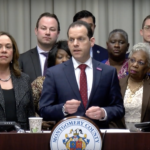
“We have needed a game changer that provides our partners in the private sector the financial tools and the practical incentives to meet our private goals,” Hucker, who chairs the council’s transportation and environment committee, said in a press conference on Wednesday. “It’s time to start acting like we have an emergency, not a little climate misgiving.”
According to a council report on the legislation, Montgomery County Green Bank has committed $5 million to projects, with approximately $6 million in the pipeline for future projects. One of the first and largest projects financed by the green bank was a retool of the energy system at Takoma Overlook, a 232-unit condominium building in Takoma Park. Using money from the green bank, the building upgraded to more energy-efficient boilers without increasing what residents paid for their condo fee.
During a press conference on Wednesday, Sen. Chris Van Hollen (D-Md.) said the county’s plan for cleaner energy can serve as a national model. He and other national lawmakers are pushing Congress to adapt a bill that would put $20 billion toward a federal green bank, with some of those funds available to state and local governments.