Margaret Barthel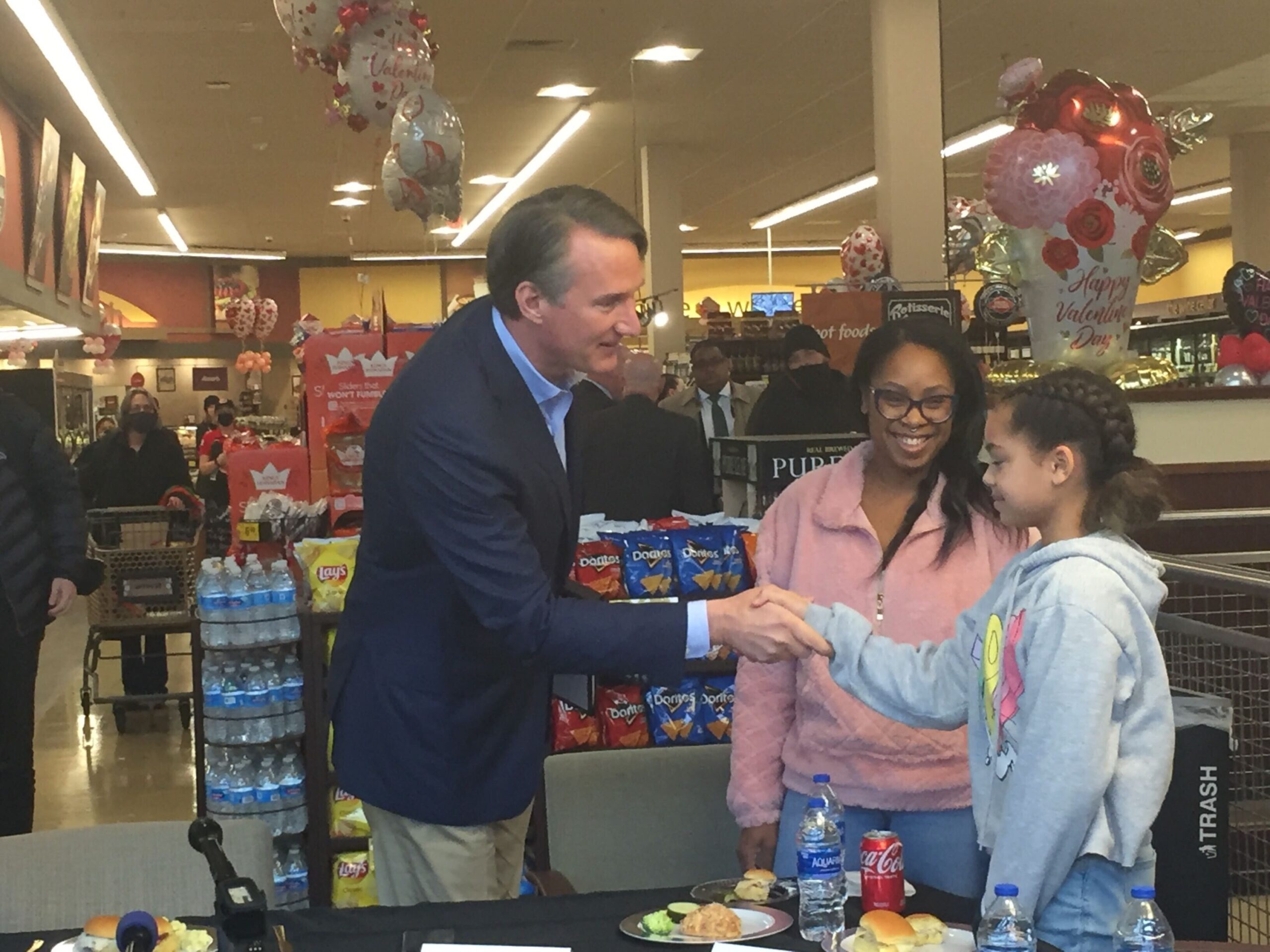
Virginia Gov. Glenn Youngkin visited a Safeway in Alexandria on Thursday to pitch his economic agenda, a collection of tax cuts and tax rebates he says will put money back into the pockets of Virginians struggling with inflation at the grocery store and at the gas pump.
“This is our chance to cut the cost of living and invest, and this is why Virginians, not Republicans, but Virginians, sent us to Richmond to go get this done,” Youngkin told press at the event.
But visitors at Safeway had other issues on their minds, including Youngkin’s executive order rescinding the mask mandate in schools.
At one point, the governor, who was unmasked, was confronted by a customer in the checkout line.
“Governor, where’s your mask?” the woman yelled over the sound of cash registers beeping and the rustling of grocery bags.
“We’re all making choices here,” Youngkin replied.
“Look around you, Governor, you’re in Alexandria,” the woman replied. “Read the room, buddy.”
Employees and most customers were masked, and a sign outside one entrance requested people entering the store to wear masks during times of high or significant community transmission.
At the start of his visit, Youngkin, along with Secretary of Agriculture Matt Lohr and Secretary of Finance Steve Cummings, spoke to a roundtable of locals in a corner of the store. He emphasized several priorities that were part of his original campaign plan to cut taxes, including ending the grocery tax, suspending the 5-cent gas tax increase for a year, and giving Virginians a rebate directly from the commonwealth’s surplus.
“All together, it’s $1,500 for the typical family,” Youngkin estimated. “This is real money.”
The governor briefly touched on some of his more extreme economic proposals from the campaign, including significantly scaling back the state’s income tax by doubling the standard deduction, which some State Senate Democrats — whose support is necessary for legislative success in the General Assembly — have characterized as “out of touch with political reality.”
Youngkin didn’t shy away from the opportunity to criticize Democrats in Washington and Richmond for presiding over a period of rising inflation, as well as what he characterized as a consistent rise in the cost of living in Virginia. He also suggested that the state is lagging in attracting businesses and isn’t sufficiently rebounding from the pandemic economically.
“We’re going to go to work and try to bring our cost of living down,” he said. “One area that we know that we can make an impact is bringing down unnecessary taxes today.”
Youngkin also touted his administration’s ambitions to fix supply chain problems and reinvigorate local agriculture, which he said would support jobs in the state and cut down on transportation costs.
The state’s surplus — a record-breaking $2.6 billion in total, which Youngkin criticizes as evidence of “overtaxation” — is key to Youngkin’s contention that it will be possible for the state to cut taxes without cutting (and in some cases actually increasing) funding for social programs, infrastructure, and schools.
“We can still invest in all the things that we know we need to invest in: better education, safe communities, economic growth and, by the way, making the government work for us,” Youngkin said.
But the details are more complicated. During his visit to the Safeway, Youngkin focused on his plan to end the 2.5% grocery tax. Currently, 1.5% goes to the state, which invests the money into local schools and transportation projects. The remaining 1% goes directly to localities. Some estimates put the total cost of eliminating both aspects of the tax at as much as $1.2 billion over two years.
Virginia is one of only about a dozen states imposing a grocery tax, and lawmakers have long criticized it as regressive, particularly impacting low income families. Rolling it back has some bipartisan support: Northam’s final budget proposal included doing away with the state’s 1.5% share, but left the local portion untouched.
Now, lawmakers in Richmond are wrestling with how to end the tax without affecting local budgets and hurting state funding for schools and transportation. In the Senate Finance and Appropriations Committee, which is under Democratic control, legislators are looking for ways to end just the state portion of the tax; the Republican-led House Finance Committee has already approved a measure that would end the tax entirely.
One attendee at the roundtable, Astrid Gamez, who as director of the local Family Services Network works with young children and their families (she’s also the chair of the Latino National Republican Committee), wanted reassurance from Youngkin that school funding wouldn’t be harmed by the tax cut.
“I really like that he really cares about kids,” Gamez told DCist/WAMU afterwards. “If as governor, he spends money on children, we are going to have wonderful people in the future.”
Meanwhile, it’s not clear that Youngkin’s economic message is breaking through to some Northern Virginians — even those who accidentally shared a grocery store with the governor on Thursday. Youngkin’s first two executive orders, one ending the school mask mandate in favor of parent choice and one taking aim at “inherently divisive concepts,” such as critical race theory, have dominated coverage of his first weeks in office, sparking lawsuits and becoming lightning rods.
Even supporters at the roundtable focused on those topics. When Youngkin opened up the floor for questions about his economic agenda, several parents thanked him for pushing to give parents the right to choose whether or not their children wear masks in schools. Gamez said she works with families who had sent their children to school unmasked — and had them sent home or put in separate classrooms as a result.
Later, Youngkin responded to press questions about Northern Virginia schools still requiring masks, expressing frustration with schools that are suspending or sending unmasked kids out of classrooms. (His administration recently joined a lawsuit against the Loudoun County School Board for not complying with his executive order ending school mask mandates.)
“History will not look fondly upon them for making these decisions to tell children who want to be in school that they can’t be in school,” he said.
For retiree Dana White, who was shopping for groceries just after Youngkin’s visit, the governor’s economic message was lost amid the debate over his more controversial moves.
“I think it’s too soon to abolish anything that is of a protective nature,” White said. “Those are my foremost thoughts on the new governor.”
Neither White nor Michael, a Safeway employee, were opposed to the idea of ending the grocery tax — “I guess less tax would be fine,” Michael said. But neither were previously aware of the governor’s proposal, and returned to the mask debate.
“I think we should be wearing masks,” Michael said, when asked about Youngkin’s overall performance.