Jacob Fenston
When Betty arrived in D.C., the bright pink newcomer to the National Zoo was already a mature bird: at age 22, she was fast approaching the average lifespan of a captive flamingo, 26 years.
The year was 1976. Gerald Ford was president; Marion Barry was a young council member serving on the first elected D.C. Council in modern history.
But Betty would go on to live another four-plus decades at the zoo, observed at the Bird House by generations of Washingtonians. When she passed away last week, 67-year-old Betty was the oldest Caribbean flamingo in North America, according to the zoo.
Sara Hallager, curator of birds at the National Zoo, says Betty was a healthy old bird. “As any geriatric animal would, she probably had some stiff joints going on, but remarkably she had no issues.”
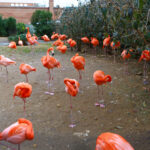
Hallager remembers Betty not just for her longevity, but for the matriarchal role she played within the zoo’s flock — or flamboyance — of roughly 70 flamingos.
“It is hard in a flock of that size to be able to differentiate the birds as individuals,” Hallager admits, but says Betty stood out.

Betty had only one chick of her own at the zoo, but fostered many chicks over the years. Zookeepers aid flamingo reproduction by putting their eggs in incubators, and letting the birds roost on replica eggs. When the eggs in the incubator are ready to hatch, they are placed with experienced flamingo parents, to boost the odds of chick survival. Betty helped rear many a young flamingo chick.
“Even if she didn’t have a chick of her own that particular year, she just seemed to take a great interest in the young flamingos — kind of like a nanny role or a parental role, you could always find her around the young birds,” Hallager recalls.
Some vulnerable chicks are hand-raised by zookeepers, then reintroduced to the flock. In those cases, Betty would often help out with their flamingo education, says Hallager.
“Because they’ve been raised by us, they know they’re flamingos but they don’t necessarily act like flamingos should. It takes them a while to get to know how to sort of ‘speak flamingo.’ Betty would quickly gravitate towards these young birds and sort of take them under her wing, and teach them how to be flamingos.”
Betty wasn’t always known as Betty. In fact, for most of her life at the National Zoo she was known unceremoniously by the number on the ID band strapped to her leg: 89. In early 2021, zookeepers decided to name this grande dame of flamingos after grande dame of television, Betty White.
“We wanted to honor that actress who has been a great friend to zoos and aquariums around the world by naming this very old, lovely lady flamingo ‘Betty.'”
Betty White died of a stroke on Dec. 31, 2021 at age 99. Betty the flamingo’s cause of death is unknown.
There are six species of flamingos in the world. Caribbean or American flamingos live throughout the Caribbean Islands and on the northern coast of South America. The Caribbean flamingo, with a population of 260,000 to 330,000 birds, is not endangered, though its habitat in coastal wetlands and marshes is at risk.
“Wetlands globally are threatened and declining,” says Felicity Arengo, associate director of the Center for Biodiversity and Conservation at the American Museum of Natural History, who studies flamingos. She says coastal development, for resorts and housing, as well as industrial uses such as salt mining, are putting pressure on flamingo habitat.
“More recently climate change, sea level rise and loss of habitat because of that are also big concerns,” Arengo says.
Historically, flamingos lived as far north as the Florida Keys and the Everglades. Florida populations of the bird were wiped out by the early 1900s, due to overhunting, to use feathers for fashion. But flamingos could be making a comeback in Florida: cleanup efforts in the Everglades, cutting down on pollution from agriculture, are making for more attractive bird habitat. And some experts theorize the birds could be pushed north into Florida as development and climate change diminish their current habitat in the Caribbean.
“There’s just generalized evidence for species making shifts because of climate change, so that could be what’s driving some of the comeback in Florida,” Arengo says.
Arengo says that while flamingos in the wild can live long lives, they are likely even longer-lived in sheltered environments like zoos.
“We have done some banding studies where we have banded chicks when they’re a few weeks old and followed them and done re-sightings. And in the wild we have we found birds in South America that were re-sighted at 35 years,” Arengo says.
The oldest flamingo on record may be one of a different species, a greater flamingo, that lived to age 83, before being put down at a zoo in Australia due to failing health in 2014.
This story was updated to add information from Felicity Arengo, and to correct the number of decades Betty lived in D.C.