 Jordan Pascale
The one-mile stretch of Pennsylvania Avenue between the U.S. Capitol and the White House has often been called “America’s Main Street” and a “Grand Avenue.” Every four years it serves as the route for the presidential inauguration parade. It is often the main thoroughfare for large-scale protests. It is a place where America mourns. It’s also where the District celebrated a Nats World Series victory.
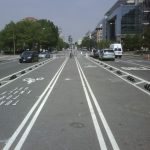
But most other times, it’s empty and lifeless — a vastly underutilized seven or eight-lane highway serving only 35,000 vehicles on an average day. It has a protected two-way bike lane in the middle.
Planners at the National Capital Planning Commission, which has jurisdiction over the federal land, say the road needs a redesign focused on people and events instead of cars, creating an “18-hour, four seasons” venue that could attract people back downtown. They’re asking the question, is there a better way to use the 110 or so feet from curb to curb?
The public can comment on the proposals through July (scroll down and click on “vision and comments”). In the fall, the NCPC will review those comments and tweak the concepts accordingly.
Although the NCPC has already been working on the Pennsylvania Avenue initiative for seven years, the planning process is just the first stage in what will likely be a multi-year and possibly even a multi-decade effort. Approvals will be needed from the Commission and other local and federal partners. A committee is working to identify funding sources from District and federal agencies.
“The avenue has been transitioning for some time,” says Beth Miller, director of physical planning for the NCPC. “Designed in the 1970s as America’s Main Street, it is no longer a crosstown thoroughfare, nor does it have the characteristics to be a successful retail street.
“The infrastructure is aging and physical condition declining. The avenue is very wide with few cars and has very little street activity, which is a detriment to the avenue’s vitality.”
She said the street has a history of cycling through decline and renewal. Pennsylvania Avenue’s current iteration was concocted in 1974. Planners say that vision no longer fits because land use, the economy of the area, and the pandemic have changed the game. Miller says now is a good time for a redesign. The street could also play a big role in celebrating the country’s 250th birthday in 2026.
The group wants to turn the avenue into “America’s Stage” and a venue where the District can showcase art and entertainment, and host events while still having a lively streetscape that can be a destination on a daily basis. It would also help relieve some of the pressure on the National Mall, which is often the main programming spot for the nation’s capital.

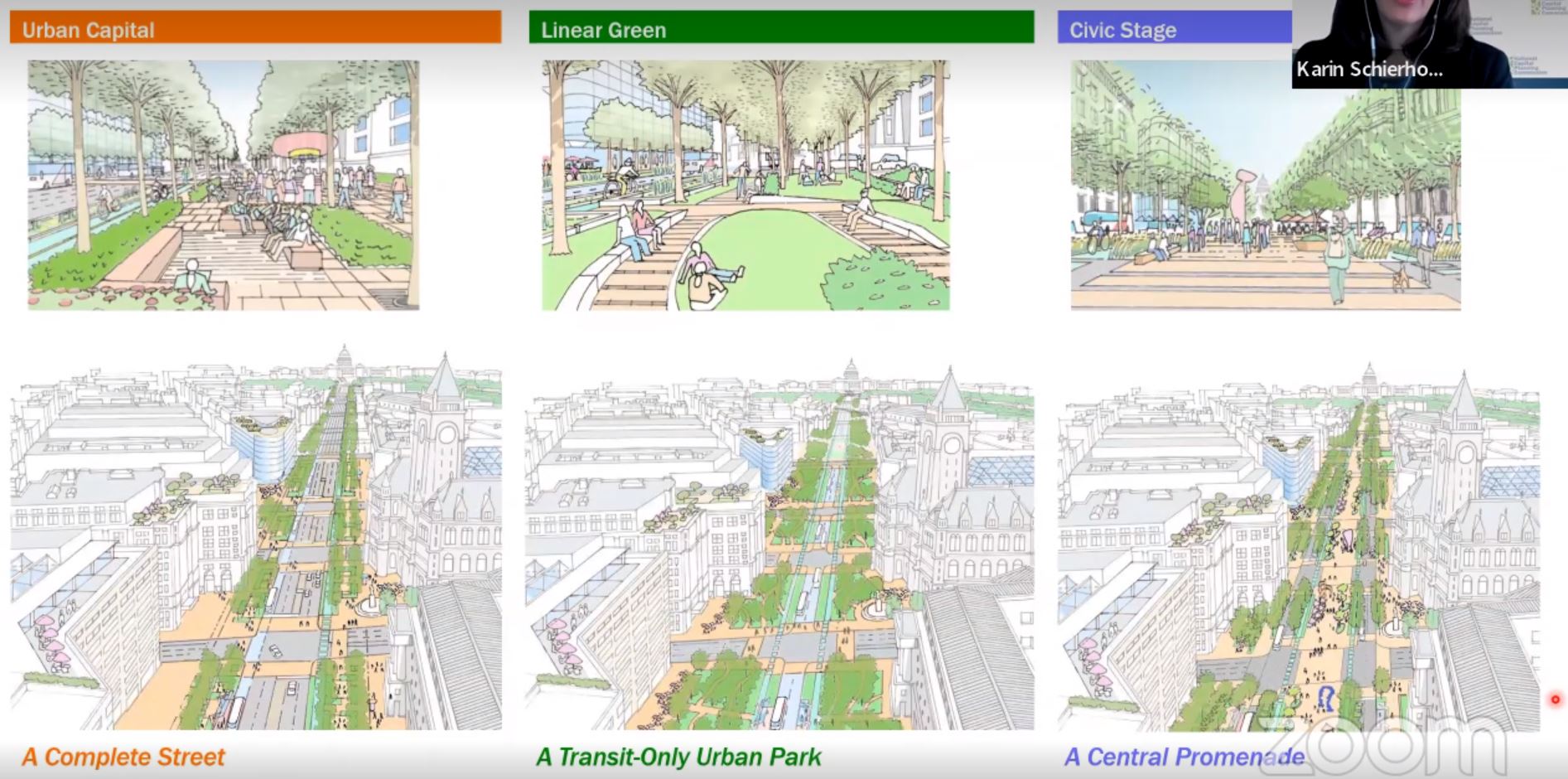
The three ideas presented at a NCPC meeting on Wednesday are:
Urban Capital creates a “complete street” with two lanes of vehicle traffic each way, a bus lane each way, and a two-way cycle track for bikes. It also would have “comfort amenities” and services like expanded sidewalks, parks, shopping kiosks, and more, to create a go-to place and respite for locals and tourists. It calls for realigning the road back to its straight diagonal figure instead of jogging near the District’s Wilson Building. It would also create a new public plaza outside Wilson Building.
Linear Green creates a mile-long green park and boulevard that eliminates cars altogether and only leaves bus and bike lanes. Planners say it would create a unique destination for outdoor gatherings and a connection to nature.
Civic Stage creates a large center median promenade for pedestrians. This design would only have a single bike lane, bus lane and car lane in each direction. It has flexible public spaces that create “iconic venues for a range of prominent events.”
Karin Schierhold, a planner who presented the concepts, said the ideas are meant to be an “inspirational overview” and each concept could be mixed and matched along the way.
The main focus is right-sizing the road for traffic, which only demands two lanes. All maintain 80-feet of space needed in the middle to accommodate inauguration parades.
The study focuses on the stretch from 3rd Street NW to 15th Street NW, but it also encourages the Capitol to reduce or remove parking from 1st to 3rd Street where lawmakers and staff park.
Many of the designs focus on connecting areas through Pennsylvania Avenue, too, like designating the quarter-mile stretch 8th Street from the Portrait Gallery to the National Archives as a potential for occasional open-street events.
In the near term, NCPC said it could try out pilot projects to test the feasibility of the designs on certain parts of Pennsylvania Avenue. By 2026, America’s 250th birthday, they could have some infrastructure plans in place, but the larger vision for the whole corridor will likely take much longer to implement.
Commissioners were impressed but overwhelmed by the plans.
“There’s so much to take in here,” Commissioner Linda Argo said. “I think I need… an opportunity to kind of digest the different components.”
Others, like Commissioner Peter May, say he’s lost some enthusiasm over the past seven years of the process, but now he’s “so excited I want to scream.”
“This is probably the most important thing that NCPC has done in my time or can do in my time,” May said. “There is nothing that’s going to impact the city as a federal city or as a living city that serves its residents more than this.” He acknowledged that the plan will need support, especially from Congress, and funding.
Commissioner Mina Wright says it will be a way to get people back together and regain some of what was lost during the pandemic.
“We’ve lost communal joy,” she said. “We don’t experience things together anymore.”
She said a Pennsylvania Avenue redesign could get people and their wallets back downtown, but also “provide this more ephemeral commodity, which is a communal experience.” She cautioned that the vision the NCPC laid out will need some sort of organizing group or governing body to keep the space active throughout the year, adding that the current lifeless situation developed because no one is in charge.
Commissioners also brought up the importance of making it a friendly and accessible space for people with disabilities, keeping it as a bus and bike thoroughfare, and thinking about how security will be worked into the plan.
In a statement, DDOT Director Everett Lott says his department, which maintains the road, is engaged in the process and any changes in the public space will require DDOT approval.
“While Pennsylvania Avenue is under National Park Service jurisdiction regarding permitting, DDOT plays an important role to determine feasibility and impacts to the District’s overall transportation network,” Lott said in a statement. “DDOT fully supports the reimagination of Pennsylvania Avenue into a more vibrant and active multimodal roadway.”
This story was updated with a link to the public comment page.