Colleen Grablick
 Rachel Kurzius
Vira Derun was headed to bed on Wednesday night when she got a call from her sister, Anastasiia.
“She called me and she cried on the phone that Ukraine is under the bomb attacks,” Vira, a D.C. resident, says of her sister’s urgent call.
Both Ukrainian immigrants, the pair spent the coming hours worried about their parents, relatives, and friends in Bila Tserkva, a city about 50 miles south of the Ukrainian capital, Kyiv.
Other Ukrainians in D.C. are organizing rallies and worrying about loved ones after news broke late Wednesday night in the U.S. that Russia had begun missile strikes and military barrages in Ukraine, creating chaos and fear for Ukrainian citizens.
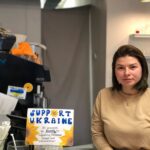
In the morning Vira got up and went to D Light Cafe, the Adams Morgan bakery she owns with Anastasiia . She spent Thursday morning calling her family every hour, feeling the pressure of stress manifest in her lower back. She says her family is safe, staying in her grandmother’s house.
“My lower back is just burning all of the time,” Vira says, who called in another employee to help out in the shop so she and her sister can be glued to their phones. “This is stress I’ve never experienced before.”
Around 1 a.m. Thursday, a small crowd gathered outside of the Russian Embassy to protest the attacks. Roxolana Wynar, a Ukrainian American, helped organize the last-minute demonstration. A volunteer with the non-profit United Help Ukraine, Wynar also helped organize a rally on the National Mall last weekend, where hundreds gathered to support Ukraine and urge immediate action from President Joe Biden as the threat of an invasion loomed.
Still, the news was shocking for Wynar as she watched it unfold on Wednesday night. Having worked in Ukraine, lived in Ukraine, and visited more than a dozen times in her life, she worries about her friends and family.
“It was horrific, it was our worst nightmare,” Wynar says. “The first thing that went through my mind is: how many people are gonna die? How many innocent people? This is a sovereign, peaceful country. It did nothing to provoke this war.”
A child of Ukrainian immigrants who fled the country during World War II, Wynar has been deeply involved in the Ukrainian community since she moved to D.C. around five years ago – which involves much more than organizing around protests or humanitarian causes. Once a month, she says she participates in a Ukraine social club, where members of the community gather at a different restaurant or bar. In pre-COVID times, she recalls a yearly debutante ball fundraiser for a Ukrainian school in Bethesda, with fancy dresses, dancing, and dinner.
“Ukrainian culture is very rich, there’s a lot to talk about,” she says. “There’s a lot to present to the world.”
Wynar says those in D.C. can do their part by learning about the history of Eastern Europe, sharing reliable information and reporting with others, and donating money to organizations like United Help Ukraine, which are raising funds to support evacuees.
Vira says that, beyond educating themselves, residents can stand in solidarity with those urging Biden and other world leaders to take swift and immediate action to stop Putin’s attacks.
“The only thing I know that will help us is that the whole world will have to help us defend the country,” Vira says. “We have literally war from the most aggressive country in the world, the only possible way to stop it is to cut [off Russia] from the world.”
Oksana Kastanda Lamborn moved to the United States from Vinnytsia, a region in Ukraine that borders Moldova, in 2014, and moved to D.C. in 2017. For weeks, she has been sending her loved ones “and whoever would listen to me all of the pieces of information that we hear in the United States … that this is a critical time for you to leave.”
She helped her mother fly out of the country a little more than a week ago. “I do worry about my friends and family, but they have all expressed their decisions either to stay or leave. And some are leaving because they have a choice, they have a chance,” and many of them have small children, says Lamborn.
But others have decided to stay, and Lamborn is proud of them.
“War is not a conversation you usually have with your friends that you grew up with or, you know, go to bars with,” she says. “But here we are. We are talking about war and how people are being mobilized … I have a few friends who are very ready to go and defend themselves and defend the city, defend the country.” Others, she says, are going to the front lines to report on what is unfolding there.
For Kate Paliy, one of the hardest parts is not knowing exactly what is happening on the ground. “The information comes in bits,” says Paliy, who grew up in Ukraine and moved to D.C. in 2016. “There is no whole picture of what exactly is happening and it’s terrifying.”
She asked her family in Ukraine to send her a message every four hours so she knows they’re okay.
“I was having a video chat with my cousins who were outside because they were afraid that their building might be bombed and they said it was safer to be outside,” says Paliy. “They didn’t have anywhere else to go.”
She’s had difficult conversations with her parents, who don’t want to evacuate. “They even said they will fight for their land because it’s their land,” says Paliy. “They don’t want to leave the graves of their ancestors.”
Because Paliy has family in Russia, she’s been wary of publicly criticizing Russian President Vladimir Putin for fear that it could endanger them. But now, she says, the invasion has prompted her to speak out.
Paliy is one of the administrators of the Facebook group “Ukrainians in DC,” which has been spotlighting different protests, rallies, and fundraisers for the Ukrainian military and aid groups over the past few months.
“We used to organize Ukrainian social events every month before the pandemic,” she says. “But right now, since our homeland is under attack, we can’t just stay still and have happy hours anymore.”