Ally Schweitzer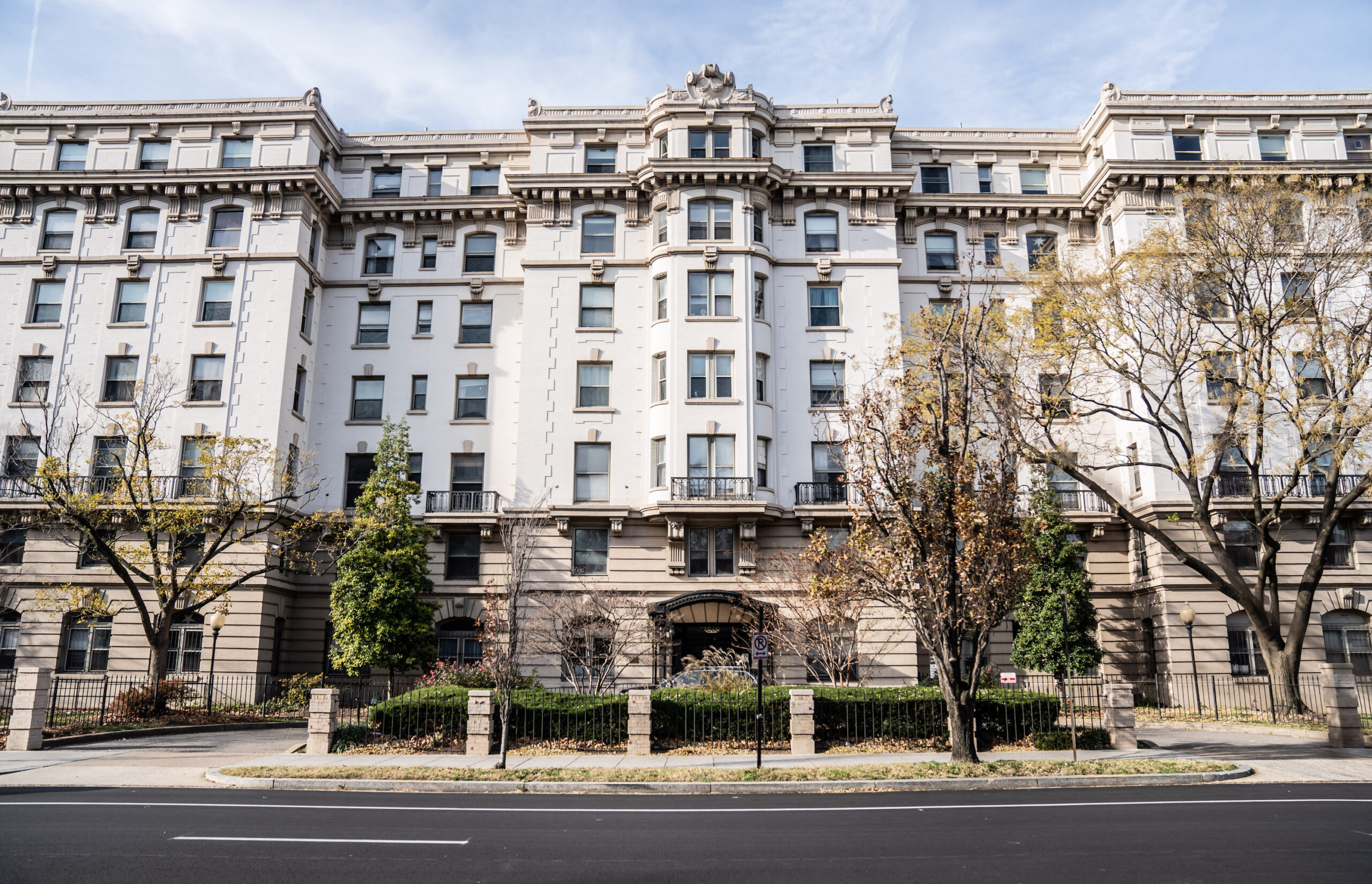
A months-long battle between Mount Pleasant residents and D.C.’s historic preservation community could soon reach a resolution after residents made their case before a key city official last week.
Residents of the Kenesaw/Renaissance, a mixed-income condominium and co-op building near 16th and Irving streets NW, testified before D.C.’s Mayor’s Agent on Friday, in the latest stage of their fight against a 2021 decision from the Historic Preservation Review Board, that they pay to fully restore more than 20 decaying decorative balconies on the building’s exterior at a cost of roughly $2 million. The residence is located within two historic districts and is legally required to maintain historic preservation standards.
Residents say the project’s estimated cost — which has increased as debate continues — is an economic hardship for low-income households, who represent roughly a third of the building’s ownership. They’ve drawn support from neighbors, Councilmember Brianne Nadeau (D-Ward 1), and the Advisory Neighborhood Commission of Mount Pleasant (ANC1D), who have urged the board to reverse its decision. Two preservation groups — D.C. Preservation League and Historic Mount Pleasant — jumped into the fray last year to defend the board’s ruling, arguing the balconies must be restored to their original appearance, and that anything less would degrade the building’s character.
But the Kenesaw/Renaissance’s co-op and condominium board leaders received encouraging news during Friday’s hearing, when the city’s associate director for historic preservation testified that residents could receive additional financial assistance from D.C.’s Historic Preservation Office to complete the balcony restoration and other costly repairs.
“We are trying to be as flexible as we possibly can in trying to make this project work,” State Historic Preservation Officer David Maloney said Friday.
The city has already offered $250,000 in grants to defray the cost of restoring the ornamental balconies, many of which are badly deteriorated and have become a safety hazard. Residents say that money would be helpful, but not enough to eliminate the hardship on low-income households, who could face steep increases in their monthly fees if they’re forced to finance the restoration in full.
The conflict illustrates a tension between two important policies of the D.C. government: maintaining housing affordability and preserving historic architecture, testified Randy Keesler, president of the Kenesaw-Phoenix Cooperative, during last week’s hearing.
“These two good policies need to be reconciled,” Keesler said.
The Kenesaw/Renaissance is owned by its occupants, who comprise both condo owners and co-op members. At least 15 of its 87 residential units are required to be affordable to low-income households, though residents say more than 15 low-income households live there. The building is historic not just for its stately architecture — completed in 1905, it was originally designed as luxury housing for the wealthy — but also for its local significance. In the 1970s, tenants successfully organized to buy the building from its owner, marking the first use of D.C.’s Tenant Opportunity to Purchase Act.
“We have a history here of fighting,” Keesler, who helped organize the purchase, told WAMU/DCist last year.
On Friday, after an attorney for the Kenesaw/Renaissance spent hours arguing that the preservation work would be an economic hardship and could be completed at a smaller scale for less money, Maloney appeared to throw a lifeline to residents.
“We do sense that both in the community at large and with the city’s political leaders, there is an interest in solving this problem,” Maloney said. “So our hope is that we could all try to work together to make that happen.”
His remarks referred at least in part to an oversight hearing earlier that week, in which Council Chairman Phil Mendelson raised critical questions about the Historic Preservation Office’s stewardship of preservation grants. Council member Nadeau also sent a strongly worded letter on residents’ behalf to the Mayor’s Agent in January, writing, “If residents of the Kenesaw-Renaissance Building — themselves an embodied and living historical record — are placed into financial hardship or fully displaced in the name of historic preservation, then we have entirely lost the thread of preservation and historical memory.”
Maloney did not commit to a dollar amount for the Kenesaw/Renaissance on Friday, but said his office has close to $600,000 in its grant fund. Mayor’s Agent Peter Byrne encouraged residents and HPO to continue to work together and report back on their progress. Byrne has until July to decide on whether residents can be granted an economic hardship exemption.
There are still many kinks to work out, including a requirement that the grant money be spent before June 9, says Neha Desai, president of the building’s condo association. But residents believe they can work with the Council on modifying the deadline, which is contained within emergency legislation Nadeau introduced last year.
“We were super excited to hear all the promises that David Maloney made,” Desai tells WAMU/DCist. “We remain cautiously optimistic.”