Debbie Truong
During one week this January, a group of educators in the Washington Teachers’ Union posted selfies to Twitter from inside classrooms, accompanying the images with #It’sNotSafe. They rallied outside D.C. Mayor Muriel Bowser’s office alongside substitute teachers, who were demanding higher pay.
And they encouraged educators to wear red in solidarity with the Red for Ed movement, a national campaign for more school funding sparked in 2018 after teachers across West Virginia walked out of school buildings in protest.
The activities by educators in the District were not officially endorsed by the Washington Teachers’ Union, an alliance that represents 5,100 educators in D.C. Public Schools. They were organized by DC-CORE, a caucus formed by educators frustrated by the way the union has handled the pandemic and other issues.
DC-CORE, which stands for the D.C. Caucus of Rank & File Educators, argues the union is not doing enough to engage its members and challenge school system leaders. Organizers say they want to build a union led by its members and driven by social justice causes.
The caucus is fighting for many of the same issues the union has already sought to address, including amplifying the voices of Black and brown educators and reducing standardized testing. Another top priority is ending mayoral control of schools.
But, like similar groups that have formed elsewhere in the country, the caucus has demonstrated a greater willingness to publicly confront and chastise city leaders to achieve its goals.
That’s inflamed tensions within the union – some educators say members in the caucus can alienate their colleagues, some of whom must represent the Washington Teachers’ Union in negotiations with the school system. Critics also argue the group is sowing division in the teachers group during a year when the organization is expected to elect a new president.
The discord has led to clashes among some union members, fueling disagreements in Zoom meetings that have spiraled into personal attacks.
Members of DC-CORE say the way the union has operated is not effective. They point to the fact that the union is still locked in negotiations with D.C. Public Schools over a labor contract that expired three years ago.
“We’re not trying to tear anyone down or rip the union apart or be a separate union,” said Laura Fuchs, a founding member of DC-CORE. “We just have really strong beliefs on what makes a strong union and we’re just trying to use the democratic process to achieve those.”
Pushing for a more ‘activist’ union
Since forming in the summer of 2020, members of DC-CORE have organized some of the most visible demonstrations over health and safety measures in schools during the pandemic.
They laid “body bags” outside the school system’s administrative offices to protest plans to return to in-person learning before vaccines were available.
They spearheaded a “sick out” where teachers were encouraged to take a mental health day as part of a broader push to delay the reopening of schools.
And they coordinated caravans to protest outside the homes of Bowser and D.C. Public Schools Chancellor Lewis Ferebee.
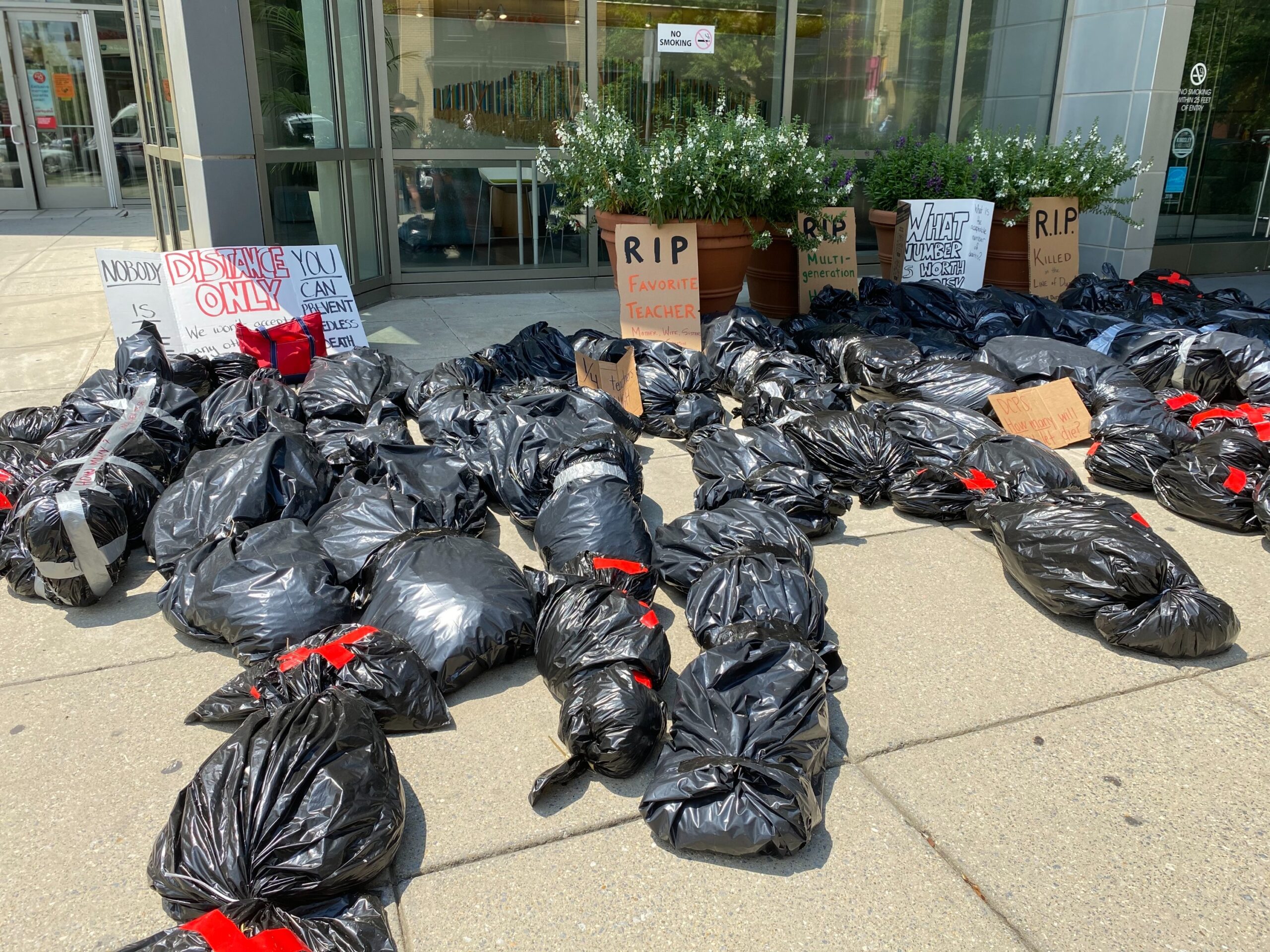
Steve Donkin, a founding member of DC-CORE, said educators felt city leaders were not listening to teachers and parents who expressed fears about reopening campuses for the 2020-2021 academic year. Many also felt leaders of the union did not do enough to convey those messages to city officials.
“A lot of members felt like they wanted more support for what they were voicing — their concerns and their desires to be more of an activist, fighting union,” said Donkin, a teacher at Francis L. Cardozo High School in Columbia Heights. “That was kind of the germ of forming the caucus — to try and push the union more in that activist direction.”
Jacqueline Pogue Lyons, president of the Washington Teachers’ Union, rejected the notion that the labor organization is not active enough, and pointed to some recent successes.
She said the union’s advocacy led to a promise from D.C. Public Schools to employ a librarian at every campus. The union also secured COVID leave for educators and time off for teachers to get the coronavirus vaccine during the work day.
“We’re more active than we’ve ever been and I’d say it’s largely been pushed by our members, by the leaders of our union, and spurred on by fear of this pandemic,” she said.
DC-CORE still believes the union can do more and has applied pressure internally.
In the days leading up to winter break in December, as the omicron variant drove infections up in school buildings, teachers’ worries intensified. Some educators urged D.C. Public Schools to temporarily shift to online instruction.
“Things were not good and chaotic,” Fuchs said.
The caucus asked Lyons to hold a virtual meeting for members to discuss possible actions the union could take. They wanted solutions in place before students and staff were expected to return to buildings after winter break in January, according to Fuchs.
Fuchs, a social studies teacher at H.D. Woodson High School, said Lyons agreed to the meeting but that “no one was really allowed to talk.”
The chat function was turned off and members were not allowed to appear on camera, Fuchs said. A question and answer portion of the meeting was heavily moderated.
“It wasn’t much of a town hall,” Fuchs said. “It was very frustrating and really surprising to me that they would try to stop people from talking to each other in this way. There was no reason for it.”
Lyons said managing the comments can be difficult during hours-long meetings with hundreds of members.
“They have to give us some grace,” she said. “We’re a mighty staff but we’re a very small staff.”
Frustrated, DC-CORE held its own meeting that Fuchs said attracted more than 400 educators. By the end of it, the caucus decided to introduce a couple of measures in the union’s representative assembly, a body of teachers elected to represent their schools.
One of the measures could have led to another “sick out” in January, where teachers would use their personal time to stay home from work for a day.
The representative assembly, which must approve such actions, wanted to put the measure to a vote, according to Fuchs. But she said the union’s executive board determined those actions could harm the union, quashing any potential demonstration. Fuchs, who is also on the executive board, said she abstained from that decision.
DC-CORE has successfully pushed other measures through in the representative assembly, including a vote of no confidence in city leaders over the reopening of schools.
That resolution, which passed in October, rebuked city officials for opening campuses without fully functional HVAC systems and failing to offer virtual teaching options, among other issues.
The caucus currently has more than 60 members who pay annual dues. Hundreds more educators have attended its meetings, according to Fuchs.
She said too much of the union’s power is currently concentrated in the presidency and executive board, which are elected positions. Instead the caucus wants the union’s members to lead its decision making, which would take organizing teachers in every campus across D.C. Public Schools.
Doing so would also better position the union to take action during an emergency, Fuchs said. That includes being prepared to go on strike, if necessary.
“We need to ask members: ‘where’s your line? What are you not willing to accept?,’” she said. “If we’re not willing to strike, then that’s fine … But if we don’t have labor action on the table, we will always be on the menu, like we are all the time.”
‘They’ll be ready to fight’
The fissures in the Washington Teachers’ Union are not unique.
Caucuses within teachers unions developed traction in the 1960s and 1970s, when teachers started winning the right to collectively bargain, according to Brad Marianno, who studies teachers unions as an assistant professor of educational policy and leadership at the University of Nevada Las Vegas.
“We tend to see teachers unions as these monolithic organizations where all teachers kind of believe the same,” he said. “But they’re like any other organizations where they have disagreements and factions.”
Social justice-oriented caucuses that emerged after the Great Recession forced school districts to slash budgets. That’s what happened in the Chicago Teachers Union, when members of the organization’s CORE caucus ascended to top leadership positions in 2010.
The caucus’ takeover culminated in a 2012 strike, Marianno said, where thousands of Chicago teachers refused to work after the union and city leaders reached a stalemate over contract negotiations.
Similar caucuses have emerged as forces in teachers unions across the country over the last decade, including in Los Angeles, Philadelphia, Seattle, and Baltimore. The groups are united by progressive causes and a willingness to become more confrontational with school district leaders.
“They’ve returned to some of the more aggressive labor tactics in order to make their demands heard,” Marianno said. “It’s no longer about the type of collegiality that tends to pervade education.”
Many of the groups meet monthly as part of the United Caucus of Rank and File Educators, an assembly of caucuses from across the country that are focused on social justice issues. The meetings are facilitated by Labor Notes, which helps labor activists organize.
Teachers unions tend to focus on providing services to members, such as representing educators in contract negotiations and handling grievances teachers file against school districts, according to Barbara Madeloni, an organizer with Labor Notes. But that work often happens without including members, she said.
Labor Notes also helps workers in caucuses figure out when and how to run for leadership.
“We come together to support people, members who are looking to transform their unions,” said Madeloni, who previously served as the president of the Massachusetts Teachers Association, a statewide union. “At some point, you’re going to run for election in order to have leadership that can use the resources of the union to transform the union.”
Membership of the United Caucus of Rank and File Educators has increased over the last two years, she added. Many teachers are galvanized by dissatisfaction over how elected leaders have managed public education during the pandemic.
“The lack of a coherent response from the federal government, from the state governments, the insisting that schools remain open without input from educators, has created really brutal circumstances for educators,” she said. “I think they’ll be ready to fight in the coming years.”
A fractured union
In recent months, the chat section of monthly Zoom meetings for Washington Teachers’ Union members have deteriorated into bickering and name calling, some members say.
Detractors of DC-CORE have criticized the group for its racial composition, arguing it consists of mostly white teachers.
Insults have been aimed at caucus members during meetings, according to Alicia Chambers, a middle school teacher in Ward 6 and another founding member of the group. She said one of its members was compared to former president Donald Trump and that the caucus has been accused of trying to “gentrify” the union.
“I’ll be honest: I think we’ve gotten a bad rap,” said Chambers, who is Black. “I think it’s being mischaracterized by people who don’t want change. They say they want change. But they really don’t. They don’t want to rock the boat.”
Chambers said she chose to participate in DC-CORE at the start of the pandemic because she felt union leadership was trying too hard to stay in the “good graces of the powers that be.”
“We were at a standstill,” she said. “We needed to push forward.”
On the other hand, some educators are discouraged by the way DC-CORE members can overrun union meetings, talk over other members, and force “lopsided” views, according to Maxine Jefferson, a special education teacher at H.D. Woodson High School.
“The way the union looks right now, from the inside, it’s disgraceful,” she said. “The behavior, it’s not professional. And it’s not what we should be showing each other or our students.”
Jefferson also said she heard from some teachers who feel DC-CORE is not doing enough to prioritize issues that are important to Black educators. In response, she started the Black Educator Caucus of Rank and File Educators, or BECOREDC.
She said the caucus has two key priorities: bolstering special education services and addressing IMPACT, a controversial system D.C. Public Schools uses to evaluate teachers. A recent study of IMPACT found evidence of racial bias — Black and Hispanic teachers consistently scored lower on evaluations than white educators.
Jefferson, who is Black, said BECOREDC has more than 70 members who pay dues to the caucus.
Gleeson Young, an instructional coach at School Without Walls at Francis Stevens, disagrees with strategies DC-CORE uses, which she feels can undermine the work of others in the union.
For example, a team within the union is currently negotiating a new labor contract with D.C. Public Schools. Actions such as the vote of no confidence against Bowser and Ferebee can jeopardize those negotiations, Young said.
“I’m not a fan of the mayor. But this is the person who controls the budget, who controls the school system, so I have to respect the office,” she said. “It’s like putting out fires.”
Young, a member of the union’s executive board, emphasized she was not speaking on behalf of the board.
She also noted that DC-CORE grew more active after the sudden death last year of Elizabeth Davis, the well-respected former president of the Washington Teachers’ Union whose disputes with city leaders regularly spilled into public view.
Young said she feels caucus members have not given the union enough time to regroup under Lyons, who Young described as a more pragmatic leader.
“Everyone more or less has the same goal or opinion,” she said. “It’s how it’s done that I think is causing a lot of problems.”
Some members have also noted the union is expected to elect a new president and other leaders in coming months, which they say is fueling some of the conflict.
Jefferson, of BECOREDC, said she is strongly considering running for president. DC-CORE said it will not run a slate of its members for union leadership but individuals in the caucus may choose to run.
For her part, Lyons said she is responsible for representing the entire union, which is formed of members who have a variety of beliefs.
Over the course of the pandemic, she has had to balance the desires of teachers who disagreed about when it was safe to reopen schools.
She has had to account for a small minority of members who do not feel the city should mandate a vaccine requirement for school staff.
And, when it comes to a strike or sick out, she said she has to remember the union represents many women who are breadwinners and may not be able to afford to miss work because they could lose pay.
“I have to do what’s best for the union and for all of our members,” Lyons said. “We have to come through unity and solidarity.”