Martin Austermuhle
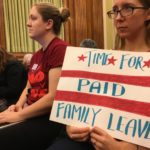
Hundreds of thousands of private-sector workers in D.C. will soon see a large increase in the amount of paid leave they get every year, while the employers that fund the program will be paying less for it.
In a letter sent Tuesday, D.C.’s Acting Chief Financial Officer Fitzroy Lee told Mayor Muriel Bowser and D.C. Council Chairman Phil Mendelson that by as early as July, workers will get 12 weeks of paid leave to care for a new child, attend to a sick family member, or address personal medical issues. The current law allows for up to eight weeks for parental leave, six weeks for family medical leave, and six weeks for personal medical leave. A new benefit of two weeks of pre-natal leave will remain the same.
At the same time, the private employers who pay for the city-run leave program will see the tax they owe cut by more than half, from the current 0.62% of an employee’s salary to 0.26% — worth roughly $200 million.
“This is huge because it’s a win-win-win,” says Councilmember Elissa Silverman (I-At Large), who chairs the council’s labor committee and co-authored the paid leave bill that was first introduced in 2015 and passed into law a year later, with the program itself launching in July 2020. In its first year, the leave program took in more than 12,000 claims for benefits, more than two-thirds of which were for parental leave.
“It’s a win for workers, it’s a win for employers, and it’s a win for this city and for what dogged council oversight can do,” she says. “This program was delivered on time in a pandemic despite incredible skepticism. And it is delivering now a tax cut for businesses who benefit from the program because of the dogged oversight. It’s increasing benefits for workers and enhancing them, and the program is working well.”
The significant increase in benefits and decrease in costs to employers comes from a large surplus in the city’s paid leave fund, approaching $500 million this year alone.
The surplus itself isn’t news: Last year it amounted to $400 million, and Bowser tried to use a large portion of it for other programs, and another chunk to lower the paid leave tax rate for employers to 0.27%. Lawmakers rejected that, opting instead to use some of the money to expand the personal medical leave benefit to six weeks from two weeks and create the new pre-natal leave benefit. Silverman and Mendelson also added language to the budget requiring that all leave options be increased to 12 weeks and the tax rate be dropped, provided the funding was available for it.
“When we saw the surplus last year in the program, we decided to put in this review because what we wanted to make sure that the contribution the employers were putting in was commensurate with the benefits that employees were getting out,” says Silverman. “And then when it reached 12 weeks, 12 weeks, 12 weeks in those three categories of parental, family, and medical leave, then at that point we said the CFO should then adjust the tax rate accordingly. Never in a million years did I think all of that was going to happen the first year.”
The decrease in costs to employers will go into effect in July. The CFO will conduct its next annual check of the tax structure in March 2023.
The paid leave program could see more changes in the future. A new bill introduced by Silverman and eight of her colleagues last month would make the benefits “portable,” meaning that a worker who is fired or loses their job would still be able to take advantage of benefits their employer had paid for. (Currently, a worker can only claim leave benefits if they are still employed, which some say negatively impacts low-wage workers in industries with high turnover.)
Silverman also says other future adjustments could be made to the wage benefits that are paid out. Currently, lower-wage workers receive up to 90% of their wages back during leave, with higher wage workers taking a lower cut. There’s a $1,000 weekly cap on wage benefits paid out.
Silverman and Councilmember Christina Henderson (I-At Large) have also introduced a bill that would bring increase paid leave for D.C. government workers to make them even with private-sector employees. There’s a hearing on that bill today, alongside another measure to offer bereavement leave following the death of a family member or stillbirth.
“With our private-sector program going to 12 weeks, we need to be able to compete to attract the best and the brightest in our area,” says Silverman.
Previously:
Tensions Flare About $400 Million Paid Family Leave Surplus In Bowser’s Budget
Beneficiaries Say D.C. Paid Family Leave Is Changing Perceptions Of Caregiving
Here’s Everything You Need To Know About D.C.’s Paid Family Leave Bill