Amanda Michelle Gomez
D.C. will no longer report COVID-19 data every weekday. Moving forward, the health department will publish cases, hospitalizations, and deaths, along with other key pandemic indicators, every Wednesday. D.C.’s vaccination data will continue to be published every Thursday. D.C. had already stopped reporting data on weekends.
The move is in line with recent D.C. government actions that aim to return residents to more ordinary routines after two years of pandemic interruptions. Mayor Muriel Bowser lifted the city’s short-lived vaccine requirement for businesses on Feb. 15 and dialed back the indoor mask mandate on March 1. The Bowser administration also just discontinued its popular testing program at firehouses, although residents can still access testing at COVID centers and select libraries.
DC Health announced the agency will be scaling back COVID-19 reports alongside another update: The metrics will now follow updated federal guidelines. The Centers for Disease Control and Prevention updated its framework on monitoring and living with COVID-19 late last month, suggesting that 70 percent of the U.S. can stop wearing masks and can safely be in crowded indoor spaces. Given a host of factors, including vaccination and treatment, federal officials are ushering a new phase of the pandemic, one that is potentially less dangerous and disruptive. The CDC recommended jurisdictions determine risk by measuring hospital admissions and beds related to COVID-19, as well as new cases per 100,000 people. According to the CDC, D.C. is low risk.
The new metrics are published on coronavirus.dc.gov:
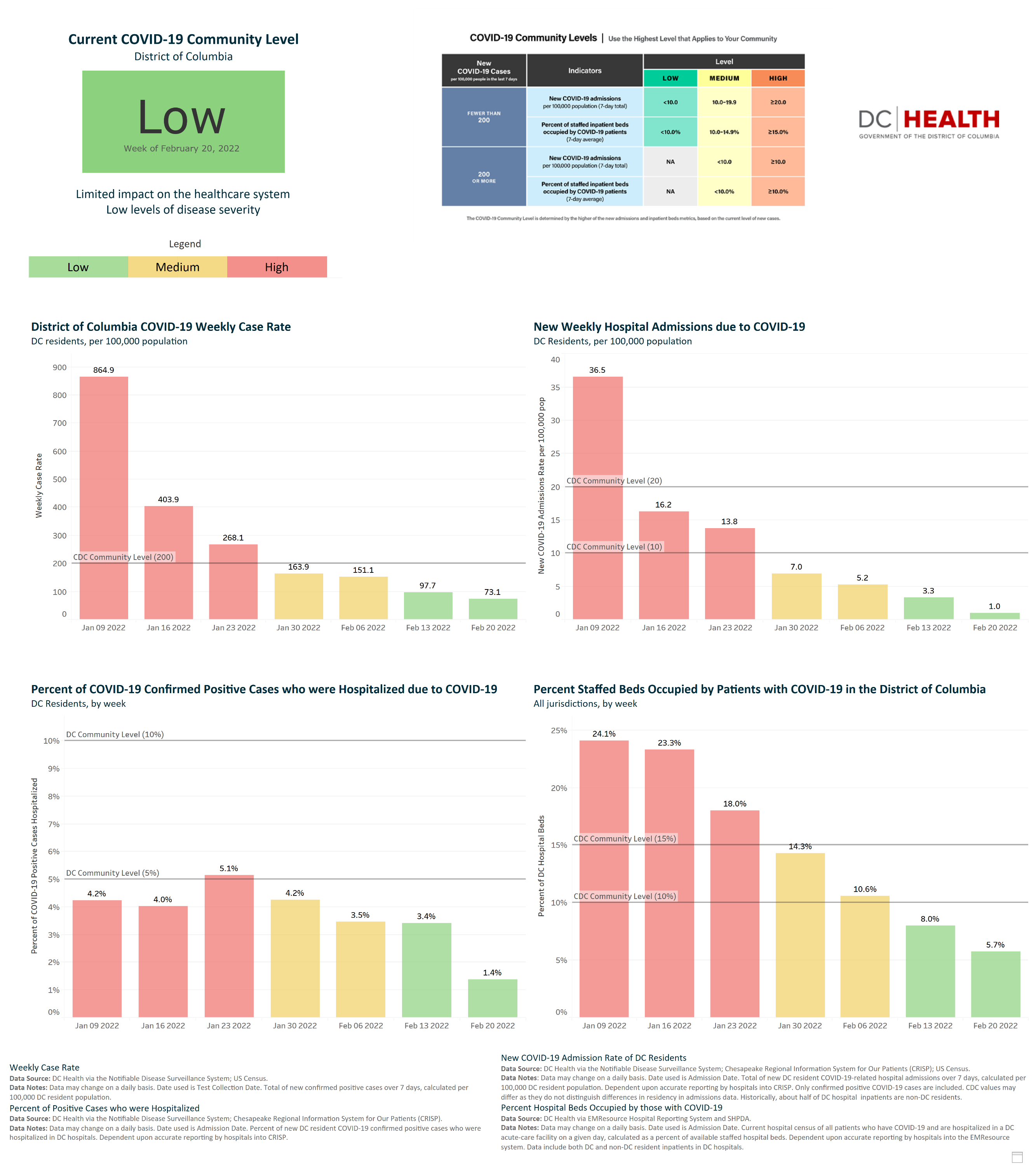
The previous metrics relied on more indicators, including contact tracing, and the way DC Health measured cases and hospitalizations meant the city was still experiencing substantial community spread, albeit improving. The metrics also offered more information and a better sense of infections over time, making it easier to compare when cases ebbed and flowed.
Senior DC Health official Patrick Ashley explained the agency’s rationale to the Council on Friday. “What you’re seeing is a shifting in the way that we want individuals to think about COVID,” he told lawmakers during their weekly conference call. “We want people to change the way that they view their risk and look at it as traditional public health data and look at trends over time.”
Ashley said the updated metrics rely on sustained trends, which will be more helpful to residents than daily reports of cases. DC Health accepted the federal guidelines because multiple factors, from vaccinations to hospital capacity, determine the risk of COVID-19 in the community and for an individual. In other words, case counts became less meaningful after things like treatment became available. “The reality is, does 100 cases really change the behavior that we want people to do?” said Ashley. “We want people to be smart about their risk.”
Some people who rely on DC Health’s daily reports about COVID-19 think the cutback is a bad idea. “If people are supposed to be making individual decisions about protecting ourselves, you have to give us the info we need to do that,” tweeted one resident.
While D.C.’s cases and hospitalizations have significantly decreased — one of the fasted drops nationwide — local hospitals are still seeing roughly the same number of COVID-19 patients as they had during the delta surge. Some local hospitals continue to be overwhelmed. Hospital workers at Capital Region Medical Center in Prince George’s County held a vigil Thursday, calling attention to their struggles mostly related to understaffing.
People are also wary of returning to business as usual because children under five are still not eligible for COVID-19 vaccines, which is why some establishments in D.C. continue to have mask or vaccine requirements for staff or patrons. People are also concerned for immunocompromised people, and nervous about long COVID.
COVID-19 surveillance is time-consuming and governments do not have “unlimited resources or the political will” so DC Health’s decision is reasonable, says Amira Roess, a professor of global health and epidemiology at George Mason University. “The reality is that health departments don’t have the resources to continue at this pace in monitoring COVID-19 and given the decrease in transmission and disease severity now may be a good time to reduce that pace,” Roess tells DCist. “We do need to keep an eye on the COVID-19 virus though because it is still a new virus and there will continue to be surprises.”
DC Health did not directly respond to questions about resource or staff capacity, a spokesperson simply says “Public heath monitoring is a priority and staff will continue analyzing data to identify trends and inform the community of changes.”
Jacqueline Dupree, who tracks COVID-19 case, hospitalization, and death numbers as reported by state health departments for The Washington Post, says daily reporting has become rare — only nine states, including neighboring Maryland, report data seven days a week. “DC is just the latest jurisdiction to move to weekly reports,” she tells DCist via email, joining Arizona, Florida, Iowa, Nebraska, and Tennessee. She’s now waiting to see whether D.C. will join other states that scale back public reports but still frequently send top-level case and death numbers to the Centers for Disease Control and Prevention, so the Post could update its own tracker. The Post already relies on the federal health department for hospitalization numbers.
A DC Health spokesperson tells DCist “Aggregate case and death numbers will be provided to CDC on a daily basis.”
The end of daily COVID-19 reporting means the end of another beloved tracker: Dccovid.com. The website, widely circulated among locals on social media, was founded and run by Ryan Stahlin (aka @Stalebread14), a contractor at the U.S. Department of the Treasury. “As much as I would like to bang my fist on the table and say, ‘We need daily numbers every day,'” he tells DCist, “Just from my experience working in the federal government, I can imagine that this has been an incredibly resource-intensive job for them. There are a bunch of smart people who are working in the health department who are probably underpaid, overworked and understaffed.”
While he didn’t work with or hear from anyone at DC Health — except from Ashley, who occasionally helped him resolve the department’s data errors — Stahlin is grateful to those government workers because they enabled his own public service. His website, which launched around November 2020 and took him anywhere between 10 to 25 minutes a day to regularly update, relied on DC Health publishing highly-detailed spreadsheets of COVID-19 data.
He saw his visualizations as complimenting DC Health’s. (Because he believed DC Health did such a good job, his website has minimal information on vaccination data. He also thought DC Health’s other visualizations could be more helpful, like accounting for population in the graphic on cases by neighborhood, so he created one.) Stahlin’s graphics are all interactive and hyper-granular, meaning visitors can see cases by age band since the beginning of the pandemic.
Stahlin, who has a background in data science, decided to create a website because he learned so much from privately downloading and analyzing DC Health’s data. Given how little people knew about COVID-19 in the early weeks of the pandemic, he was first struck by the number of young people who were testing positive, and he wanted to share information to help people make informed decisions. He does not work in health, so did not offer predictions or policy recommendations. But several councilmembers have publicly shared that they relied on his website.
“I’m not going to say the pandemic is over or anything,” he says, “but I think my role in helping Washingtonians interpret it is probably over.”
This post has been updated to include Friday’s Council call with DC Health, as well as email correspondence with DC Health. This post was also updated to correct the spelling of Patrick Ashley’s name. Colleen Grablick contributed reporting.