The race is on to find the right space on arguably the most coveted real estate in D.C. — the National Mall — for two new federal museums: the National Museum of the American Latino and the Smithsonian American Women’s History Museum.
Congress approved the two new museums as part of the Smithsonian Institution in a year-end spending bill just before Christmas 2020, and gave the Smithsonian Board of Regents two years to select the sites.
The selection process is well underway — the Smithsonian is taking a broad look at the prospective sites and studying 24 potential locations, including several that seem unlikely, like the FBI headquarters on Pennsylvania Ave.
But there’s some measure of controversy around the exact location the Smithsonian will eventually pick.
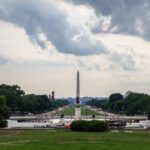
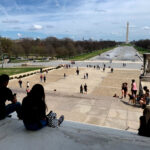
The approximately 2-mile green space from the Lincoln Memorial to the U.S. Capitol is lined with civic monuments and museums dedicated to American history and culture. Supporters of the two new museums under consideration want the buildings to be on this corridor, believing anything less signals potential disrespect to the museums and the groups they represent.
“Latino history is American history,” actor John Leguizamo, a board member of the Friends of the American Latino museum and activist for Latino causes, told DCist in December. “It would be this Mecca where we can bring our children and grandchildren … If you’re not on the Mall, you can feel like a second-class citizen.”
Rep. Carolyn Maloney, D-N.Y., a leader in the congressional drive for a women’s history museum said, “When I walk around the [National] Mall, they have museums for everything – but not women. And it is hard to empower women if we don’t even recognize them.”
The law Congress passed in 2020 cites four potential locations that could be used for the Latino or women’s history museum:
- The South 14 Monument site, near the foot of the Washington Monument. It is bordered by 14th Street and Jefferson Drive, Wallenberg Place and Independence Avenue, and is across the Mall from and parallel to the National Museum of African American History and Culture;
- The Northwest Capitol site bordered by Third Street, Constitution Avenue, First Street, and Pennsylvania Avenue. It’s at the foot of Capitol Hill on the Senate side and is across the Mall from and parallel to the U.S. Botanic Garden.
The legislative language on the Latino museum specifically added two potential sites:
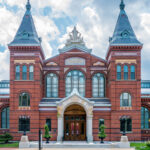
- the Arts and Industries Building at 900 Jefferson Drive; The eye-catching red brick structure, the second oldest Smithsonian building, is next to the iconic Castle. It has been a spot “held” for the Latino museum by Smithsonian leadership for years and only reopened in 2021 after being closed for nearly two decades. The complication is that the small display space could only be expanded underground.
- the Agriculture Department facility bordered by 12th and 14th streets, Jefferson Drive and Independence Avenue.
But the law’s language still leaves room for the Smithsonian Board of Regents to locate the new museums where it is “appropriate.”
“The final call is the Regents’,” says Linda St. Thomas, chief spokesperson for the Smithsonian. (Notably, six of the 17 Regents are members of Congress.) Officials with the Institution are keeping their cards close to the vest about where those museums may end up.
“It’s too early to say,” St. Thomas tells DCist in an interview.“We’ve hired an architectural engineering firm, Ayers Saint Gross, to do a survey of 20 to 24 sites. They will narrow it down to six or seven by the fall with a decision at the end of December.”
And the firm is looking at sites that are not just on the Mall, but near it. “We have to be realistic,” St. Thomas says. “There is no empty land.”
The Smithsonian has not publicly released the list of 24 sites it’s considering, but DCist obtained a map of the sites from the office of Sen. Bob Menendez, D-N.J., the lead sponsor of the Latino museum legislation in the Senate who has worked on the legislation for 20 years.
“I look forward to continue working with the Smithsonian to ensure the American Latino Museum is placed on the Mall, which is Congress’ intent,” Menendez said in a statement to DCist.
Among the 24 sites on the map is the FBI headquarters, the J. Edgar Hoover Building downtown. That building was years ago rendered “functionally obsolete,” and Congressional and local leaders have long sought to move the headquarters from that spot.
Other potential sites on the Smithsonian look list include L’Enfant Plaza, the Corcoran Gallery of Art building (the museum closed in 2014 and now houses the Corcoran School of the Arts and Design, part of George Washington University), and the U.S. Department of Labor building on Constitution Ave. near the U.S. Capitol.

Meanwhile, the Smithsonian has been quietly seeking private input from community members and organizations with an interest in the new museums. The institution has organized focus groups on the site selection process, according to a communication from the Smithsonian obtained by DCist.
“The Smithsonian is convening conversations about the new museums to inform the evaluation of potential sites,” reads the FAQ page. “This is a first step in the process of developing the museums.”
One focus group participant, who was part of a small group of about 10 people convened to discuss the site of the Latino museum, told DCist the conversation was mainly focused on whether the new museums should be located on the Mall or off of it. “The general consensus was that it should be on the Mall,” said the participant, who agreed to speak on the condition of anonymity because of the private nature of the focus groups.
But there is a vocal resistance to the addition of monuments and tributes, let alone museums, to the Mall from a high-powered civic group, the National Mall Coalition.
Judy Scott Feldman, a Ph.D art historian and educator who is the group’s chair, says Congress is too fond of “plopping things on the Mall,” as she told DCist recently. She thinks her coalition has a better idea than the four locations proposed in Congress’s bill: situating the museums side-by-side across 15th St. from the National Holocaust Museum next to the Tidal Basin.
The coalition’s plan was developed by architect and vice-chair of the coalition, Arthur Cotton Moore, who designed the Washington Harbour and other landmarks in the city. “Moore’s new sites would create a pedestrian destination on what is poorly used Mall acreage south of the Washington Monument,” Feldman says.
The elephant in the room — er, on the lawn — is the National Museum of African American History and Culture, opened in 2016, which has set the gold standard for what other new museums should look like — and where they want to be. It’s located right at the foot of the Washington Monument.
But how much and where can buildings be added to the Mall itself without causing congestion and overcrowding and destroying the historic vistas?
Congressional supporters of the museums tried to head off any idea of putting either museum somewhere off of the Mall with forceful letters to Smithsonian Secretary Lonnie Bunch III last November.
Before being named secretary in 2019, Bunch, who has enormous sway over the process, was the founding director of the National Museum of African American History and Culture.
A bipartisan group of 24 senators and 82 representatives sent letters to Bunch with a not-too-subtle message: pay attention to “Congressional priorities” in selecting the location for these museums. And since the Smithsonian gets 62% of its funding from Congress, that message packs a punch.
“The addition of the two new museums on the Mall will further the Smithsonian’s mission by showcasing and highlighting the untold and overlooked contributions to our nation of both women and Latinos,” said the letter spearheaded in the Senate by Menendez and Sens. John Cornyn, R-Texas, Dianne Feinstein, D-Calif., Susan Collins, R-Maine and in the House by Maloney and Reps. Tony Cardenas, D-Calif., and Jaime Herrera Beutler, R-Wa.
“It is fitting that these two museums be prominently located as that will help ensure that more visitors will be able to enjoy and learn from them.”
Once the sites are decided on, then the fundraising will begin to get the structures built, with non-federal donations making up 50% of the cost.
“It’s a tight timeline,” said Estuardo Rodriguez, president and CEO of the Friends of the Museum of the American Latino, a nonprofit booster group.
Once the site is selected, it will take as long as 10 years before a museum is ready to open.
“I think that the reality is that you shoot for a decade,” Bunch told the Art Newspaper last year. “ And then, see what happens.”
This story has been updated to clarify that John Leguizamo is on the board of the Friends of the American Latino Museum.