Matt Blitz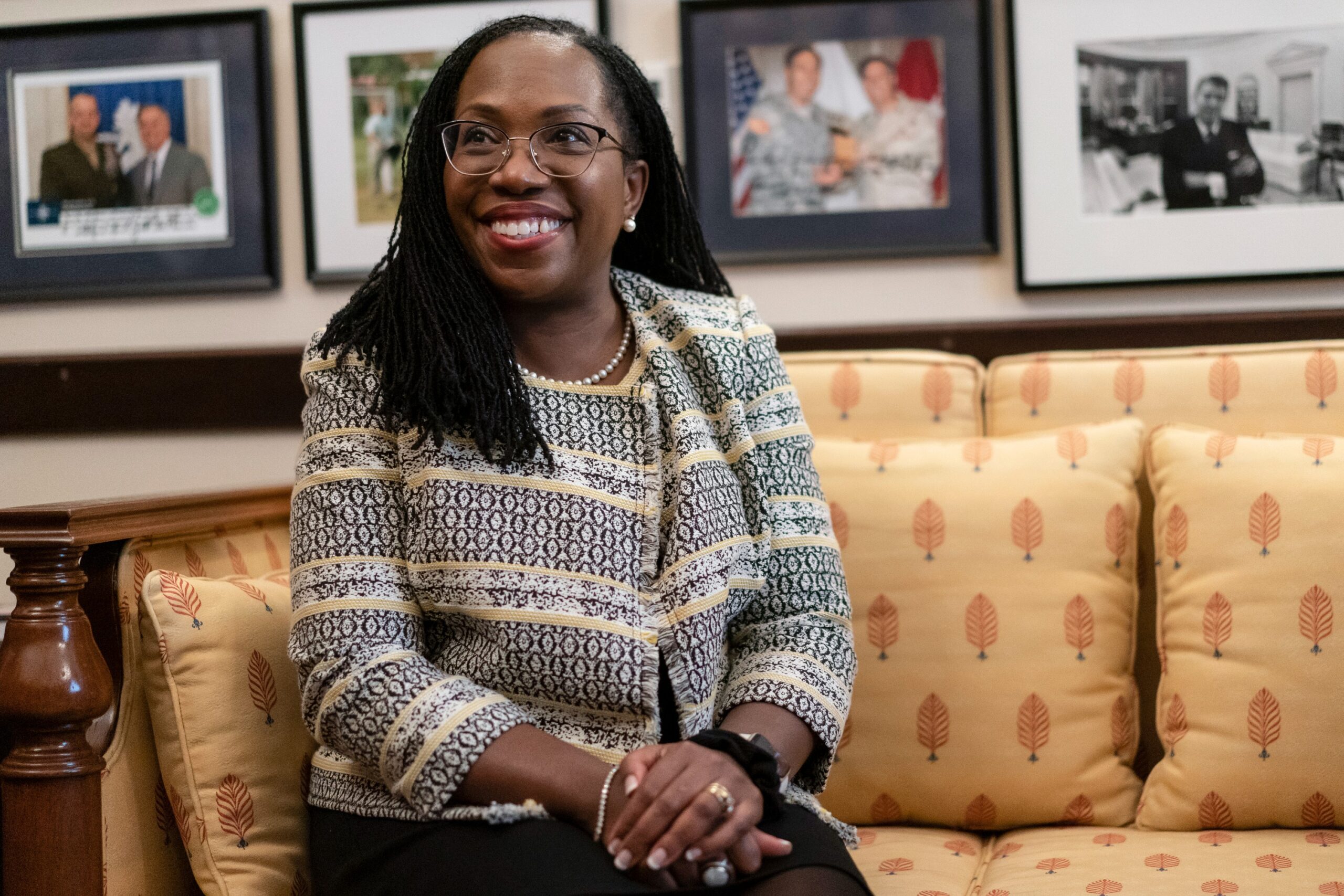
Update:
The Senate voted to confirm Judge Ketanji Brown Jackson to the U.S. Supreme Court on Thursday. Jackson will become the first Black woman in history to sit on the country’s highest court.
Original:
D.C. native Judge Ketanji Brown Jackson is set to make history on Monday as she sits in front of the Senate Judiciary Committee for her U.S. Supreme Court confirmation hearing.
For the Washingtonians who know Judge Jackson personally — and who will be eagerly watching as she potentially becomes the first Black woman to take her seat on the highest court in the land — the moment will carry particular significance.
“Seeing somebody break that glass ceiling that you, you know, respect, and someone that deserves it so much, it’s going to be very emotional for me,” says Jo-Ann Sagar, a D.C. appellate lawyer and a mentee of Jackson’s. “I’m full of pride. I’m just honored to witness this moment.”
For Black women in particular, the moment carries profound meaning.
“Having somebody that looks like me, that shares some of the same identities, sit on the highest court we have in this country, is a very big deal,” Howard University law student and activist Jasmine Marchbanks-Owens tells DCist/WAMU. “I never thought that I would see something like that.”
Late last month, President Joe Biden nominated Jackson, who currently sits on the U.S. Court of Appeals for the D.C. Circuit. The confirmation hearing begins Monday morning and will last four days. It’s expected the confirmation vote in the Senate will happen prior to the April 8 Easter recess — that could mean as soon as the week of March 28, according to the Washington Post. It is likely Jackson will be confirmed, since the Senate has already done so twice for judgeships and Democrats hold a slim majority due to Vice President Kamala Harris’s tie-breaking vote.
Beyond becoming the first Black woman on the court, Jackson would be the first federal public defender on the modern Supreme Court. She would also be among four women on the court, one of just five ever. She’s also a one-time Harvard Law Review editor and musical theater performer, a former Supreme Court clerk, a “child of the 70s,” and a mom.
Ketanji Brown Jackson is a D.C. native, born in 1970 to a public school principal and an attorney.
She spent most of her childhood in South Florida and attended law school at Harvard, but made her way back to her hometown in 1998 to work at a private firm before being tapped to clerk for Supreme Court Justice Stephen Breyer (whom she’s now up to replace).
In the years since, Jackson has stayed in the District, rising higher and higher as a lawyer and then a judge, slowly building further ties with the city where she was born.
She’s served as a federal public defender for D.C., got nominated to the U.S. Sentencing Commission by President Barack Obama (where she had a significant role in retroactively reducing sentences for those convicted of crack and powder cocaine crimes), and became a District Judge for the District of Columbia. Just this past summer, she was commissioned to be a U.S. Circuit Judge in D.C.
D.C. Congresswoman Eleanor Holmes Norton first met Jackson when she was nominated for District Judge in 2012, interviewing and ultimately choosing her for the position. Although it was a decade ago, Norton says she remembers Jackson matching and even exceeding everything she had heard and read about her.
Introducing Jackson at the 2012 Senate hearing Norton told fellow lawmakers that she was “the entire package.” To this day, Norton says she’s proud to claim Jackson as a D.C.-native.
“Her historic appointment as the first African-American woman … is another breakthrough of immense importance,” Norton tells DCist/WAMU. “I’m very proud that she has lived here in the District and was a public defender in the District. We feel that we own her.”
She also notes that Jackson’s nomination is a message to the young generation “that there are no limits that you cannot reach.”
It was while Jackson was serving as a District Judge in D.C. that Jo-Ann Sagar became her clerk. It was her first job out of law school; as she puts it, “I took the bar and, a week later, I was in her chambers.”
Sagar says Jackson was an extremely supportive teacher, taking time to explain the ins and outs of writing opinions and preparing for hearings. She showed her clerks how to “grind,” as Sagar put it, often being the first person in the office when it opened and the last one to leave. Jackson also had an eye for detail, nuance, and perfection.
“We would turn in version, after version, after version [of a brief]. Then, she would send it back to you, then we would draft it again,” says Sagar, who is now with the D.C. law firm Hogan Lovells. “If you could get an opinion out the door that was less than version 50, you had done a good job.”
What Sagar also noticed was how careful Jackson was to make sure everyone who stood in her courtroom knew their rights and the law.
“She told me that when she was a public defender, she was surprised by how often when she was representing people at the appellate level that she would ask them what had happened during the trial court stages, and they wouldn’t really have understood what had happened,” says Sagar. “She really strove to make sure [that] never happened in her courtroom.”
Sagar clerked for Jackson for a year, from July 2014 to July 2015, but even after her time was up, they stayed in touch. As Sagar’s career also blossomed, Jackson became a sounding board for her. They often talked about how to balance career and family, something Sagar continues to take to heart today.
“Like me, she’s a Black woman…an issue that I had when I was in law school is that often people want to mentor people that they can relate to. And when the industry is not diverse, it can be hard to find mentors,” Sagar says. “I felt like I hit the lottery by being able to clerk for a Black woman judge because it was such a rare experience.”
The impact of Jackson’s nomination is resounding at Howard University School of Law, where about 70% of the students are Black women.
Danielle Holley-Walker, the Dean of the law school (who herself was floated as a potential candidate for the Supreme Court in 2016), says she hears in the hallways about how much Jackson’s nomination and potential confirmation means.
“With Judge Jackson crashing through this glass ceiling, I hear students talking about the possibility for them to become federal judges, for them to possibly become Supreme Court justices,” Holley-Walker. “So, it really does make a difference.”
First year Howard law student Jasmine Marchbanks-Owens will be watching the hearings on Monday. She expects them to be exciting, but filled with some mixed emotions as well.
“As Black women, we’re oppressed by both our race and our gender. And, so, I think we are going to see a lot of different questions that are going to show the intersectionality or the nuance of that specific type of racism and sexism,” Marchbanks-Owens says. “So, I think those questions are going to be disheartening.”
But she also says she knows she’s going to be inspired. Marchbanks-Owens is really interested in movement lawyering, providing legal support to social justice movements and community organizing. Seeing Jackson in front of the Senate Judiciary Committee potentially on her way to a confirmation as a U.S. Supreme Court Justice, she says, tells her that the door is open for whatever future she wants for herself.
Marchbanks-Owens says it will also likely prompt her to think about the past, when all possibilities were not possible.
“My mother’s great grandmother was born enslaved. When my mother was born, Black people didn’t have the right to vote. Women were not able to get their own bank account,” says Marchbanks-Owens. “Now, 65 years later, a Black woman is going to be appointed to the Supreme Court.”
This post has been updated to correct the spelling of Jasmine Marchbanks-Owens’ name.