Colleen Grablick
Hitachi Rail, the company contracted to build Metro’s newest 8000-series trains, will open a factory in Hagerstown, Maryland. The $70 million factory will create a total of more than 1,300 jobs in the region, bringing in more than $350 million annually for D.C., Maryland, and Virginia, according to a statement released by Hitachi on Monday.
Hitachi is only the second manufacturer to construct Metro trains in the region. The retired 5000 series trains (the ones with the carpeting) were also assembled in Maryland, in a joint contract between the Spanish manufacturer Construcciones y Auxiliar de Ferrocarriles and Maryland-based AAI Corporation. Other fleets, like the 7000-series and 6000-series, were built overseas in Spain, Italy and Japan, and domestically in New York and Nebraska.
“Having a global company like Hitachi Rail select Hagerstown as the site of a major U.S. expansion is outstanding news for Washington County and the entire state of Maryland,” Gov. Larry Hogan said in a statement Monday.
The factory, located about 90 minutes from the Greenbelt Rail Yard, where the completed trains will be delivered, is slated to be operational by winter 2023-2024. Taking up more than 300,000 square feet (the length of about five football fields), the factory will produce about 20 railcars a month, according to Hitachi, with the ability to manufacture several different types of trains.
Hitachi signed a contract valued at around $1 billion with WMATA in 2020 to construct the 8000-series set, with the stipulation that the trains would be built in the area. The agreement came after urging from Congressmembers, the Federal Transit Administration, and trade groups to keep the manufacturing and procurement of trains in the U.S. In 2019, members of Congress forbade Metro from contracting with a Chinese-based manufacturer, amid security concerns, and threatened to withhold $150 million in annual funding. The Alliance for American Manufacturing also pushed WMATA to follow the Buy American Act, which required 70% of the cost of components produced and final assembly to happen domestically. According to Hitachi’s statement Monday, 60% of construction value for the factory will be spent in D.C., Maryland, and Virginia.
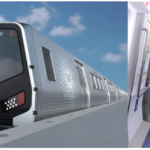
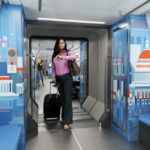
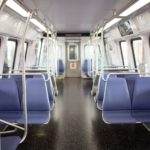
The 8000-series fleet, once completed, is expected to the replace the decades-old 2000 and 3000-series fleets. They’re all-electric, with upgrades like heated floors, on-board WiFi, and more space between seats and aisles.