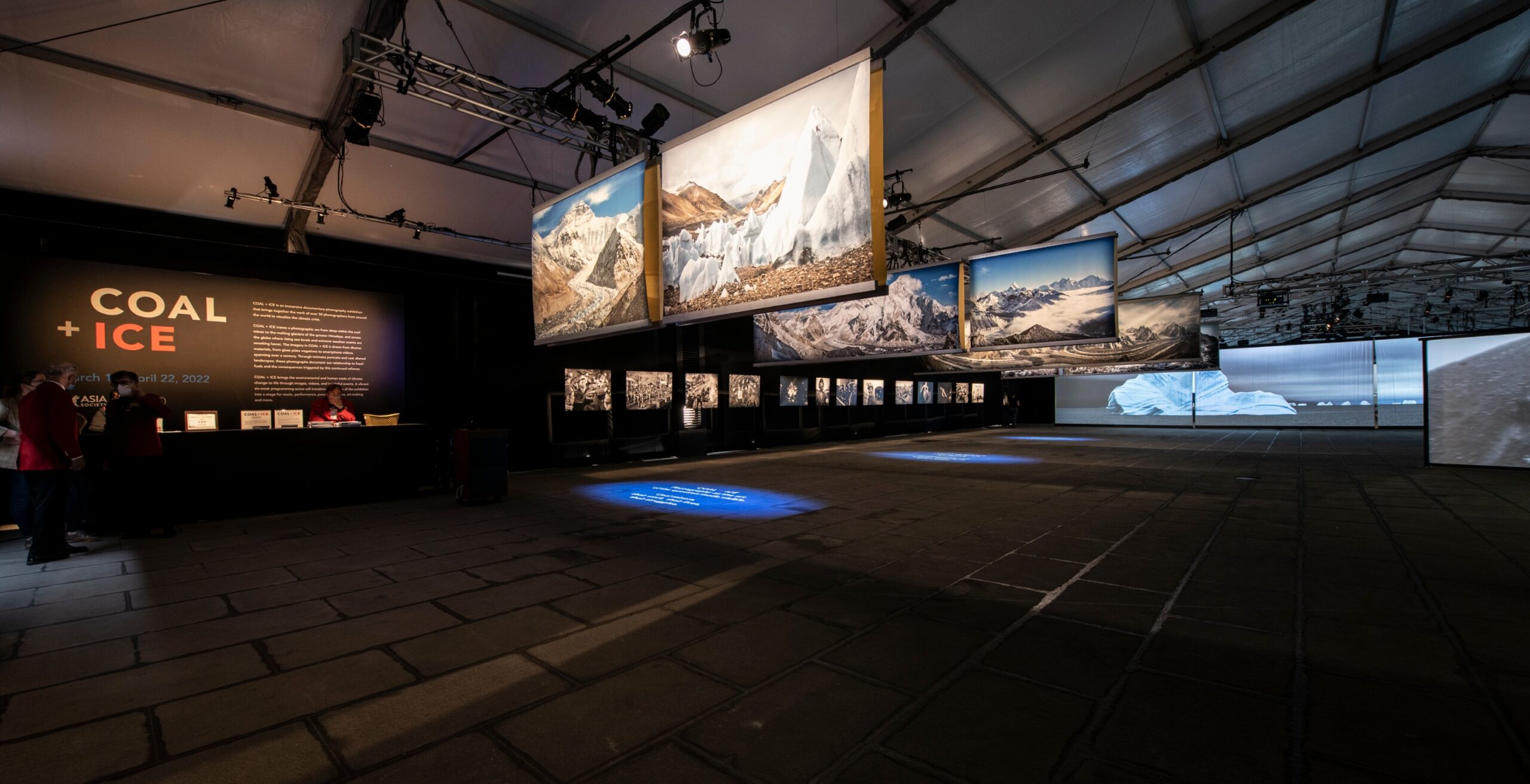
In the wake of natural disasters like hurricanes, floods, and droughts, temporary relief tents house the displaced, serve as medical facilities, and store supplies. At the REACH at Kennedy Center, a similar structure now holds an immersive documentary exhibit, COAL + ICE, which seeks to dramatically visualize the climate change crisis — including by signaling that, without action, these emergency structures are likely to become much more commonplace in the years to come.
When attendees enter COAL + ICE, they’re met with monumental photographs of glaciers suspended from the ceiling. When they walk to the other side of the images, they’re greeted with massive headshots of coal miners — a powerful juxtaposition of the source of carbon emissions and the resulting melting ice caps. Throughout the exhibit, images depicting over a century of global environmental change are projected onto screens erected into four-sided cubicle enclosures or simple partitions. The images can be seen from either side of every screen, creating an intense and multi-layered effect.
Over 50 photographers and videographers are showcased, including eight for the first time in the D.C. exhibit. Mountaineering photographer George Mallory’s 1921 pictures of Mount Everest are depicted in a slideshow with David Breashears’ 2007 photographs of the same locations; together, they document the shrinking glaciers. The sharp black and white portraits of photographer Song Chau, who worked as a coal miner in China and photographed his coworkers, also hang in the exhibit. Glaciers in Antarctica snapped at golden hour by Camille Seaman glow on warm colored backgrounds, almost like they’re threatening to melt at any moment.
“Art can do things that journalism or science cannot. We really tried to create a space, a story that people will experience differently than you would a book or a newspaper,” says co-curator and exhibition designer Jeroen de Vries of creating an exhibit that puts the earth’s beauty and destruction on such a monumental and close up scale that it feels difficult to ignore.
COAL + ICE first launched as a project of the Asia Society with a 2011 premiere in Beijing. It’s since made stops in Shanghai, Yixian, Paris, and San Francisco, and is now making its east coast debut in the district. While the scope of the exhibit is worldwide, the programming leans heavily on the District’s artists and performers. “Climate is global and climate is local,” says Asia Society President and CEO Kevin Rudd on opening night.
OnRaé Watkins, a local musician, arts educator, and videographer whose work blends artmaking and activism, moderated a panel at REACH that included photographers from the exhibit and other artists working on climate change issues. In spite of the global focus, Watkins says she saw parallels to her own life and experiences that resonated in a personal way.
“Looking at some of the photos, I see people who look like me. I’m familiar with police abolition and combatting state sanctioned violence, but I saw the violence that Black and brown people are experiencing due to climate change.” She specifically points out Gideon Mendel’s “Drowning World,” series, in which subjects stare defiantly at the camera while up to their knees, waists, or necks in floodwaters.
“This isn’t really my realm of activism,” Watkins says. “Art for me is one of those mediums that helps bring people into social issues that they might not have familiarity with. It brings in every type of learner. I was able to learn based on what I was seeing through film, through photos.”
Another one of the exhibit’s local manifestations was the play We Hear You: A Climate Archive, performed on March 18. An initial version of this play was written by Jacob Hirdwall to center around Greta Thunberg’s speeches and was performed at Sweden’s Royal Dramatic Theatre in Stockholm in January 2020. In that performance, a child actor portraying Thunberg was surrounded by dozens of community members, most of them untrained as actors. When project Director Caitlin Nasema Cassidy, who is the inaugural artist in residence at Georgetown University’s Earth Commons Institute, she immediately thought of adapting it using student narratives.
“They have given us extraordinary answers about their lived experience with climate, in D.C., in Maryland, in Virginia, and also all over the world, because these five young people are from everywhere,” says Cassidy, who weaved the student’s experiences with climate change into a new script.
One of these students was Georgetown senior Ashanee Kottage, who spent the summer in her native Sri Lanka doing field work for her thesis project on how climate affects communities living near a national park.
“I realized, these people whose information I’m using, and to whom this information is most relevant, are never going to read the academic articles I’m writing. Whereas if I were to translate my pieces into a play, that is something they can watch and engage with,” she says.
The D.C. performance of We Hear You marks the kickoff of a two-year process that will add over 70 more young people’s narratives to the project, though most will be gathered virtually to be mindful of emissions. Subsequent performances will include these new stories and all of them will be included in a digital storytelling archive featuring written narratives and performance footage.
“Climate is this hyperobject that we can’t get our hearts or our minds or our bodies around, and telling stories that are rooted in our backyards, literally, is the thing that is hooking me and other people into the issue,” says Cassidy.
The exhibit also includes interactive activities that bring climate change issues home in creative ways. At the far end of the tent, there is a reading area with environmental books for visitors to peruse, as well as tablets where participants can design their own climate change posters. The REACH’s Moonshot Studio is hosting a series of workshops that include collaging and writing letters to planet Earth. Reservations are recommended for most activities, but there are also drop-in options, like a station to create beats.
On March 23, former Vice President Al Gore will be in conversation with student environmental activists from Georgetown. Other upcoming events feature luminaries like Michael Pollan, Alice Waters, and Renée Fleming. A full event listing, as well as viewing hours, can be found on the COAL + ICE website.
COAL + ICE, March 15-April 22 at REACH at Kennedy Center. All events are FREE, but some require advance reservations.