Martin Austermuhle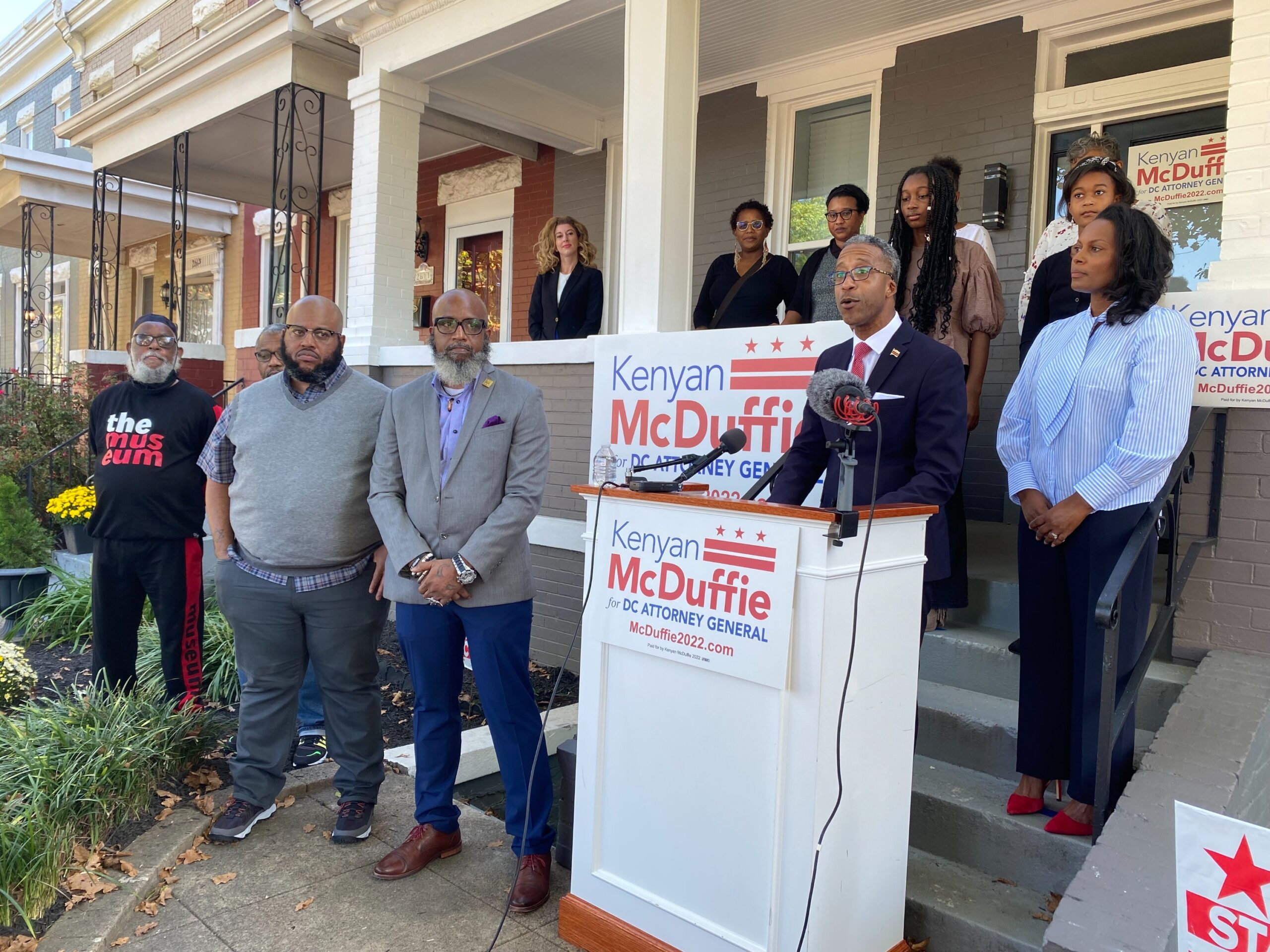
D.C. Councilmember Kenyan McDuffie (D-Ward 5) is seen as one of the front-runners in the race for attorney general, but his run for the office could well be complicated by 23 vague words in the city’s law.
On Tuesday fellow candidate Bruce Spiva formally challenged McDuffie’s candidacy, arguing in a 17-page filing to the D.C. Board of Elections that the Ward 5 lawmaker does not meet the legal qualification that any candidate for attorney general have been “actively engaged, for at least 5 of the 10 years as an attorney in the practice of law in the District of Columbia.”
In the filing, Spiva, a managing partner at the international law firm Perkins Coie, says that while McDuffie was educated, trained, and once worked as an attorney, over the last decade he has instead served as an elected lawmaker — but not a lawyer.
“Councilmember McDuffie’s work over the last ten years as Ward 5 representative on the D.C. Council does not constitute the practice of law,” reads Spiva’s challenge, which was first reported by The Washington Post. “The residents of Ward 5 are his constituents, not his clients, and he is their political representative, not their attorney. He does not maintain attorney-client relationships with his constituents, and the services he provides as their political representative are not legal services.”
Spiva points to rules laid out by the D.C. Court of Appeals that define what it means to practice law: preparing legal documents or opinions for another person or entity, appearing in court, or providing legal advice to someone else.
“The people of D.C. deserve an attorney general who is ready on day one to take on the full responsibilities of the office. Councilmember Kenyan McDuffie’s lack of legal experience will prevent him from being able to effectively take on the important fights for housing justice, criminal justice reform, and workers’ rights that the next D.C. Attorney General needs to be able to win,” said Spiva in a statement. “The council enacted and District voters approved specific, minimum qualifications for an attorney general candidate. Councilmember McDuffie, while a dedicated public servant, does not meet those requirements.”
The challenge comes at the start of the 10-day period when candidates’ qualifications for office can be contested before the elections board. While those challenges most often involve a candidate’s nominating petitions — the signatures they collect from voters to get on the ballot — they can also address other qualifications of the particular office. The elections board will have 20 days to rule on Spiva’s challenge.
Chuck Thies, a senior advisor to McDuffie’s campaign, says Spiva is grasping for straws. He says McDuffie is the leading candidate, having taken in more than 1,800 campaign contributions and received the endorsement of AFSCME District Council 20, the city’s largest public sector union. Spiva is self-funding his race; he has given his campaign $300,000.
“We’ve reviewed this question. Kenyan looked into this prior to announcing his candidacy. There is no doubt about his qualifications,” he said. “If we’re talking about doubts, it’s clear that Bruce Spiva doubts he can win this election at the polls. And so he has chosen underhanded trickery as his Hail Mary.”
When D.C. lawmakers passed a law more than a decade ago turning the once-appointed position of attorney general into one that’s chosen by voters, they also spelled out qualifications for any candidate seeking the office. The candidate has to be a D.C. resident; a registered voter; a member in good standing of the D.C. Bar for at least five years prior to taking office; and have been “actively engaged, for at least 5 of the 10 years as an attorney in the practice of law in the District of Columbia.”
Qualifications for attorney general range widely by state. Delaware has none, Virginia requires that a candidate have been a member of the bar for five years before serving, and New York only sets an age and residency requirement (30 and five years, respectively). Maryland, like D.C., specifies that anyone running for attorney general has to have practiced law for the preceding 10 years.
McDuffie easily meets most of the qualifications in D.C., since they also apply to his status as a councilmember: he lives and votes in D.C. And according to the D.C. Bar, McDuffie has been an active attorney in good standing since he was admitted in June 2008, after which he served as trial attorney for the U.S. Department of Justice through at least 2010.
But it was after that that he committed himself to winning a seat on the council, which he did in 2012 when he won a special election in Ward 5, and has since served in that capacity. And the issue Spiva is raising revolves around that point: Is being a lawmaker the same as practicing law?
Ryan Jones, a solo practitioner also running for attorney general, thinks not. In late November he tweeted out a link to the provision of the D.C. Code, cryptically adding, “Gonna put this right here.” And in a recent interview with DCist/WAMU, Jones similarly said he doesn’t believe McDuffie would qualify to run for the office.
“Are you actively engaged in the practice of law? The answer’s no because he’s a councilmember,” he said. “Want to know how I know that that’s not the practice of law? Because there are other councilmembers who aren’t attorneys who are doing that job. So are they engaged in unauthorized practice of law?”
Paul Zukerberg, who ran for attorney general in 2014 and recently gave McDuffie’s campaign $50, disagrees.
“My initial take would be creating law as a councilmember, writing legislation, is practicing law, although you don’t have to be a lawyer to do it. You’re deeply enmeshed in legal work,” he said. “The requirement is someone who is familiar enough with the legal landscape.”
Chatter over what D.C. law requires of candidates for attorney general and whether McDuffie would qualify rose to the point that in recent weeks the elections board started looking into it. (“We’ve heard a couple of whispers and have done our research on this issue,” said board spokesman Nick Jacobs earlier this month, though he declined to get into specifics.) But it also goes back to when D.C. held its first election for attorney general in 2014, when Lateefah Williams, one of the candidates, tried to determine whether she met the requirements of being a practicing attorney for the time set out in the law. In a 2014 op-ed in The Washington Blade, she says she never got a definitive answer.
“It is absolutely outrageous that… a potential candidate cannot receive definitive guidance on a key qualification for the race. It should increase the outrage that the result may serve to silence a candidate who is a member of several underrepresented groups that otherwise will not have a voice in this race,” she wrote. (Williams’ qualifications were never challenged, and she was on the ballot.)
In 2006, Tom Perez (who served as Secretary of Labor under President Barack Obama) was disqualified from running for Maryland attorney general because he did not meet the requirement of practicing law for a decade before the election. In 2010, a Connecticut judge dismissed a similar challenge to the Secretary of the State’s qualifications to serve as attorney general there, broadly ruling that her work in that office counted towards the 10-year requirement of practicing law. The state supreme court then reversed the decision, ruling the candidate ineligible.
This story was updated to reflect the fact that an initial ruling on eligibility in Connecticut was later reversed by the state supreme court.