Steve Horoff’s weekly commute into D.C. for dance practice has taken on a new meaning since Russia invaded Ukraine a month ago.
The Columbia, Maryland resident and third-generation Ukrainian American dances with the Carpathia Folk Dance Ensemble, named for the Carpathian Mountains of Central Europe that pass through Ukraine. About half of Carpathia’s 22 members are of Ukrainian heritage or have connections to the country, said founder Wesley Reisser.
With Ukraine’s culture under literal attack from Russian forces, celebrating local traditions has taken on new meaning for the Ukrainian diaspora in the D.C. region. The group has doubled its performance schedule since mid-March, performing at least twice a week to highlight Ukrainian folk culture and to raise money for those impacted by the conflict — including three sold out Dancing to Stand With Ukraine benefit performances.
“A few extra bucks on gas is well worth being able to support my family,” Horoff says at a recent practice. Horoff says he has relatives living in Western Ukraine, and a cousin defending Kyiv from Russian forces.
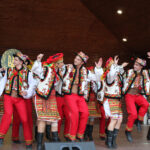
In a largely unadorned rehearsal room at Dance Space in Brookland, where you can hear Metro trains passing on the tracks outside, dancers worked intently on their moves in preparation for a benefit performance at Glen Echo and a long-planned engagement at the National Cherry Blossom Festival. Some dances, like the Hopak, included male dancers doing deep squats and kicks, while others, like the Kozachuk, involved men spinning while holding their female dance partners aloft. The dancers glistened with sweat from the effort.
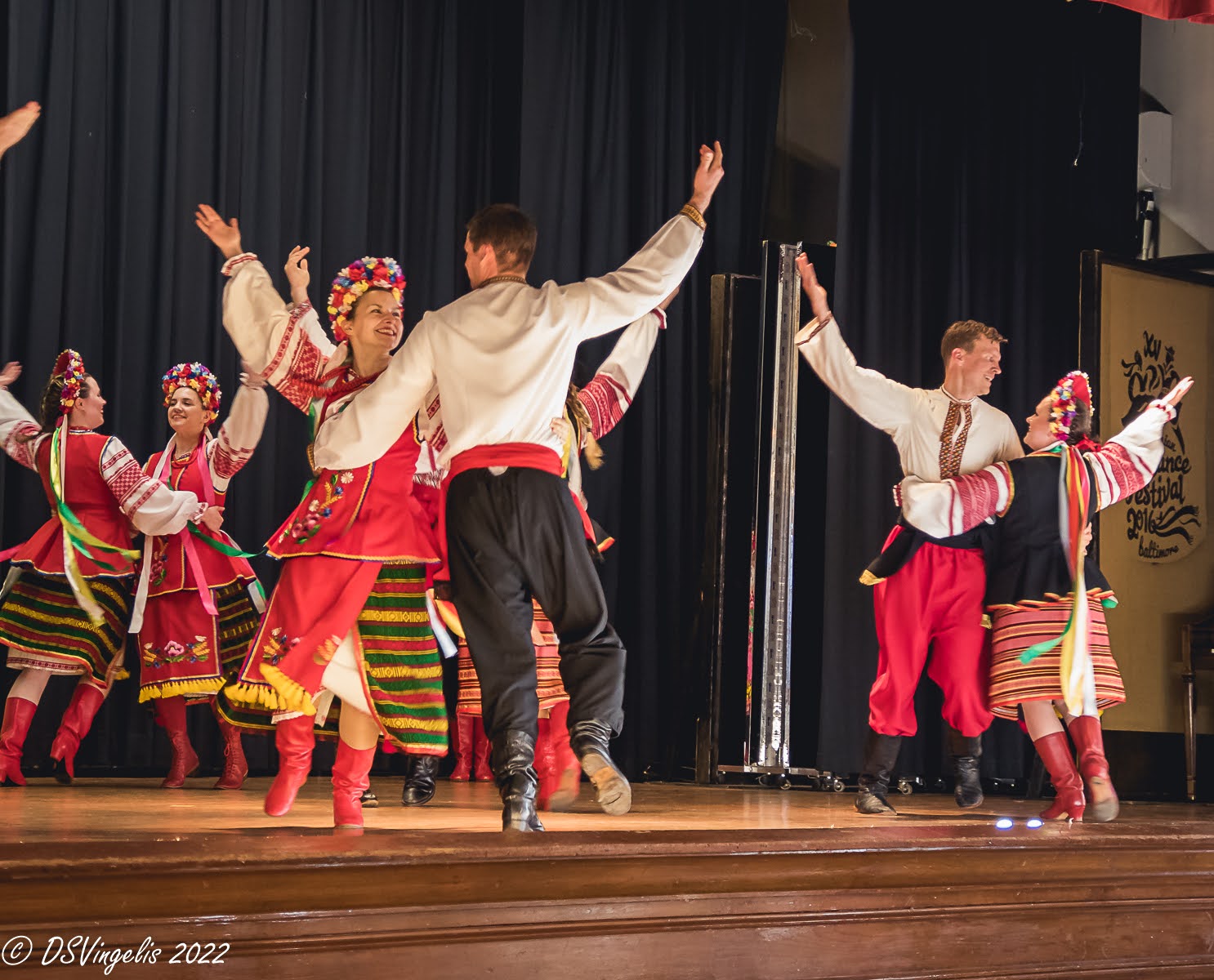
Hanging in the air, however, were the on-going hostilities in Ukraine that most of the performers say have given their dancing a renewed sense of purpose.
“There are different ways to fight this battle,” says Roxolana Wynar, who characterizes her dancing as a form of resistance against the Russians. The Arlington resident is the child of Ukrainian refugees who left the country during World War II. She says she has family and friends in Western Ukraine who are supporting the country’s war effort, including taking in internally-displaced people who were forced to leave their homes and sewing uniforms for the military.
Carpathia’s repertoire spans the former Soviet bloc, including the Baltics, Czech Republic, and Poland. For its benefit performances, the group has focused on Ukrainian dances as well as ones that have some connection to the country, including those from Bulgaria, Poland, and Romania.
“When you watch this stuff on the news, you feel very helpless, you can’t do anything — even just going onto a website and donating some money, it doesn’t feel like you’re doing very much,” says Reisser, who founded Carpathia in 2011. “With this, not only are we raising money, but [we’re] creating a space where we can do something about Ukraine that [isn’t] only images of damaged buildings and people fleeing the country.”
The Washington and Baltimore area is home to the fourth-largest community of Ukrainians or people of Ukrainian descent in the U.S., or some nearly 37,500 people in 2019, according to the latest Census data. Only the New York City, Chicago, and Philadelphia areas have larger communities.
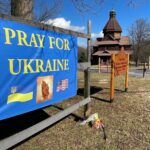
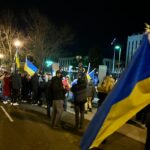
Carpathia’s performances are just one way groups are promoting everything Ukraine across the Washington region. There are rallies, volunteer opportunities at some of the region’s Ukrainian churches, and Arlington’s sister-city partnership with Ukraine’s Ivano-Frankivsk.
Carpathia has raised more than $22,000 for D.C. Chef Jose Andres’ disaster relief organization World Central Kitchen and the Catholic charity Caritas that is doing relief work in Ukraine.
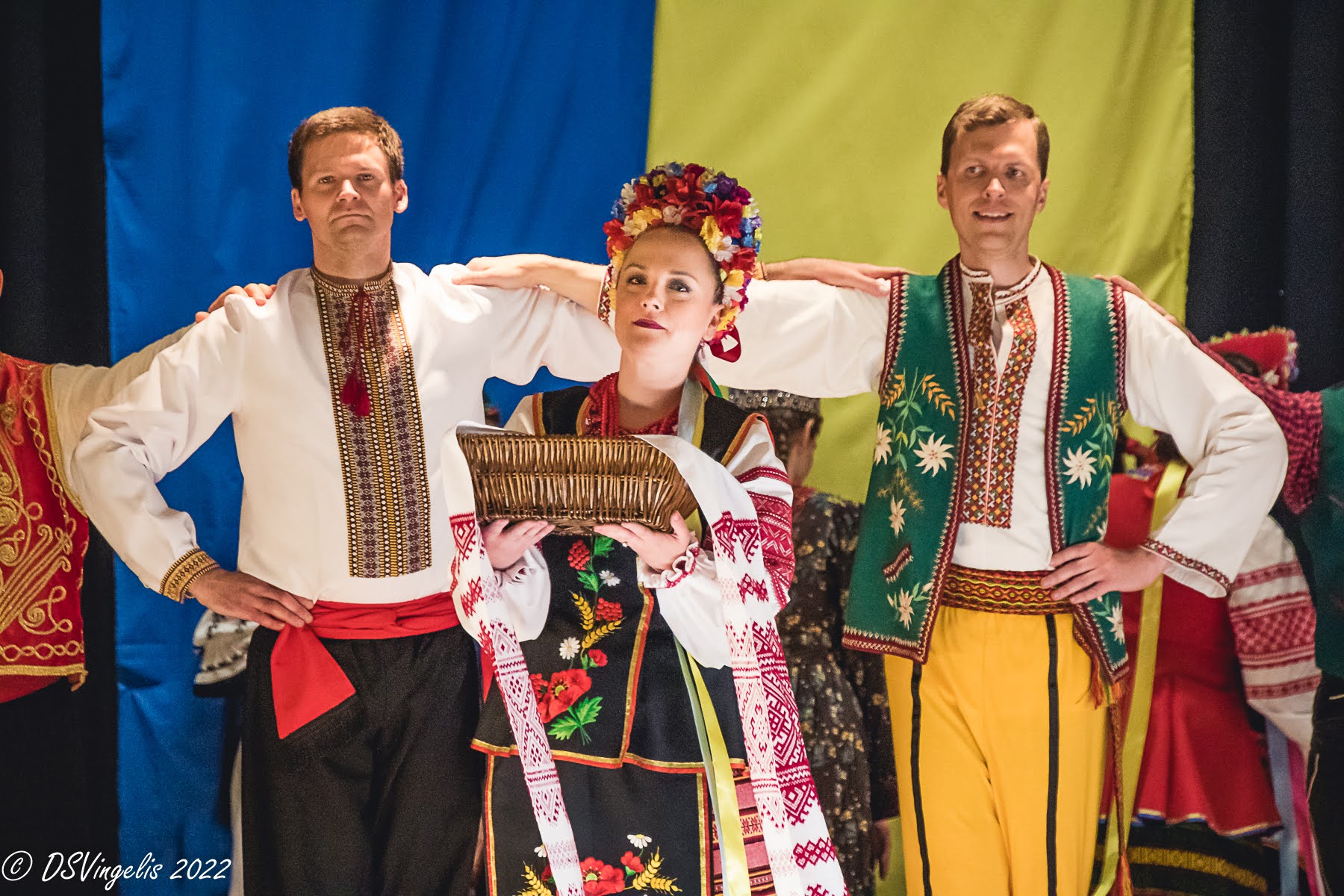
One of its benefit shows was at the Lithuanian Hall in Baltimore earlier this month, where Carpathia was joined by Tisza Hungarian Ensemble, Mituva Lithuanian Folk Dance Ensemble, and Ukrainian a capella group SPIV-Zhyttya. Dances included the Privit, a welcome dance that includes an offering of bread, and the Hutzul Suite where dancers with interlocked arms spin in a large circle. Lithuanian Hall provided the space free of charge for the performance and sold Eastern European beers and Ukrainian cabbage rolls after the show.
“Ukrainian culture is always confused with Russian culture,” Irina Douda says at the rehearsal. She hopes that the group’s dances will, in one small way, help people understand that Ukraine has its own unique and distinct culture. The Maryland resident was born in Ukraine and raised in the U.S. and still has family — all safe, she says — in the country.
Carpathia member Yaryna Onufrey’s parents emigrated from Ukraine and she says she has family in Lviv, the hub of Western Ukraine, and one cousin fighting in Kyiv. She hopes that these dances show another side of Ukraine, one that’s harder to see these days.
“I also hope that [people] have fun. This is a form of dance that’s very lively,” she adds.
To find out more about Carpathia and their upcoming shows visit their Facebook page. The group is scheduled to perform at the Kennedy Center’s Millennium Stage on April 1, and a sold-out benefit show at All Souls Church Unitarian in Washington, D.C., on April 3. Additional shows are planned in the coming months. The group is also accepting new members.