Martin Austermuhle
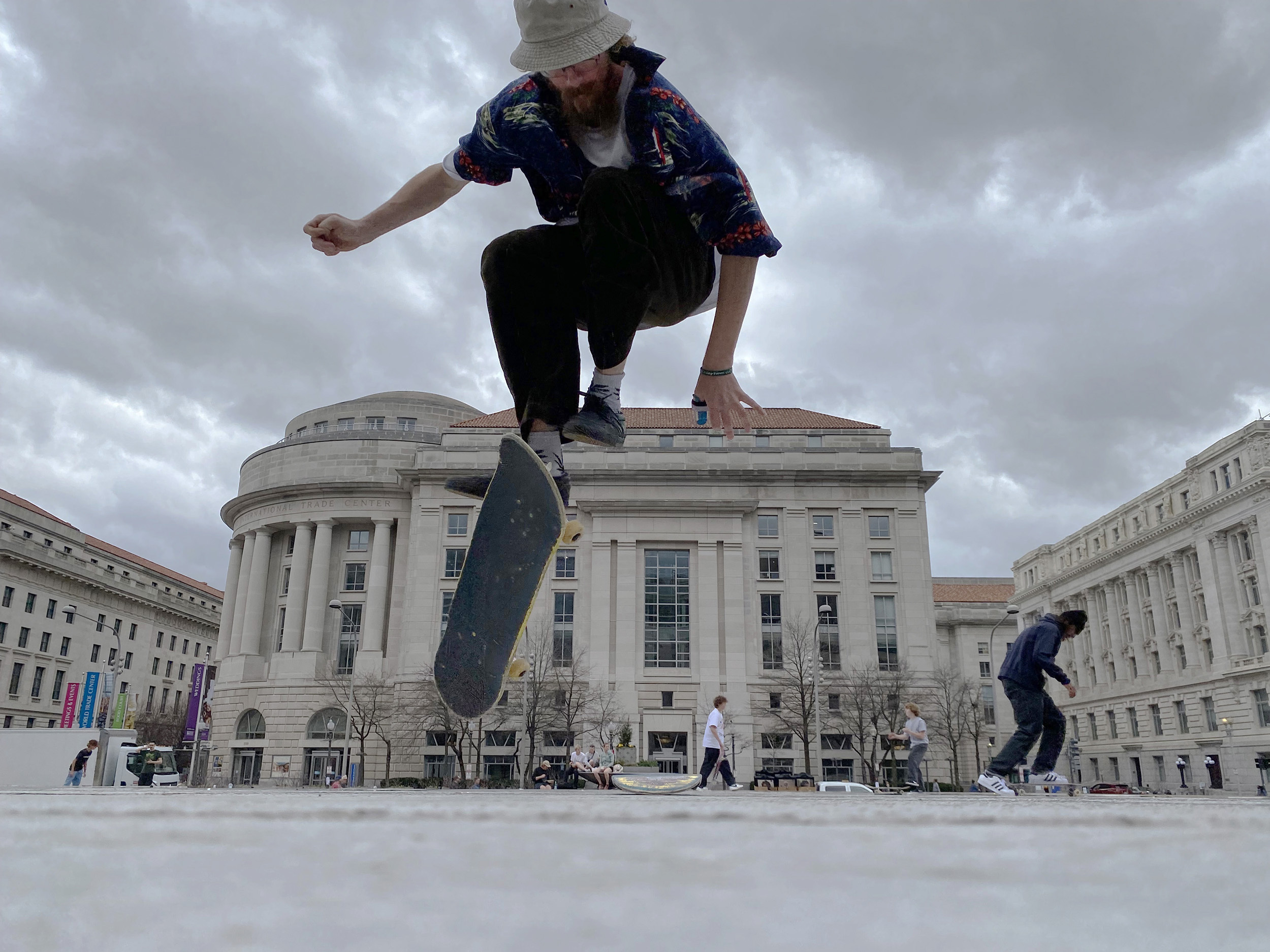
Mikey Payne takes a short running start, propelling his skateboard quickly forward along the clay-colored granite surface on the eastern edge of Freedom Plaza.
In a seamless motion, he flicks his skateboard onto a knee-high marble ledge, balancing precariously along its worn edges. He rapidly kicks the skateboard around in a fluid 180-degree spin, briefly holding upright before a final twitch of his feet brings him back to the plaza’s floor.
“It’s hard as hell,” he tells another skateboarder of the move, known as a 50-50 to 180 back into a switch 50-50.
Payne, 29, has had years to perfect it. He’s been skateboarding for the better part of two decades, and almost everything he’s learned he picked up at Freedom Plaza, the block-long expanse of white and gray marble that sits just above Pennsylvania Avenue in front of the Wilson Building and National Theatre.
“This is the first place I had ever seen people skateboard,” he says. “And this was the first place I started skating.”
But Payne and other skaters are now concerned that a place they refer to as the “mecca” of D.C.’s skateboarding scene may have its days numbered. A recently unveiled plan from the National Capital Planning Commission proposes significant changes to the plaza, largely to make it welcoming to more people. Some of the skateboarders worry that in trying to appeal to everyone, planners may destroy the unloved space they have adopted as their own.
“It would totally disrupt the street skateboarding culture,” says Payne of possible changes to Freedom Plaza. “It would have a very heavy impact.”
‘A desolate island’

Originally conceptualized as a grand gathering place and physical commemoration of Pierre L’Enfant’s design of Washington (a map of the city’s monumental streets are inlaid in the marble), the 42-year-old Freedom Plaza has more often been derided as a good idea that was poorly executed. Denise Scott Brown, the plaza’s designer, said as much in a 2020 interview with Greater Greater Washington, calling the space a “failure.”
While it often hosts protests, 5K runs, and the occasional festival, Freedom Plaza doesn’t often draw tourists or office workers out on their lunch breaks. There’s virtually no shade to escape D.C.’s summer heat, a fountain on the western edge isn’t often working, and people walking across the plaza rarely realize they are treading on a map of the monumental city.
“It’s a desolate island in a way, with very few amenities, very little shade, and it doesn’t really engage its adjacencies very well, i.e. the commercial uses to the north or even the more civic institutional uses to the south,” says Elizabeth Miller, the director of physical planning at NCPC, the federal planning commission for the capital region.
That’s not an outlier opinion.
The plaza’s shortcomings were even evident to a group of 13-year-old D.C. students interviewed by the Washington City Paper in 2016; they declared the space “too gray,” “boring [and] cold,” and lacking in its own identity. “It looks like it doesn’t know what it wants to be,” said one student.
Elizabeth Emerson, an architect with D.C.-based EL Studio who studies the areas where local and federal spaces intersect, is similarly critical. “As a comfortable, commodious space, a place to to stop and linger, it’s not great,” she says.
For years there have been murmurs of changes to come, and last month they were made public. As part of a broader plan to liven up the stretch of Pennsylvania Avenue running from the White House to the U.S. Capitol, NCPC is similarly contemplating redoing Freedom Plaza — which it says “is surrounded by streets and lacks the human scale and comfort elements that sustain consistent daily activity.”
NCPC’s three proposals would focus on bringing Freedom Plaza down to street level, adding more trees and shading features, and breaking up the plaza into smaller and less-imposing segments. In one vision, a slimmed-down Pennsylvania Avenue would diagonally bisect the plaza, creating two separate spaces — one aligned to the Wilson Building to the south, the other to the National Theatre to the north.
The goal, as with the broader plan to change Pennsylvania Avenue, is to bring more life to a part of the nation’s capital that feels left behind and stale.
“It’s kind of lost its zest and its vitality,” says Miller.
‘The skateboarding mecca of D.C.’
For Darren Harper, though, Freedom Plaza is as vital today as it was when he first discovered it more than three decades ago. Now 40, Harper can remember how in his younger years the plaza attracted legions of skaters, a medley of locals drawn to the plaza’s open spaces and hardscape obstacles. (It was also a draw for U.S. Park Police who chased away skaters; skateboarding on the plaza is technically illegal.)

“When I came down here in the 90s, I would catch the 32 bus coming up Pennsylvania Avenue and I could see people skating from [National] Archives coming all the way down the street, and it used to give me the chills,” he says. “This is the skateboarding mecca of D.C.”
Now a star in the world of skateboarding, Harper was then just a kid looking for a way to escape a difficult childhood — and he says skateboarding at Freedom Plaza was exactly where he escaped to. (He now brings his own daughters to the plaza; they’ve become viral sensations in their own right.)
“When I was growing up in Southeast D.C. I had all the drugs, the violence, I was surrounded by all of that, living in poverty, mom on welfare,” he says. “Through all those trials and tribulations I was able to come down here and all that negativity would go in the back of my mind. Skateboarding saved my life.”
And what makes Freedom Plaza so good for skateboarding, says Harper, is exactly the things that some of the plans for changing it would get rid of. “What attracts the skaters is the marble, the flat ground, the big area,” he says. “Skaters are big on stone, marble plazas, and this is almost one of the last ones left. This is the dying breed of places.”
Skaters forlornly remember the plazas that once were: LOVE Park in Philadelphia, redone in 2016; Lincoln Square in Melbourne, Australia, demolished the same year; Brooklyn Banks in New York City, shuttered during the pandemic; and more.
“It’s really unique,” says Payne of Freedom Plaza. “You have a downtown-sized block that’s full of really nice marble. I do get it how people get bummed on it getting skated, but there are people who travel literally all across the world just to skate this one block.”
It’s a block so central to skateboarding’s identity in D.C. that skaters long ago gave it a new name known the world across: Pulaski Park, a reference to the statue of General Casimir Pulaski, the Polish nobleman who fought in the Revolutionary War, on the plaza’s eastern-most end.
Many skaters also take pride in the fact that in a town with an outsized federal presence, they reclaimed an underused federal space for a local subculture. “We took use of a space that no one was really even using that much. We adapted like human beings do, like we’re on top of the food chain and put it on our plate to eat,” says Payne.
Miller of NCPC appreciates that skateboarders have taken to Freedom Plaza over the years, but she also says that the space needs to work for more people, and that some users may be put off by the skateboarding — much of which takes what few places there are to sit.
“I’ve been out there many a weekend, very much entertained and watching the activities that take place and grateful that there’s some activation in the space,” she says. “But on the other hand, it belongs to the city, it belongs to the region, and it belongs to the nation. So there is a lot of different users that we need to think about, and there’s the everyday users. We hope that we’ll get some people back downtown working and they’ll go out there for lunch and that they can have a comfortable place.”
A call to action
By his own admission, Brian Aguilar never much stirred the pot, politically at least. But when the 30-year-old Silver Spring native and owner of Crushed Skate Shop — the last remaining skate shop in D.C. — heard of the possible changes to Freedom Plaza, he dashed off an online petition urging supporters to let federal planners know “that this monument needs more love, support, and care… instead of ‘eliminating & replacing’ such an important piece of history!”
Within two days, more than 5,000 people had signed the petition; as of this week it’s at more than 10,100. “Skaters and a lot of the folks like protesters… a lot of these fights that are brought up get overlooked,” he says. “This petition means so much just to make sure we have their attention.”
It did just that: NCPC took notice, and got in touch with Aguilar to organize a meeting with the community.
“We’re really happy to have this conversation and hear about their feedback, and also just fill in some of the gaps, maybe as to the timeline and kind of calm some of those immediate fears, possibly that that this might be happening faster than it actually is,” says Karin Schierhold, a community planner with NCPC.
Schierhold says the goal is to stress that NCPC’s first proposals are just that — ideas — and the current 120-day public comment period will inform future designs. (There are three planned public sessions on the designs: April 13, April 26, and May 21.) Even after those are done, there’s plenty of process left to play out; Freedom Plaza isn’t likely to change anytime soon. And many skaters themselves admit that while they hold tight to what Freedom Plaza is, they recognize that improvements could be made.
“I like it as it is, but I believe that it could use some love. There are lights that don’t turn on, outlets that don’t work, there’s the beautiful fountain they never turn on. I think Freedom Plaza deserves more love. I would like it to be as is and get a nice renovation,” says Aguilar.
Emerson, the architect, says Freedom Plaza should be made smaller and more intimate, and also be brought down to street grade. But she thinks that doesn’t have to forsake the skaters who have adopted the plaza as their own.
“They’re actually not sitting across the big open space. They like the edges, right? They’re filming each other doing these long trailing shots. So I would think about, how do you make these inside edges accommodate the way they use the park, but deal with the other stuff separately,” she says.
Gerren Price also has his own interest in Freedom Plaza. He’s the acting president of the Downtown D.C. Business Improvement District, which includes the plaza. He says the BID wants to make the space more lively and vibrant, but adds that skateboarders can be a part of that. “Anything that is meeting the needs of the community that’s responsive to as many people as possible and that’s helping to make like a more vibrant and just engaging space we’re all for,” he says.
Harper hasn’t yet made up his mind about possible changes to Freedom Plaza. But he says losing even a part of it would be hard; beyond the design and legacy of the space, he says it’s centrally located and simply bigger than the few dedicated skate parks that D.C. has built, one in Shaw and the other next to RFK Stadium (which, ironically, was designed with elements modeled on Freedom Plaza).
“This place is kinda like my neighborhood. It’s a breath of fresh air. This is my heart, my home. I wouldn’t want to skate anywhere else,” he says. “The thought of losing this place, I don’t even want to think about it.”