Avery Kleinman
D.C.’s alt-weekly newspaper Washington City Paper announced Friday that it is ending print publication and laying off five members of its staff. The final free print edition will be published on May 5.
The lay-offs cut the current editorial staff significantly, from 11 to six, and include Darrow Montgomery, who’s worked at the paper since 1986 and held the position of staff photographer since the early 2000s. Sports editor Kelyn Soong, City Lights editor Ella Feldman, creative director Nayion Perkins, and director of classifieds, human resources and circulation Heather McAndrews are also losing their jobs.
“This was a difficult but necessary decision, and one that many of our peer publications nationwide have had to make over the past decade,” City Paper wrote in a statement on Twitter. “We will continue to cover the critical political and cultural news of Washington, as we always have, online. We will continue to hold events, and we will occasionally publish special print editions. The same important journalism that has shaped our 41-year-history will live on.”
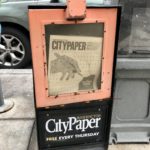
The end of regular print publication followed a shift from weekly editions to monthly in 2020, which meant the “Free Every Thursday” statement that emblazoned the paper’s pick-up boxes throughout the city no longer rang true. At the time, the change was billed as a temporary cost-saving measure resulting from the financial hit of the pandemic.
Local journalists, many of whom have worked for Washington City Paper, reacted with dismay to Friday’s news. While they may have seen the end of print on the horizon, many were surprised by the firing of long-time staff-photographer Darrow Montgomery.
I worked with lots of geniuses @wcp, but there was no one whose judgment I trusted more than @Darrow_M. I lived in fear that he’d pan some story or idea or scheme of mine. A magnificent photographer of DC, but also a conscience for generations of writers & editors. This sucks! https://t.co/A4J3yVQ6Il
— Michael Schaffer (@michaelschaffer) April 1, 2022
“What gives a publication an identity isn’t just the writing, the ability to cover breaking news or investigative reporting, it’s also the person behind the camera,” former City Paper reporter Jason Cherkis told DCist/WAMU. “They reveal the city in a way that reporting can’t sometimes, and Darrow did that better than anyone else in the city. I considered him the best reporter in the city.”
Montgomery declined an interview request from DCist/WAMU.
The cutbacks leave the staff less diverse in terms of age and race, something the soon-departing creative director Nayion Perkins referred to in a statement on Twitter, in which he pointed out that he is “the only black member on the editorial staff and a native of D.C.”
“I feel like while I was working hard to represent DC, I was ultimately deemed as invaluable,” he wrote. “Ultimately if we want our stories to be told, and keep our communities informed, we have to do it ourselves.”
Perkins wrote that he was hired only six months ago, under the pretense that print publication would continue for the foreseeable future.
“To say online and social media sites such as IG are your strengths, but to cut your photographer and people who deal with arts and imagery makes no sense,” he wrote on Twitter. “It puts the remaining staff in a bad position, who are already stretched thin.”
Local businessman and philanthropist Mark Ein purchased Washington City Paper in 2017 for $50,000, according to Washingtonian. He was the first local owner in more than 30 years. Former editor-in-chief Alexa Mills described the team as “overyjoyed” by the sale.
“Every thriving community, which I think we have in Washington, needs strong local journalism,” Ein said at the time, “and the City Paper has been an important part of D.C. for four decades and I wanted to make sure it would be an important part for the next four decades.”
“I think his demonstrated actions have over the last two years been very different than what he said about the paper when he bought it,” said Morgan Baskin, a former housing reporter and editor with the paper. “To see the news laid out is horrifying and shocking, but to have experienced what it was like to work on staff, on some level, no, it was not a surprise.” Baskin was formerly employed by DCist/WAMU.
What’s the point of very rich people owning media outlets if they’re not willing to spend excessively to sustain a public good? Kind of like ordering a milkshake then complaining that it’s not broccoli. @Darrow_M @nayion202 @ellamfeld @KelynSoong https://t.co/ZBuXczH5pf
— Justin Wm. Moyer (@justinwmmoyer) April 2, 2022
City Paper’s financial woes reflect a nationwide trend. Alt-weekly newspapers across the country have halted print production, lost staff, and ceased production altogether, including the Baltimore City Paper in 2017.
Former Washington City Paper editor and columnist Erik Wemple, who now writes about the media for the Washington Post, blamed the decline partly on the loss of ad sales. He recalled when people would walk into the office to buy classified ads in the 1990s.
“It was like a steady parade of D.C. types just coming in, paying in cash for their classified ads. You could see the money rolling in through the front door,” he told DCist/WAMU. “It’s hard to fault the leadership of the paper for failing to make a go of it. It’s really tough.”
Washington City Paper will continue to publish online, “where the vast majority of [its] audience already consumes [its] journalism,” according to its statement.
“It’s kind of an amazing kind of proving ground for young reporters, I think it still is. I think it’s just a smaller publication,” Cherkis said. “They’ve proven that with a small staff and smaller budgets, they can still kick ass with the best of the reporters around.”