Amanda Michelle Gomez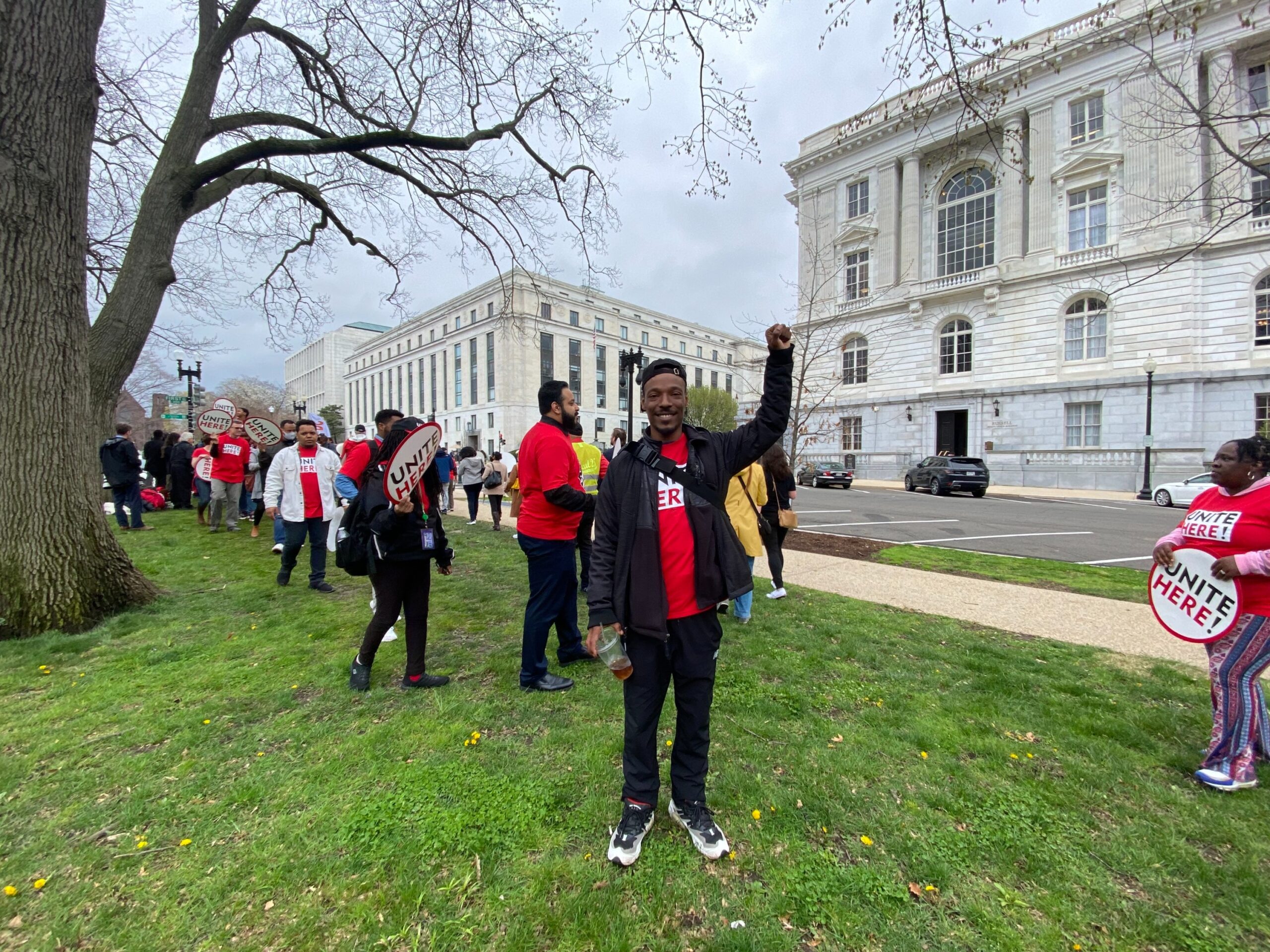
Quentin Blackman was prepared to be laid off from his food service job at the U.S. Senate come April 15.
In a last-ditch effort to save his job, Blackman joined colleagues and their supporters to picket outside the Senate office buildings for several hours Wednesday afternoon.
“Care for your employees,” he said, as people chanted behind him. “We’re the people that actually help move your business.”
“Even with these jobs being maybe looked at as somewhat small of a job,” he continued, “they’re still just as important as the next person who does make a lot of money and has those benefits from their job.”
Blackman is among the 175 workers who ensure some of the most powerful people in the county are fed. They man the Senate cafeteria and U.S. Capitol café. Because funding for these jobs is running out, nearly half the workforce, or 81 people, would be laid off in one week’s time — unless senators dedicated more dollars.
The Senate had previously dedicated COVID-19 relief dollars to avoid layoffs when Capitol Hill was void of legislators, much less visitors. When those dollars dried up, Restaurant Associates, the private contractor that technically employs the Senate food service workers, issued layoff notices.

These workers are organized through their labor union, UNITE HERE Local 23. That union backing helped empower a group of workers to leave the cafeteria on Wednesday for senators’ individual offices to plead for their jobs and then demonstrate publicly in front of the Senate office buildings. Near the end of the informational picket, which lasted more than two hours, various senators joined the crowd of a few dozen people to announce they had identified funding to prevent immediate layoffs. Senators acknowledged they had found temporary solutions to longtime problems.
“As a result of your efforts, a deal is close or will or has been reached,” said Vermont Sen. Bernie Sanders. “Your jobs are going to be protected.”
“The money’s been found. Nobody is getting laid off,” added Minnesota Sen. Amy Klobuchar, who also offered a plan on how to get the cafeteria more patrons so their jobs aren’t dependent on relief dollars.
The senators were light on the details at the picket. In a letter to Senate leadership dated April 2, Ohio Senator Sherrod Brown called for funding to save the food service jobs to be included in the COVID-19 supplemental bill, which remains stalled. Massachusetts Sen. Ed Markey, among the senators present to announce the deal, deferred questions to his staffer. When approached at the picket, the staffer pulled out his phone to show a tweet from Roll Call reporter Chris Cioffi, which says $3.75 million in already-appropriated pandemic funding can be redirected to save workers’ jobs, citing a Senate Democratic aide. Dollars will be appropriated to the Capitol’s Office of the Architect, which oversees all restaurants including those managed by Restaurant Associates, according to reporting from The New Republic. Senators Elizabeth Warren of Massachusetts and Cory Booker of New Jersey told TNR that Restaurant Associates can only dip into these funds to prevent layoffs and these dollars only last for roughly five months.
Meanwhile, workers via Local 23 have been in contract negotiations with Restaurant Associates, having formed their union last fall. Among the union’s top priorities is affordable health insurance. Currently, only 18% are enrolled in employer-based insurance because coverage is too expensive considering their low wages, according to Local 23. A union spokesperson, Diana Hussein, tells DCist/WAMU the Senate has the power to fund contract priorities.
Blackman qualifies for Medicaid, so accesses health insurance through the public program instead of his employer. Meanwhile, Blackman’s colleague, Luz Villatoro, says she is uninsured.
“Because when I had health care on my own,” Villatoro said in Spanish as she picketed, “I would pay too much money.”
Not only was her employer-based insurance eating into her wages, she said the benefit didn’t cover enough of her medical expenses when she used it after being diagnosed with diabetes during the pandemic. When she went to the doctor’s office to treat her chronic health condition, Villatoro says she incurred significant out-of-pocket costs. She received a $1,500 medical bill, much to her surprise because she had insurance through work at the time. Her 12-year-old now has to access health care through the government.
“God willing that the senators will help us,” she told DCist/WAMU.
Local 23 and Restaurant Associates reached a tentative agreement on Wednesday, as first reported by Roll Call — but the Senate would need to partially cover associated costs. The deal includes a $5.60 pay increase, access to platinum insurance, meaning the cost to the employee would be $30 for a single person per month or $80 for a family, and a company-funded pension.
Members of Congress assured the food service workers on Wednesday that preventing mass layoffs was the first of many actions they’d be taking in the coming weeks to improve their jobs. The legislators applauded their efforts, including working during a global pandemic and the Jan. 6, 2021 insurrection. Several also thanked them for forming a union to advocate for their needs.
“How dare we say we support worker protections, we support workers’ rights and we won’t support the ones that are right in the buildings with us,” said Congresswoman Cori Bush of St. Louis, Missouri.