Martin Austermuhle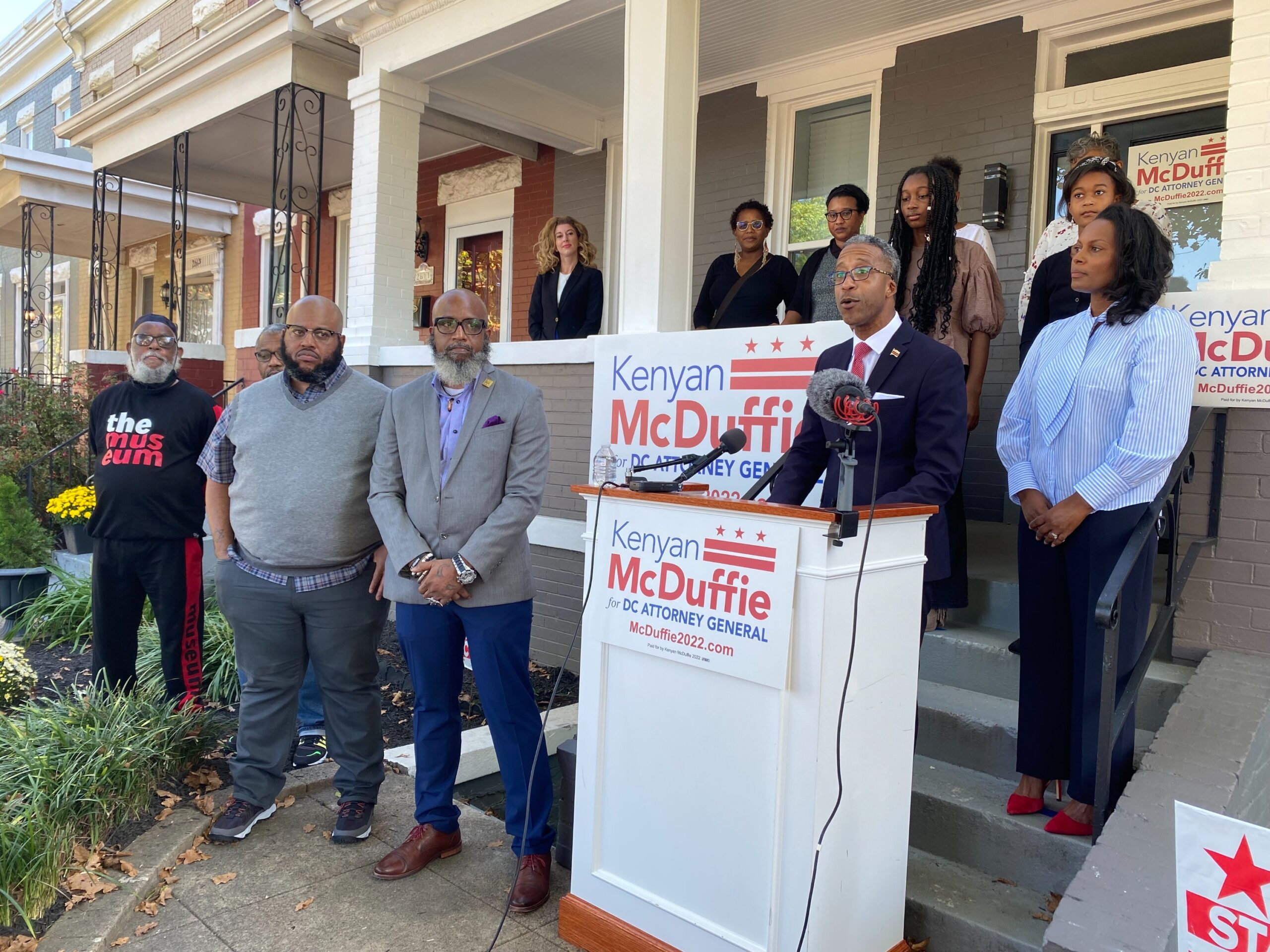
The D.C. Board of Elections dramatically shook up the race for D.C. attorney general on Monday, ruling that frontrunner Councilmember Kenyan McDuffie (D-Ward 5) does not meet the qualifications to run for and hold the office.
The unanimous ruling from the three-person board came in the wake of a challenge from fellow candidate Bruce Spiva, who argued in a filing late last month that McDuffie did not meet the legal requirement that anyone running for attorney general have been “actively engaged, for at least 5 of the last 10 years as an attorney in the practice of law in the District of Columbia.”
While McDuffie is a member of the D.C. Bar and had prior to 2012 acted as a trial attorney, Spiva said that his decade worth of council service since then did not equate to being “actively engaged” as an attorney. Speaking on Monday afternoon, Gary Thompson, the board chairman, agreed.
“The position of D.C. councilmember, while it certainly helps to be an attorney, it’s not one that one is necessarily an attorney, [and] does not have to be an attorney,” Thompson said. “I’m persuaded that the candidate does not meet the qualifying language of the statute.”
In a statement on Monday afternoon, McDuffie pledged to appeal the ruling.
The question as to McDuffie’s qualifications had been quietly percolating for months, with some in his camp dismissing it as a desperate attempt by his opponents to derail a potent candidate who has swept up endorsements in his quest to succeed Attorney General Karl Racine. It even prompted a Washington Post op-ed from two former councilmembers, who wrote that Spiva’s challenge was a “cynical distraction and meritless.”
In arguments to the board on Monday, attorneys for McDuffie tried to brush aside any questions as to his legal experience and practice during his term in office. “[McDuffie] is undeniably an attorney, and is employed in the District and by the District,” said Thorn Pozen, one of his lawyers.
Joe Sandler, another of McDuffie’s attorneys, argued that McDuffie had long used his legal education and experience in drafting laws, notably during a three-year stint serving as chair of the council’s judiciary committee. “I ask as a matter of common sense, can you imagine that job being performed by a non-attorney?”
But Thompson pointed out that non-attorneys serve on the council and also write laws; the judiciary committee’s current chairman is Councilmember Charles Allen (D-Ward 6), who is not an attorney. Additionally, Ted Howard, an attorney for Spiva, said that while McDuffie is an attorney and is employed by D.C., he is not employed as an attorney for D.C.
“I think the folks who are in this legal community know what is meant when someone says he or she is a government lawyer. And that does not contemplate a councilmember or a congressman or senator, even though many of those folks have law degrees,” Howard said.
In a statement, Spiva’s campaign said it was pleased with the outcome.
“The people of D.C. deserve an attorney general who is ready on day one to take on the responsibilities of the office. That’s why the Council enacted, and District voters approved, these specific, minimum qualifications that Councilmember McDuffie failed to meet,” said Alaina Haworth, Spiva’s campaign manager. “The people of D.C. deserve an Attorney General who is a fighter, ready to stand up to the powerful and do what’s right — something Bruce has made clear with this challenge and has done his entire career.”
In his own statement, McDuffie blasted the board’s ruling.
“Let me be clear, today’s ruling was an attack on our democracy and on working people in D.C. Unelected bureaucrats, prompted by a frivolous challenge from a corporate lawyer, who is funding his campaign with the millions he made defending powerful interests like Facebook and Amazon, telling a lifelong District resident who has spent his career fighting for working families that he’s ‘not qualified’ is exactly what it looks like,” he said. “When you come from communities like mine and spend your career taking on the powerful, you get used to people trying to hold you back. But that just made me fight harder for communities like the one I grew up in.”
The council could also take up emergency legislation to clarify the qualifications for the office, but that could be perceived as lawmakers changing the rules late in the game to benefit a colleague. (McDuffie opted not to run for reelection in Ward 5 because of the attorney general’s race.) The elections board has to finalize the ballot for the June 21 primary in early May in order to start mailing ballots to voters later in the month.
The other candidates for attorney general include Brian Schwalb and Ryan Jones, who similarly raised concerns around McDuffie’s qualifications in an interview last month with DCist/WAMU.
“Are you actively engaged in the practice of law? The answer’s no because he’s a councilmember,” Jones said. “Want to know how I know that that’s not the practice of law? Because there are other councilmembers who aren’t attorneys who are doing that job. So are they engaged in unauthorized practice of law?”
The issue of qualifications for attorney general has been hashed out in other states. In 2006, Tom Perez (who served as Secretary of Labor under President Barack Obama) was disqualified from running for Maryland attorney general because he did not meet the requirement of practicing law for a decade before the election. In 2010, a Connecticut judge dismissed a similar challenge to the Secretary of the State’s qualifications to serve as attorney general there, broadly ruling that her work in that office counted towards the 10-year requirement of practicing law. But the state supreme court then reversed the decision, ruling the candidate ineligible.
It also goes back to when D.C. held its first election for attorney general in 2014, when Lateefah Williams, one of the candidates, tried to determine whether she met the requirements of being a practicing attorney for the time set out in the law. In a 2014 op-ed in The Washington Blade, she says she never got a definitive answer.
“It is absolutely outrageous that… a potential candidate cannot receive definitive guidance on a key qualification for the race. It should increase the outrage that the result may serve to silence a candidate who is a member of several underrepresented groups that otherwise will not have a voice in this race,” she wrote. Williams’ qualifications were never challenged, and she appeared on the ballot.
This post was updated with a comment from McDuffie’s campaign.