Margaret Barthel
The Arlington County Board voted unanimously to approve the second phase of Amazon’s HQ2 campus on Saturday, after the plans won approval from the county’s planning commission earlier in the month.
“The opportunity to not only provide something exciting for the near neighborhoods, but to lift up the entirety of Arlington County makes this project a joy to support,” said Board chair Katie Cristol just before voting on the motion.
With the Board’s vote, Amazon and developer JBG Smith have received the green light to develop PenPlace, the mostly-empty block bounded by Army Navy Drive, S. Eads St., S. Fern St., and 12th St. S in what is now National Landing. Previously, the block had been zoned for a hotel.
“We are proud to play a role in supporting the ongoing collaborative process, led by Arlington County, to create a more vibrant National Landing that is animated by local residents, business owners, students, workers and visitors to the region,” a spokesperson for JBG Smith said in an email.
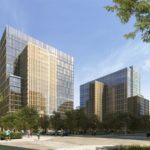
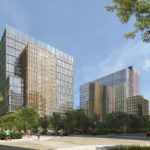
Under the new design plan, the 12-acre space will be developed to host 3.2 million square feet of office space, 94,500 square feet of retail space, and 26,500 square feet of public space. Also included are a child care center, public park, and a home for Arlington Community High School – an alternative high school serving roughly 300 students which has never had a dedicated space of its own.
“With the County Board’s approval, we look forward to continuing our work with the community as we take the next steps on this journey to build an integrated, innovative, and sustainable second headquarters in Arlington, Virginia,” Amazon head of Global Real Estate and Facilities, John Schoettler, said in a statement after the vote.
Multiple public speakers, small business owners, and leaders from county commissions who weighed in on the planning process made remarks in support of the project, touting the public green space and the company’s work engaging with local businesses and nonprofit groups.
But a handful raised existing areas of public concern, including the impact of HQ2 on already-high housing prices in the neighborhood, the possibility of the public being subject to surveillance by Amazon’s private security, and criticisms that the county had not bargained for enough community benefits attached to the project.

In all, the PenPlace plan represents 1,697,764 square feet of additional density more than what was planned for the block by county planners, most recently in the Pentagon City sector plan, the updated long-term vision for the neighborhood. Green building, affordable housing contributions, and the addition of community facilities are all ways for Amazon to “earn” that necessary additional density from the county, per the report on the project prepared for the Board.
The office space in the plan is split into three 22-story towers and “The Helix,” a 355-foot twisty glass-and-green space spiral that looks a little like a soft-serve ice cream cone (or, as Twitter has unsurprisingly suggested… other things). It will hold meeting space, a conference center, an artist-in-residence program, and 25,000 square feet of “planting areas and living walls,” according to Amazon’s description of the project, posted by Schoettler. It is also designed to be bird-friendly, and the FAA says it is airplane-friendly, too. The company says it will open the structure twice a month to the public.
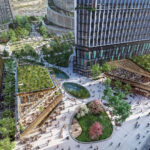
Arlingtonians can expect to be able to use other parts of the new PenPlace on more than just a bimonthly basis. The plans include 2.75 acres of public park space, “including immersive forest rooms, shaded seating groves, water features, and many native and pollinator gardens,” with over 100 native plant varieties, per Amazon. There will also be an amphitheater and a dog run. The space will be part of the Arlington parks system and controlled by the county, but it will be owned and maintained by Amazon.
Multiple protected bike lanes will be added to three of the streets bounding PenPlace, including a protected two-way cycle track along the south side of Army-Navy Drive and protected lanes on the east side of S. Fern St. and the west side of S. Eads St. For employees, Amazon also plans “more than 900 interior and exterior bike storage stalls, to encourage bike commuting over the use of single-occupancy vehicles.”
But that doesn’t mean no added car space. The 1,980 parking spaces and seven loading docks associated with the project will all be underground.
Sustainability is a major focus of the plans for the new campus. Amazon says it will power all HQ2 operations — PenPlace and neighboring Metropolitan Park, where the first phase of construction is already complete — with renewable energy, mostly sourced from a solar farm in Pennsylvania along with on-site rooftop solar panels. The buildings at PenPlace will be LEED platinum certified, and overall the plan received a 90% score from the Arlington County Climate Change, Energy, and the Environment Commission, meaning it “largely meets what is required to achieve the county’s carbon neutrality and other sustainability goals,” a letter from the commission to the Board states.

Amazon plans to contribute $30 million to affordable housing in conjunction with the PenPlace project construction, a community benefit which the county has hailed as a win for its commitment to racial equity. The $30 million “could allow the county to make investments in affordable housing in the vicinity of the project, thus increasing the income diversity in Arlington,” the Board report says.
Housing advocates and residents have long worried that Amazon’s arrival in Northern Virginia would worsen an already overheated housing market and push out low-income residents, a concern many shared even before the tech giant chose Arlington as its new home. Amazon has sought to assuage those concerns by making investments in creating and preserving affordable housing, including the latest $30 million pledge. Amazon’s help has increased affordable housing in Arlington by 22%, according to county data. But much of that work so far has been targeted at higher-income brackets than the lowest-income earners: just 215 of the 4,100 units involved in the effort so far have been set aside for people who make less than 50% of the area median income, a Washington Post analysis found.
This vote followed an extensive planning and public review process, after the initial designs were released in early 2021. They’ve been tweaked to address community feedback about everything from the project’s sustainability and outdoor space goals to the architecture of the office towers (the Helix, for its swoopy part, was “generally well-received” and received only minor changes, according to the report prepared for the Board).
Some community concerns about the project linger. At the planning commission meeting earlier in the month, locals raised questions about a variety of issues, including Amazon security and surveillance in public space, the desire for bike lanes on 12th St. S, and even the composition of native plants planned for the park. One consistent concern has been that the public space will in practice be for Amazon employees, not residents in general.
“Amazon will use its park as a recruitment and branding tool,” said Ben D’Avanzo, of the Aurora Highlands Civic Association. “It’s hard to feel like this park is truly the community benefit this site plan makes it out to be.”
Amazon, of course, says that won’t be a problem. “We’ve designed PenPlace to be part of the local neighborhood because we want both employees and local residents to enjoy the space equally,” the company’s project announcement claims.
County staff said there would be options for signage and design to help make clear to passerby that the campus was for public use.
D’Avonzo also expressed concerns about whether visitors to the park would be subject to surveillance of any kind by Amazon.
“If this park is going to be patrolled by private security or observed by security cameras that can track the identity of every user, that is a major chilling effect on free public use,” he said.
Representatives with the PenPlace project said surveillance would be focused on security within the office buildings, parking garages, and immediately outside of the buildings. County officials said they appreciated the concerns and would take them under consideration in future planning discussions — but also noted that it would be impossible to ensure total privacy anywhere in public places, including at PenPlace.
“Today, as we walk on the street, we are subject to surveillance and sensing from aerial drones, from ground robots or anyone who has a modern iPhone or equivalent who may want to surveil us,” Vice Chair Christian Dorsey pointed out. “And we have no recourse to stop that from happening.”
Many residents have also expressed frustrations over the added density the project represents — or called for the county to advocate for more community benefits in exchange for it.
County staff said the county’s requests for public benefits in exchange for added density are guided by zoning rules and the existing plans for the area.
Dorsey said some speakers who suggested the county had not gotten the best benefits package failed to account for the longer-term value of some of the assets the PenPlace plan would bring to the county, including the economic benefits of future Amazon employee spending in the area, and the first-ever permanent home for the Arlington Community High School.
He called the project overall “a benefit that will accrue not only for Arlingtonians today, but obviously for future generations.”
Dorsey and other Board members also suggested the project represented a way for the county to chip away at the local office vacancy rate and job losses after the departure of multiple federal agencies in past years — and thus begin to recoup lost tax revenue.
“This project is backfilling that hole,” said Dorsey.
Some questions about the effect on Arlington’s already-tight housing and rental market linger, too. Housing Commission member Michael Hemminger summarized concerns about the impact HQ2 will have on already-high housing prices in the neighborhood, and questioned whether the county had done enough to secure resources from Amazon to support affordable housing projects.
“While we’re confident that this proposal will sail through today,” Hemminger said, “I do ask Board members to consider the following: If you have kids or grandkids or nieces or nephews, I’m ultimately asking you to think about how those little ones and those that are not currently in our community, and how they will be able to one day afford to live in this community too.”
Heminger said his commission was asking for more details on how the county and Amazon landed on the company’s $30 million contribution to Arlington’s affordable housing fund as part of the community benefits attached to the project.
Meanwhile, multiple social services nonprofits, including Doorways, which serves people experiencing homelessness and domestic violence, and Bridges to Independence, which helps low-income residents in the nearby Green Valley neighborhood, spoke on behalf of the project, pointing to support they had already received from Amazon as evidence of the company’s interest in investing in the Arlington community writ large.
The vote on the PenPlace project came in the same week that Amazon said it had hired 5,000 employees associated with HQ2, according to Washington Business Journal. That’s just a fifth of the way to the 25,000 employees expected to be on site by 2030 — at least if Amazon wants to take advantage of the $550 million in cash grants offered by the Commonwealth of Virginia if it hits that hiring goal. The company has not indicated what percentage of new hires it hopes will come from residents of the region.