Martin Austermuhle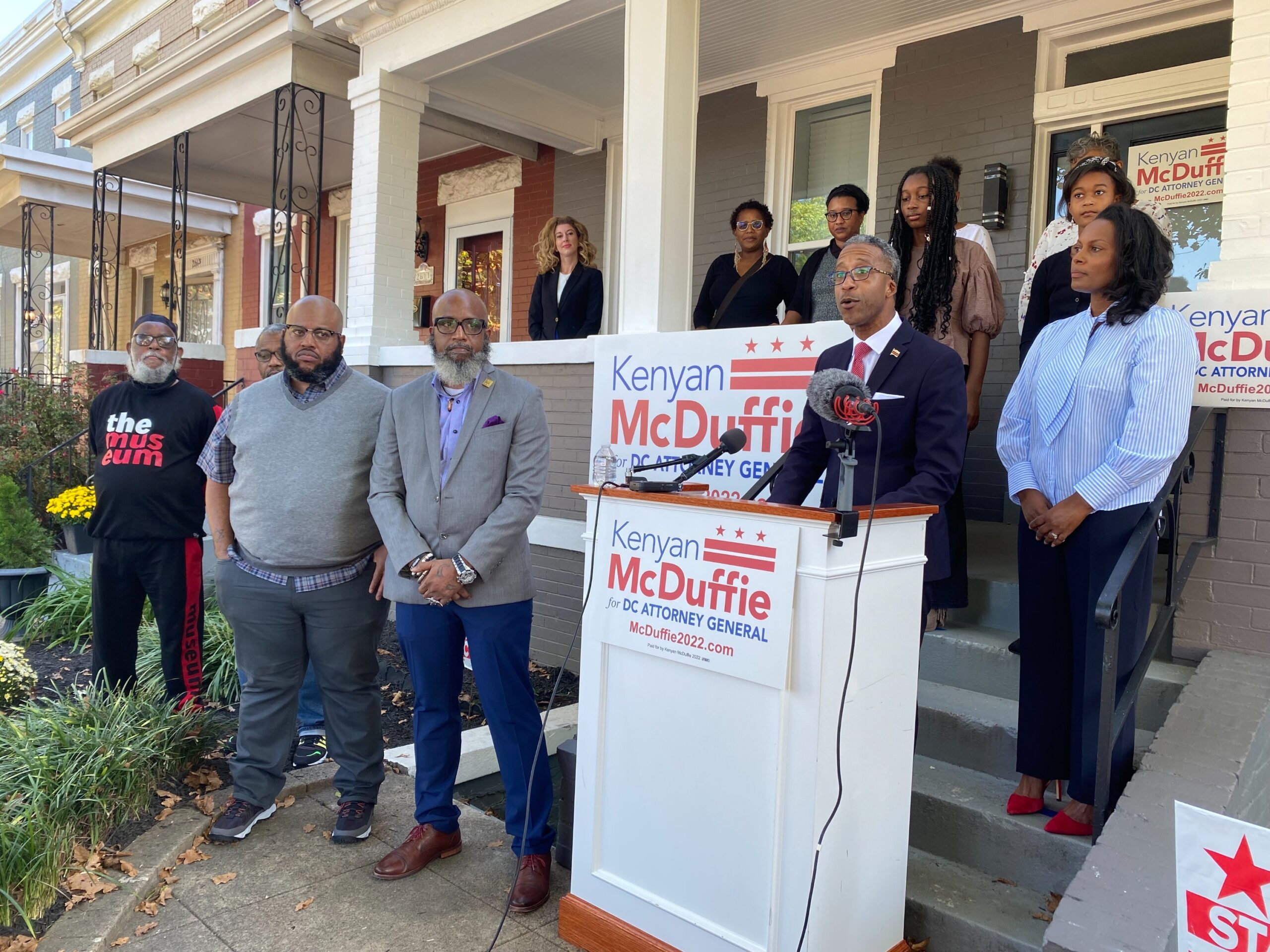
A three-judge panel of the D.C. Court of Appeals heard 90 minutes of arguments on Wednesday in D.C. Councilmember Kenyan McDuffie’s (D-Ward 5) bid to be put back on the ballot for attorney general, after the Board of Elections deemed him ineligible to run last week.
The board ruled that McDuffie — who has served on the D.C. Council for a decade — did not meet a requirement laid out in D.C. law that a candidate must have been “actively engaged… for at least 5 of the 10 years” as an attorney. McDuffie’s team disagrees, saying that he employed his legal skills while working as a lawmaker and that the city’s statute should be read broadly.
Wednesday’s arguments and questions largely revolved around how D.C. law defines “actively engaged,” with attorneys for the elections board and Bruce Spiva — a fellow candidate for attorney general who challenged McDuffie’s qualifications — saying it meant a person was taking part in traditional legal activities, like representing clients in court.
Baruch Weiss, McDuffie’s attorney, countered that a sub-provision of the law clarified that an “attorney employed in the District of Columbia by the United States or the District of Columbia” — like an attorney who is elected to the council — would meet the threshold of active engagement.
But that broad reading drew probing questions from Judge Catharine Easterly, who inquired whether an attorney who takes a job as a D.C. Public Schools teacher would be eligible to run for attorney general.
“Do you think that the council was referring to anyone who is an attorney who happens to be also employed in the District by the District of Columbia?” she asked. “Or do you think… that they are saying, ‘No, you actually have to have experience working as a lawyer for the District of Columbia,’ which seems to me the far more sensible reading of that language.”
Weiss responded that the law only requires that a potential candidate has been “engaged” as an attorney, not explicitly employed as one. He also said that when the council wrote the qualifications for attorney general into law in 2010, “they didn’t want to rule themselves out.” Earlier this week, seven current and former councilmembers submitted a brief making that very argument.
But Judge Easterly seemed unpersuaded. “The fact remains that it’s 12 years later,” she said of their recollections, adding that the council’s legislative record provided little guidance on what lawmakers at the time intended.
A more permissive reading of the city’s qualifications law seemed to come from Judge Phyllis Thompson, who largely stayed quiet during Weiss’s arguments but pushed back when attorneys for the board and Spiva presented their case. She pointed to the qualifications to be a D.C. judge, which include employment as an attorney.
“And yet that language doesn’t appear in the statute with which we’re concerned. It seems to me that the strongest argument as to why the [attorney general] statute means something different is that there is a glaring omission of that language that appears in the judge statute, ’employed as a lawyer,'” she said.
Judge Thompson also asked Ted Howard, an attorney for Spiva, why the matter of qualifications would have to be litigated at all, echoing an argument from McDuffie’s side that the ultimate decision should come at the ballot box. “Why isn’t it a voter issue to determine whether Mr. McDuffie or the school teacher brings the relevant experience to be attorney general?” she asked.
“The imposition of minimum requirements… is characteristic of governments across the country,” responded Howard.
In her own arguments to the court, Christine Pembroke, an attorney for the elections board, urged the three judges to defer to the board’s ruling. If it were overturned, she said, the board would be left having to decide on a case-by-case basis who qualified to run for attorney general and who doesn’t, which could have a “devastating impact” on elections, she said.
Judge Thompson, though, seemed unmoved. “Why should the board be entitled to avoid line-drawing activities?” she asked.
Regardless of the outcome, it’s clear that the judges will have to render a decision quickly. McDuffie’s team has asked for a ruling by Thursday, citing an impending deadline for ballots to be finalized so they can start being sent to military and overseas voters by the end of next week. (Ballots will be mailed to D.C. voters starting May 17.) In the alternative, his attorneys have asked for a delay — which could push back the date of the June 21 primary.
The other candidates for attorney general are Ryan Jones and Brian Schwalb.
The issue is also playing out politically. Ron Moten, a longtime D.C. activist, has organized a series of public protests of the board’s decision, the first of which took place yesterday outside the board’s offices in Navy Yard. “We live in a democracy, and everyone has a right to win if they get the votes,” he said, pledging to push the council to pass emergency legislation to clarify that McDuffie can run should the court side with the board’s decision removing him from the ballot. (It’s unclear the council would do this.)
Another protest is set for this evening at the corner of 14th and U Streets NW.