Martin Austermuhle
 Margaret Barthel
 Dee Dwyer
 Jenny Gathright
 Amanda Michelle Gomez
 Rachel Kurzius
 Tyrone Turner
Editor’s note: The original version of this story was published when the draft decision of Dobbs v Jackson Womens Health Organization was leaked. For coverage on the final opinion, see here.

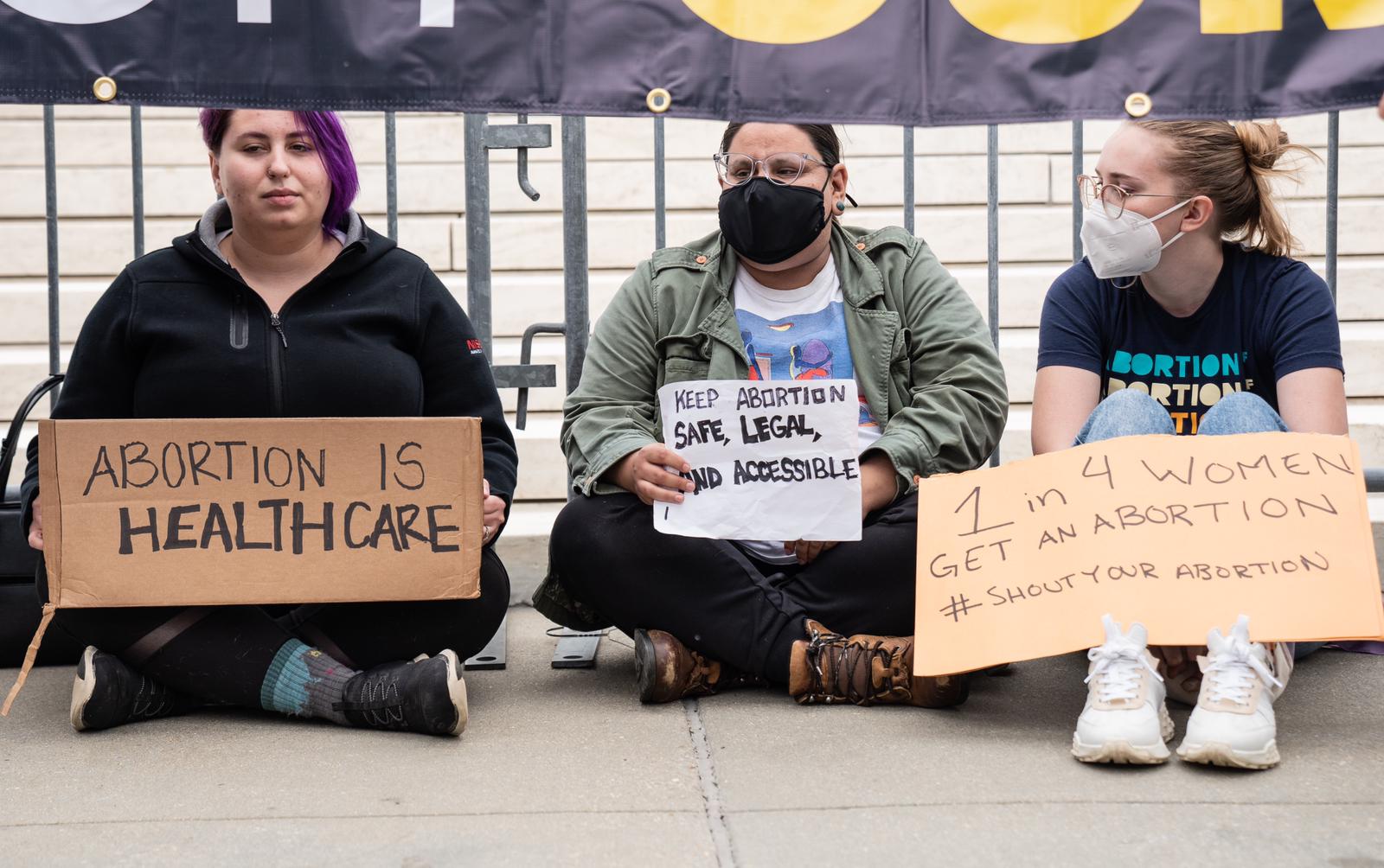
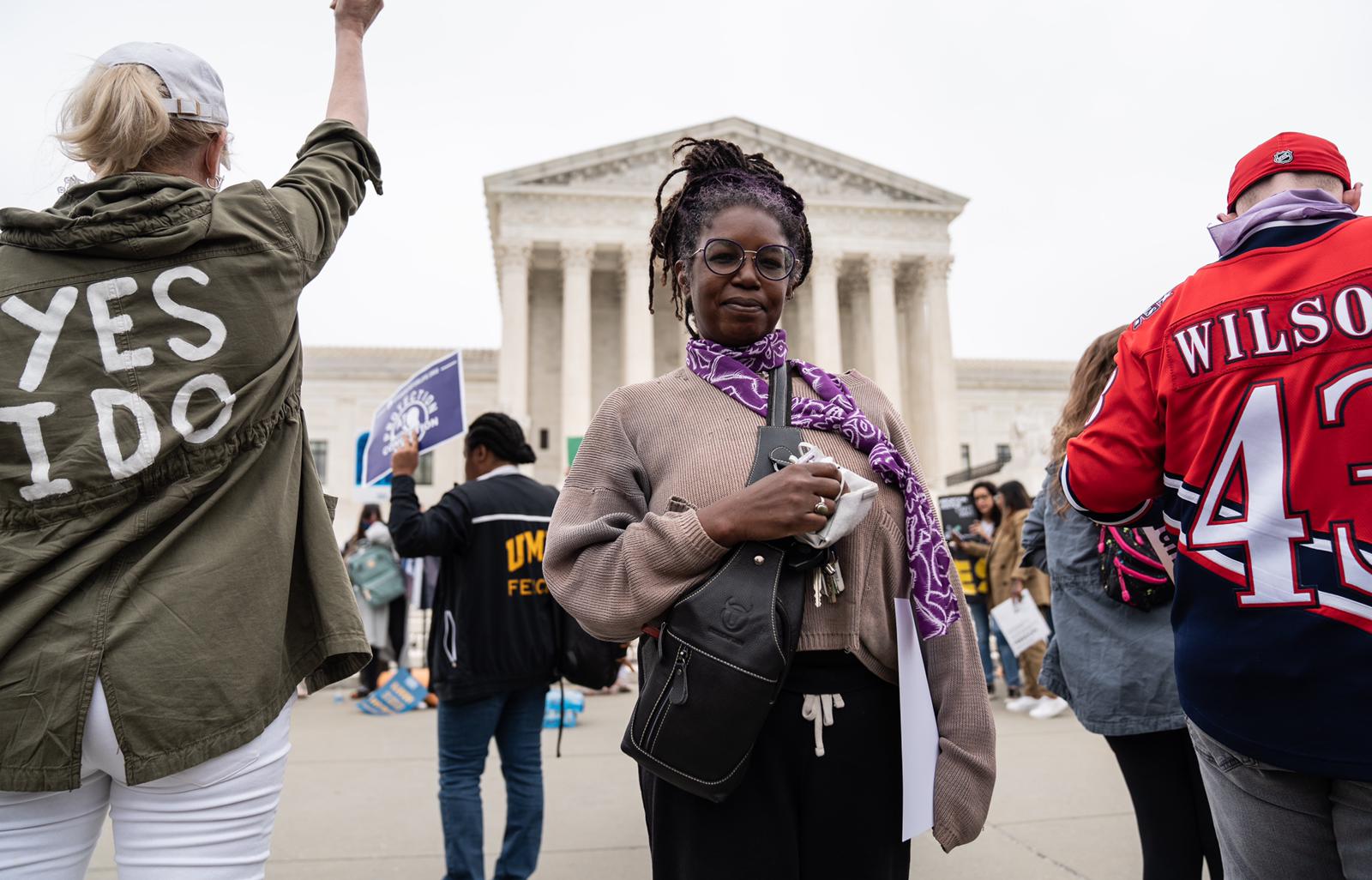
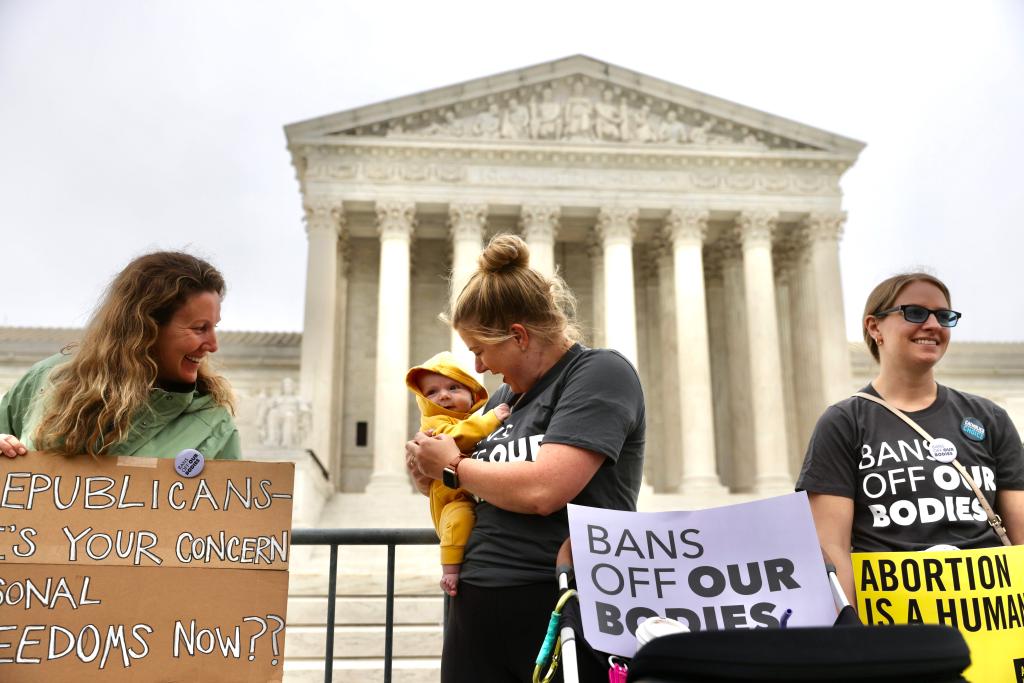
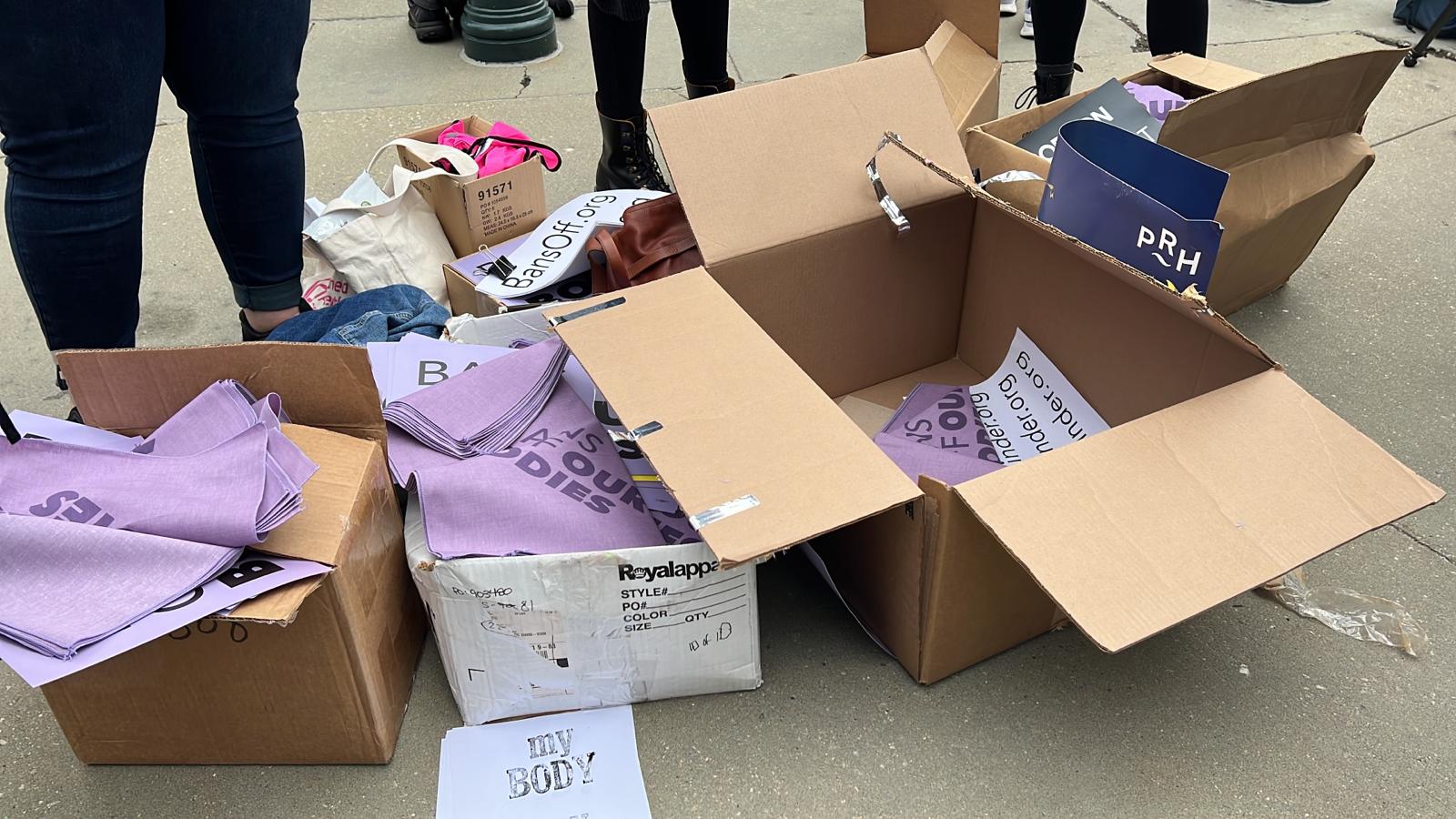
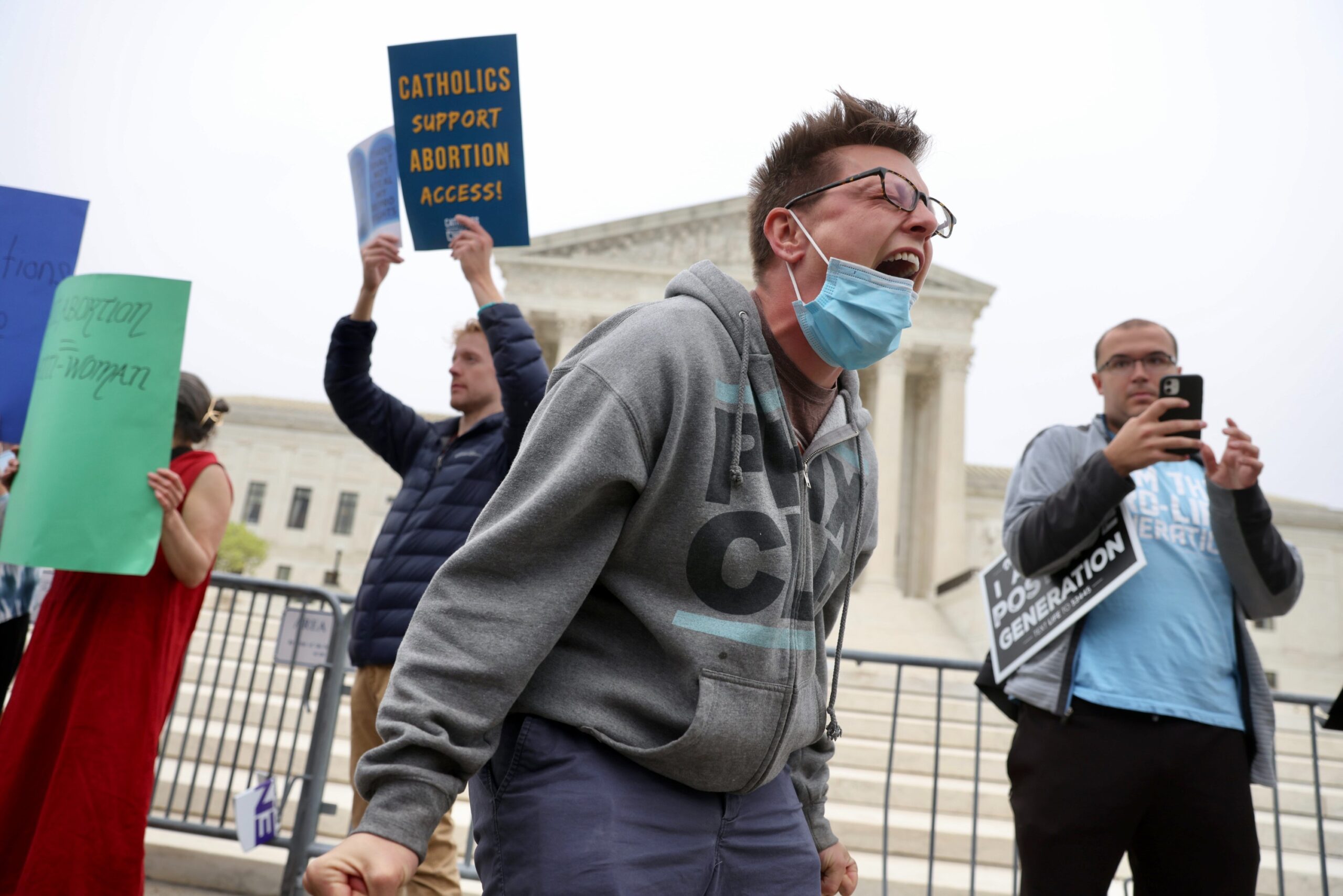
When Sarah Goggans arrived at the Supreme Court this morning, she had her four-month-old daughter Lilith Centrola on her hip. Goggans was among more than a hundred demonstrators who gathered outside the steps of the building after learning about the precarious future of abortion access in the U.S. According to a draft opinion obtained by Politico, and later confirmed to be accurate by Chief Justice John Roberts, a majority of justices intend to strike down the landmark 1973 Roe v. Wade decision, which establishes the constitutional right to an abortion.
“You can’t get a babysitter at the drop of a hat when injustice strikes,” she said, of why her infant was with her. “It was incredibly important to come down here and protest and voice our concerns. … While I don’t think Supreme Court justices’ votes are gonna change based on anything out here, hopefully Congress hears us.”
Today’s gathering is the second round of demonstrations outside the Supreme Court: People first rushed to the building last night, shortly after Politico’s news broke. The local chapter of the Democratic Socialists of America tweeted to the group’s 17.8K followers to rally an hour after the bombshell draft opinion leaked.
Police were quick to establish a barricade around the steps of the Supreme Court. “We are working closely with our partner law enforcement agencies to prepare for any potential demonstrations in the area of the Supreme Court, including adding additional officers in the area,” U.S. Capitol Police said in a statement this morning. The Metropolitan Police Department is also taking precautions, activating its civil disturbance unit through Sunday, according to Fox 5.
But the gathering on Tuesday was more organic, motivated by anger and fear about what could follow the end of abortion rights. While most of the roughly 150 protestors at the steps were opposed to the latest opinion, a small number offered anti-abortion chants. Senators Amy Klobuchar (D-MN) and Elizabeth Warren (D-MA) also made appearances.
“I’m very scared for all of the things that will be affected after Roe is overturned, if this decision gets finalized,” says D.C. resident Patricia Bencivenga at the Supreme Court on Tuesday. “It’s gonna make people seek out abortions in maybe unsafe ways. Abortion is a safe procedure, sure, but when you limit it, bad things could happen. And when you try and restrict it, bad things could happen.”
Bencivenga says she plans on protesting outside the court for as long as she can.
Lindsey Bestebreurtje, who’s 38 weeks pregnant, says she showed up because she wanted people to see that parents can be pro-abortion. (According to recent CDC surveying, a majority of people who have abortions are already parents.)
“I am pro-abortion and I am pro any kind of family that people would like to create for themselves,” she says from the court. “I am 38 weeks pregnant, so I am very familiar with the amount of physical, emotional, financial, mental, labor and difficulty that goes into having a baby. So the idea that you would do this — that someone would be forced to do this against their will is heartbreaking.”
At the moment, abortion remains a protected right, notes Laura Meyers, chief executive officer at Planned Parenthood of Metropolitan Washington. In a potentially post-Roe world, abortion access would vary state-by-state; currently, 16 states and the District have laws on the books that permit abortion, either throughout pregnancy or until the fetus is viable, according to the Guttmacher Institute. Meyers also expects the medical procedure to remain accessible in the D.C. region in the immediate aftermath of the fall of Roe, which is expected within the next two months.
“Locally, we can be thinking about how are we — as havens, if you will — how are we going to help those who need care?” says Meyers. “What kinds of resources might we need to set aside in order for that to happen to assist our neighbors?” She says local leaders need to strike any policies that make care more difficult to access, including funding restrictions and parental consent laws.
Given that the laws and politics differ between D.C., Maryland, and Virginia, here’s what abortion access could look like in the region if Roe falls:
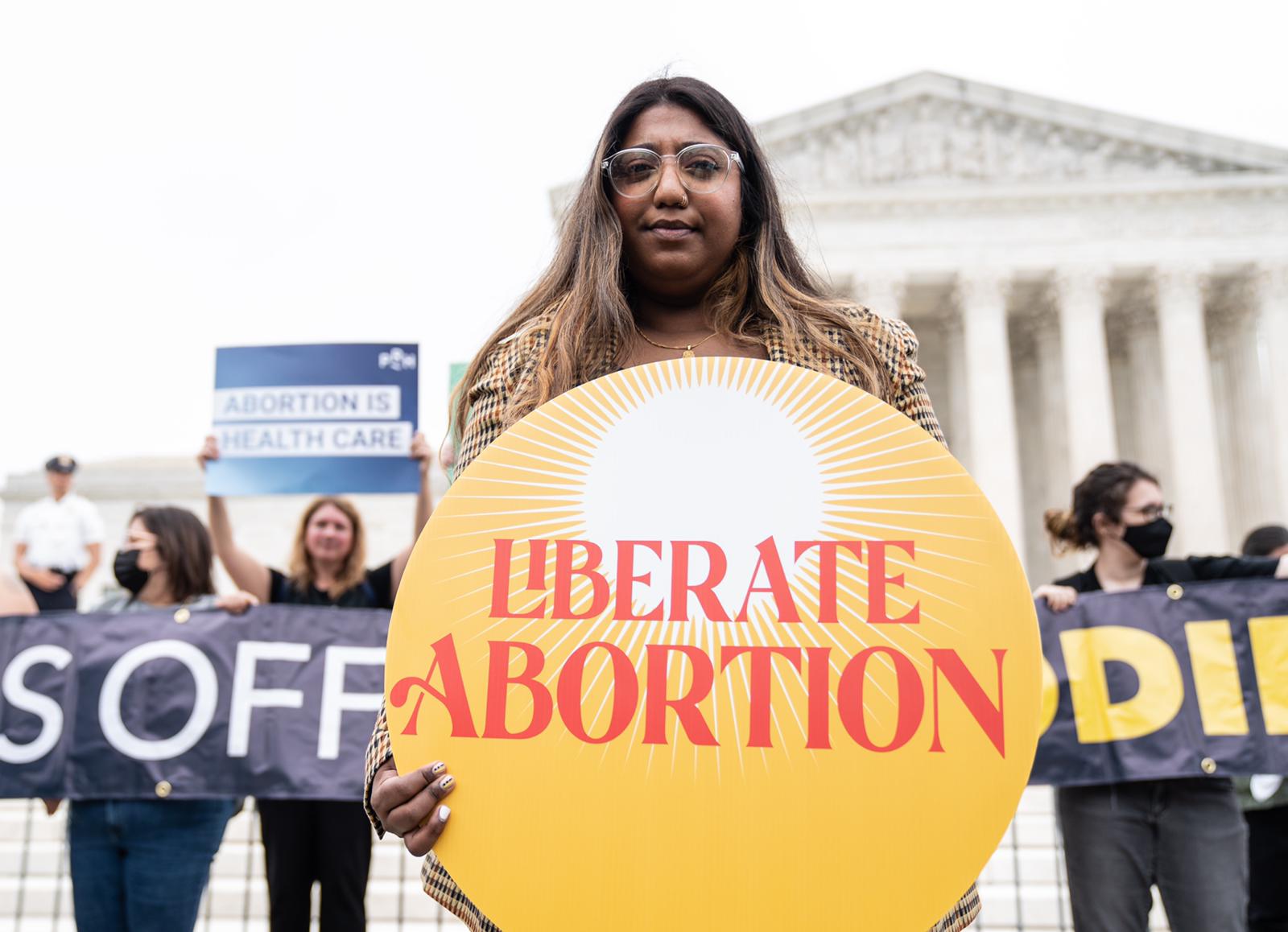
D.C.
Despite being a Democratic city where abortion rights have long been protected and promoted, the revelation of the draft opinion that would overturn Roe v. Wade shocked elected officials — largely because any final decision on whether abortion remains legal in the city might not be up to them.
While the court’s apparent opinion would devolve any decision-making over abortion to the states, D.C. remains under the control of Congress — and over the decades Republicans on Capitol Hill have repeatedly targeted how abortions are provided and paid for in the city.
“In D.C. we know that the stakes are even higher because even if the courts allow states to decide abortion policy, that won’t apply here,” said D.C. Mayor Muriel Bowser during a press conference alongside D.C. Del. Eleanor Holmes Norton and members of the D.C. Council on Tuesday afternoon.
The Republicans’ longest-running tool has been a budget rider that prohibits the city from using its own Medicaid dollars to subsidize abortions for low-income people. (In the late 1980s, it even prevented D.C. from paying for an abortion for a 12-year-old ward of the city who had been raped and impregnated by a cousin.) In the mid-90s some Republicans went further, proposing a ban on any abortions in city-funded hospitals or medical centers. And in 2012, Sen. Mike Lee (R-Utah) unsuccessfully pushed for a budget provision that would have banned abortions after 20 weeks — but only in D.C.
Many of the Republicans’ efforts were largely constrained by Roe or Democratic majorities in either the House or Senate, but D.C. Councilmember Christina Henderson (I-At Large) worries what will happen to the city’s abortion rights if both of those change.
“We have [our own] protections in place. We have updated our human rights laws and rules on reproductive decision-making. I have a bill that’s pending right now to provide some additional enhancements as it pertains to self-managed abortions,” she told DCist/WAMU. “And then I thought, ‘Man, if Republicans take back Congress, they will use the District as their petri dish yet again.’ They will they will attempt to go further than just saying, ‘You can’t spend local funds on abortion.’”
“When it comes to D.C., we are at special peril. The GOP Congress is likely to… ban abortion in D.C. in particular,” said Norton on Tuesday afternoon.
Bowser equated a likely congressional intervention into D.C.’s abortion rights to the many years that Republicans prohibited the city from spending any money on needle-exchange programs. “We have seen before what happens when Congress intervenes in our ability to provide health care. Hundreds of D.C. residents died because of Congress’s ban on needle-exchange programs. The government shouldn’t be in the business of blocking access to health care,” said Bowser.
In the interview with DCist/WAMU, Henderson said one remaining protection is that President Joe Biden remains in the White House, but she also noted that in the past Democrats have agreed to allow the existing budget rider on D.C. abortion spending remain in place.
“Past is prologue,” she said. “D.C. has been used as a bargaining chip and they’ve given us away for less. I think that this is a rallying call to my friends in other states, especially states who have senators on the ballot. Today is the day to plug in, folks, because this is not just about you. This really has implications for what happens in the nation’s capital.”
In a tweet, Councilmember Charles Allen (D-Ward 6) tied the city’s fight for statehood to the likely coming fight over the city’s abortion laws. “A lack of statehood not only meant we had no vote on these Supreme Court justices, but the members that put them in could change our local laws,” he wrote.
A bill to give D.C. statehood was twice-passed by the House, but remains stalled in the Senate.
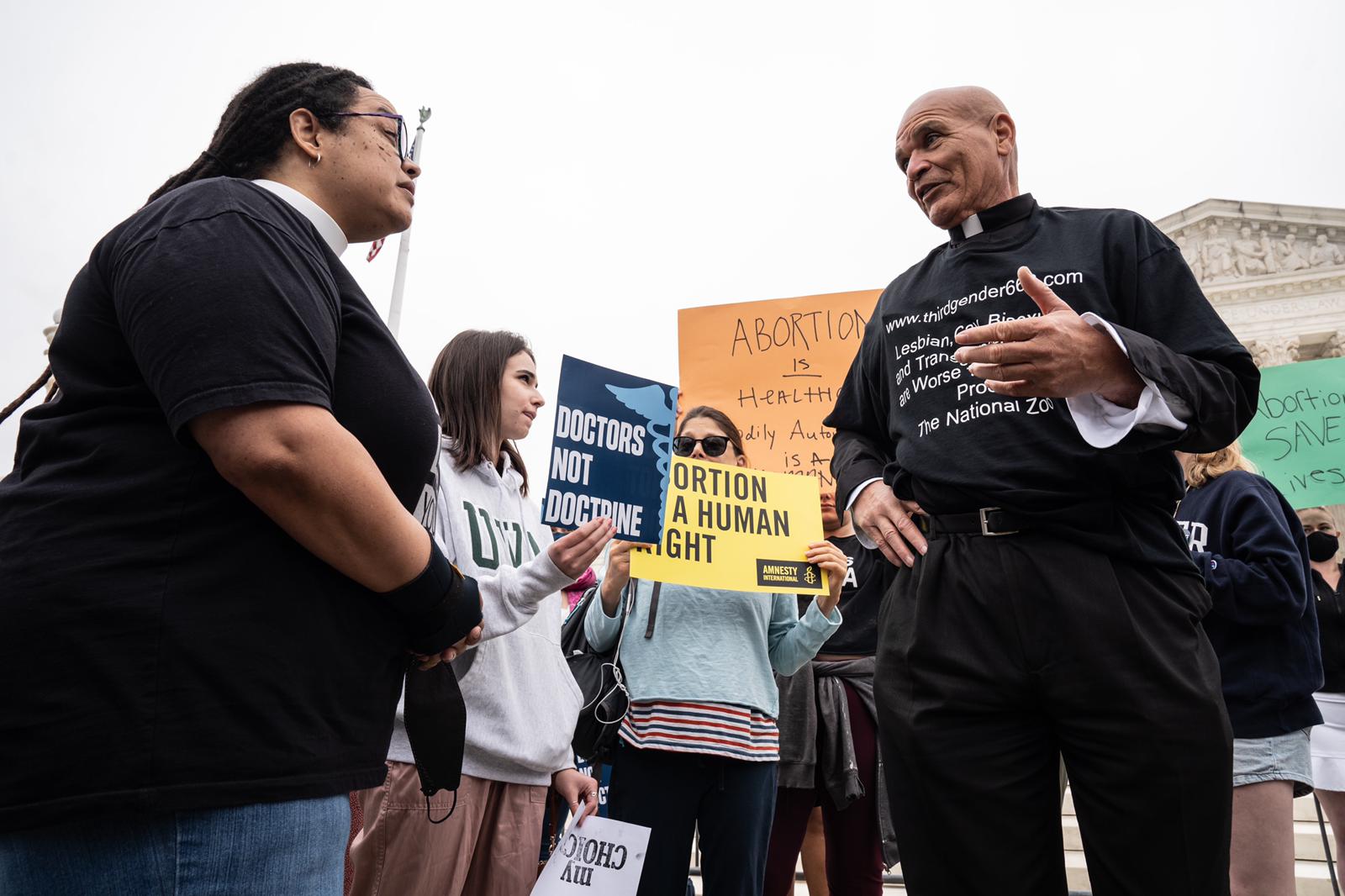
Maryland
As legislatures in other states have moved to restrict abortion access, Maryland’s state government recently did the opposite, taking steps to expand abortion access and make reproductive care more affordable.
Last month, the Maryland General Assembly voted to override Gov. Larry Hogan’s veto of the Abortion Care Access Act, a law that allows nurse practitioners, midwives, and physician assistants to perform abortions in the state. Previously, only physicians were permitted to perform abortions in Maryland, but with the new law, which goes into effect July 1, Maryland will join 14 other states that currently allow non-physician health care professionals to perform abortions.
The law also provides $3.5 million in funding to train health care professionals offering reproductive services, with the goal of increasing racial and ethnic diversity among health care professionals who are trained to provide abortion care. And it requires most private insurance plans to cover abortion without cost-sharing or deductibles, in addition to making the existing Medicaid abortion care coverage in the state permanent. Members of the House of Delegates overrode Hogan’s veto 90-46, and state senators voted in favor of overriding the veto by a vote of 29-15.
In a letter explaining his veto of the bill, Hogan wrote that “as governor, I have upheld my commitment to take no action that would affect Maryland law where it concerns reproductive rights.” Hogan added that he affirmed that commitment, but opposed the bill because it would “set back standards for women’s health care and safety.”
Hogan has largely dodged the issue of abortion during his tenure as governor. He has expressed anti-abortion views, but has repeatedly said access to the procedure in Maryland is a “matter of settled law.” Hogan has not commented on the draft opinion.
It has indeed been settled law in Maryland for three decades: In 1991, the Maryland state legislature approved a law that ensures abortion access in the state even if the Supreme Court were to move to restrict it, and Maryland voters overwhelmingly approved the law in a 1992 ballot referendum. It’s not uncommon for people from states with more restrictive laws to travel to Maryland for abortions and receive support from Maryland-based abortion funds. And support for abortion access remains strong among members of the Maryland public: Per a Goucher College poll last year, nearly 90% of Marylanders support keeping abortion legal in certain or all circumstances.
Lynn McCann, the director of development and communications for the Baltimore Abortion Fund, told DCist/WAMU the number of people traveling from outside of Maryland to seek their services has increased as restrictions on abortion have gone into effect in other states. About 40% of the people they served last year were coming from outside of Maryland, and that percentage increased to more than 50% this year.
“I think that really speaks to the increasing pressure and restrictions that are harming people,” said McCann.
McCann said the group, which serves people living in Maryland or traveling to the state for abortion care, has been preparing for years Roe v. Wade to be overturned or weakened. The Baltimore Abortion Fund is part of a coalition of abortion funds in the D.C. and mid-Atlantic region that has been working to fundraise and build capacity, knowing that many more people may seek abortion care in the region if Roe goes.
Recently, some lawmakers in Maryland have tried to take those protections a step further by enshrining abortion rights in the state constitution. This spring, the state’s house of delegates passed a bill that would have initiated that process and put the amendment on the ballot in November, but it did not advance to a vote in the Senate.
Democratic gubernatorial candidate John B. King and his running mate Michelle Siri said in a Facebook Live discussion Tuesday morning that they would support that constitutional amendment process.
“We’ve got this statutory right, but we can’t take for granted that our legislative body won’t change in some way,” said Siri, the lieutenant governor candidate and former chair of the Planned Parenthood of Maryland board.
Virginia
In Virginia, abortion is legal through the second trimester, though second-trimester abortions must be performed in a hospital. In the third trimester, it is allowed to be performed only in hospitals, and only in cases where three doctors agree that the pregnancy endangers the patient’s health.
Patients seeking abortion cannot receive public funds for it in Virginia, unless there is a health risk. Virginia health care providers — individuals or institutions — can choose not to offer the procedure. Parents of minors seeking the procedure must be notified and must give consent for an abortion to occur.
It wasn’t too long ago that the landscape looked markedly different, though. In the 2010s, Virginia Republicans passed a wide variety of restrictions on the procedure, including a 24-hour waiting period, a requirement that patients undergo an ultrasound and counseling against the procedure, and zoning and other regulations that forced reproductive health clinics to close. As of 2017, 93% of Virginia counties did not have a health clinic that performed abortions, and as recently as 2019, NARAL Pro-Choice Virginia called abortion in Virginia “severely restricted.”
Democrats in the state only recently managed to overturn some of those restrictions, and a now-divided government in Richmond makes the political future of abortion rights in Virginia uncertain.
According to a February 2022 poll from the Wason Center, Virginians largely support abortion access, with 57% opposing ultrasound requirements and 58% opposing a 6-week ban on abortions.
Governor Glenn Youngkin, a Republican, opposes abortion. Along with Lieutenant Governor Winsome Earle-Sears and Attorney General Jason Miyares, he attended the March for Life in Richmond last week. But the Youngkin administration has largely avoided pushing the issue in legislation or even on the campaign trail last fall — despite telling campaign supporters in a leaked video that he would go “on offense” if elected.
True to form, Youngkin focused on the nature of the Supreme Court leak in a statement on Tuesday.
“I am in utter disbelief that the sacred confidentiality of the Supreme Court would be violated in this manner,” he wrote. “It’s premature to speculate on what the Supreme Court’s decision will be; however, we learned from listening to Virginians over the last year that we have much common ground on this issue.”
“I am pro-life, and I have been very clear about that since the day I launched my campaign,” he added.
Many Virginia Democrats, who control the state Senate by a single vote, immediately focused on the possible Supreme Court ruling as a future campaign issue.
“I have one message tonight,” tweeted Sen. Louise Lucas, the President Pro Tempore of the chamber and the chair of the committee that examines abortion-related bills. “When Glenn Youngkin comes to take away our abortion rights, he is going to run into a BRICK WALL.”
Senate Democrats did succeed in killing several pieces of legislation aimed at limiting abortion access this year, and Virginia Democrats have successfully pushed for abortion access in legislation and on the campaign trail in the past. In 2013, Democrat Terry McAuliffe, who lost to Youngkin last year, won the gubernatorial race in part by criticizing his opponent’s staunchly anti-abortion stance. Party leaders successfully rolled back a 24-hour waiting period requirement and restrictions on reproductive health providers to be classified as hospitals in 2020, when they held unified control of the General Assembly and the governor’s mansion.
But the issue is more fraught for Democrats than it might appear. At least one Senate Democrat, Joe Morrissey of Richmond, has publicly opposed abortion in the past, and was a patron on a now-dead bill in the 2022 session that would have created a ban on abortion after 20 weeks, except in cases where the patient’s health is at risk. A spokeswoman for the Senate Democrats said the group did “not have consensus on the issue,” and would not comment on the leaked Supreme Court opinion.
Virginia Democrats ultimately balked at requests from abortion supporters to codify abortion rights in 2021, just before the party handed over control of the governorship and the House of Delegates to Republicans.
This story has been updated with additional photographs from the Supreme Court on Tuesday, to clarify the status of abortion access nationwide, and to include an interview with the Baltimore Abortion Fund and additional comments from D.C. officials.