Amanda Michelle Gomez
Workers at the D.C. food retailer Union Kitchen worry that with five workers who voted in favor of unionization fired and their certification stalled indefinitely, their fight for justice will be a long one.
“There’s absolutely zero doubt in my mind that we won,” says Mckenna Willis, one of the few remaining union leaders still employed at Union Kitchen of her expectation that they will form a union of 50 people across five stores.
While a majority of workers voted for unionization on March 29, the election outcome has been delayed for over a month due to several contested ballots, mostly by CEO Cullen Gilchrist. He challenged some ballots on the grounds of voter eligibility, including those of two vocally pro-union employees who were fired after votes were cast but before they were counted.
The food service workers are now waiting on the National Labor Relations Board to resolve the challenged ballots and to issue decisions on the unfair labor practice charges they filed over the firings, which constituted one-fifth of pro-union employees, including the two workers responsible for starting the effort four months ago. Both of these decisions could take months, according to labor experts.
Even if the NLRB rules in their favor they anticipate highly contentious contract negotiations, more retaliation, and worry the success of their union will be hobbled by the spate of firings and a loss of momentum after weeks of delays. Labor experts say that Union Kitchen is representative of the challenges many workers experience when they seek to organize — challenges that endure even in a Democratic city and during a time of increased interest in unions nationally.
“That’s the thing with unions, ” says Willis. “The entire thing is a long game. Walking into this, I knew that was true. And I made it clear to everybody who signed the cards that that was true. Nobody’s surprised. Everybody’s disappointed.”
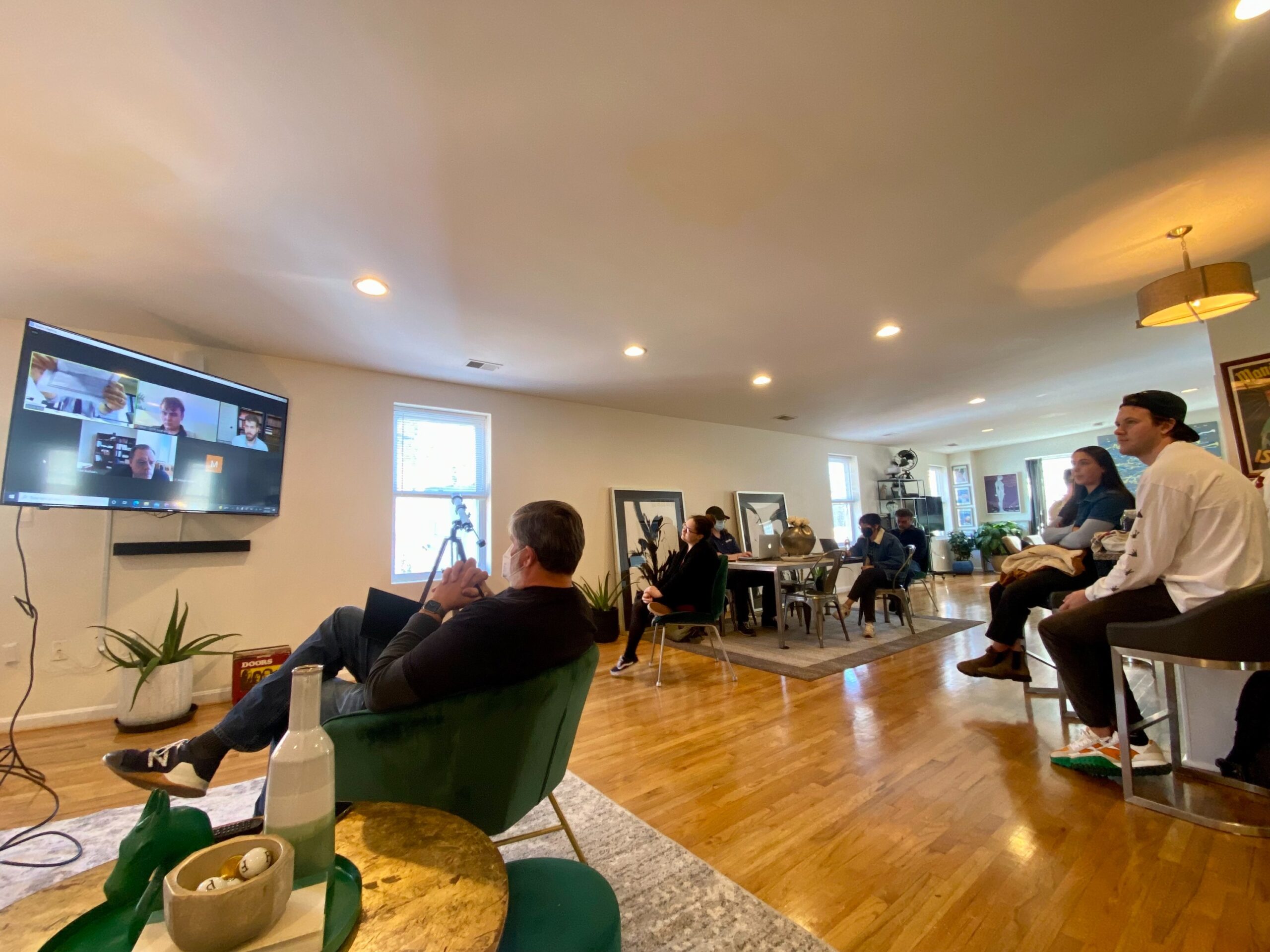
Organized workers hoped the election would bring a clear victory. They even planned on celebrating with their supporters on the day NLRB counted votes, renting an Airbnb and stocking it with sandwiches and bottles of champagne.
The union says that while they believe the firings have been the most severe tactic, management has also used questionable disciplinary warnings and anti-union meetings to undermine their efforts. Gilchrist, who created the stores to distribute and sell products from his food accelerator, declined to be interviewed for this story but has repeatedly denied union-busting allegations to DCist/WAMU in past interviews.
“It’s really frustrating,” said Travis Acton, a staff organizer for the regional labor union that workers are seeking to affiliate with, United Food and Commercial Workers Union Local 400 on election day. He spoke from the Airbnb in Logan Circle, where they had gathered to watch the results live on a giant screen TV. “It’s just another trick in their book to try to delay the certification and delay them having to bargain with us.”
Dave Kamper, who researches labor as a senior state policy coordinator at the Economic Policy Institute, says “the number one tactic in the playbook of an anti-union employer is to play for time.” “A lot of these steps are handled by everyone just kind of agreeing to go ahead and take the next step,” he says of union certification. “But then if one side decides to back off of that agreement, you start all over again. And if your goal is simply to buy time, an employer has oodles of options.”
He says NLRB certification will mean that workers have more protections, even before they’re able to negotiate a contract. This includes the fact that employers can’t unilaterally make changes in wages, hours, terms, and conditions of employment and that workers gain the right to request a union representative in disciplinary meetings (called Weingarten rights). This could prove impactful given that Gilchrist banned UFCW Local 400 staff from even entering the stores, according to an email shared with DCist/WAMU.
One worker has already been fired during the month-long wait for certification. Jennifer Espana says she was cut April 7 for failing to notify her manager when she was absent for a shift in March. She says management did not discipline her at the time because she’d been unable to show up for work as a result of an assault.
“How in the world am I going to reach out to you if I was injured?” says Espana, who started working at Union Kitchen in 2018. “I don’t have an issue with attendance and I’ve been working there for years. A month before this happened I was next in line to become the general manager at that location because my GM was leaving … How can it go from zero to 100 that quick?”
She’s unsure whether her firing had to do with her support of the union as she hasn’t been very vocal about it. Her termination, however, has reinforced her views. “I had really fallen for everything that they would tell me just because I thought I could trust them,” she adds, “I worked there for so long. I did build a career there.”
Espana now worries how she’ll pay rent and care for her dog. She says she thought she’d get paid out for unused vacation and sick days but management changed the policy without her realizing and now she’s leaving the company with less money than expected.
“The process for any certification is just so stacked in favor of the employer,” says Gabe Wittes, a founding member of the union who received his termination notice April 8.
Union Kitchen also banned Wittes from company properties, according to an email notice reviewed by DCist/WAMU, “due to the nature of [his] violations.” Among the listed reasons was his “relentless” approach in addressing the “tip situation,” which Wittes says is a reference to a time that he asked for more transparency and back pay after he and a colleague noticed discrepancies in how tips were paid out. This concern was one of the motivating factors behind unionizing. In Wittes’ view, management is suddenly taking issue with his advocacy from several months ago in order to undermine his case with the NLRB.
“I believe I was terminated in a directly retaliatory manner for my role in the union,” says Wittes.
He is especially suspicious because he says management accidentally shared a Microsoft Word document of reasons for his termination that included a comment from Jacki Thompson, a Ford Harrison lawyer who represented management in the charges filed against them in February over firings.
Rob Ballock and Alyssa Russell-Sadoff, both of whom were vocally pro-union, were fired in February and say they didn’t receive much of an explanation. Russell-Sadoff says she only learned she was fired after texting her manager about not being scheduled.
Union Kitchen employees are at-will, which means management doesn’t need to provide a reason for termination — something workers hope to address with collective bargaining.
“I didn’t appreciate the extent to which NLRB charges take time,” says Wittes. “We’ve probably relied too heavily on that tool — not that it isn’t ultimately going to be effective.”
In addition to the NLRB and a weekend-long strike in February, organizers have responded to perceived retaliation by publicly shaming Gilchrist on social media and in email campaigns, as well as wearing buttons to inform patrons of their union drive.
Existing federal labor laws makes unionization difficult, according to experts who point to national examples like Amazon and Starbucks. That’s partly why so few local retailers successfully unionize. Before Union Kitchen, the last retailer the UFCW Local 400 supported was Politics and Prose, which was the labor union’s first D.C. retailer in at least a decade.

The NLRB — a federal agency whose funding and staffing levels have not kept pace with workplace organizing — takes anywhere between 7 to 14 weeks to decide the merits of a charge, and some cases can take even longer. Workers then have to wait for a final resolution, either through a settlement or an order from the labor board. If an employer is penalized for firing a worker over union activity, they have to provide back pay and reinstatement.
Russell-Sadoff has no interest in being reinstated. Ballock does, however, saying “I would like to be able to leave on my own terms.”
The lack of serious penalties means employers are not easily deterred from engaging in retaliatory action, says James Benton, director of the Race and Economic Empowerment Project at Georgetown’s Kalmanovitz Initiative. According to one estimate, union leaders have a 15 to 20% chance of being fired and resolutions can take years. He’s currently researching a case where a company closed a South Carolina textile mill in the 1950s because workers unionized. They eventually won their case alleging retaliation but he says the process took 25 years, which meant that nearly a fifth of payments went to workers’ heirs.
“They can really draw out the negotiating process. With the type of turnover that you see in the retail industry, they can bet that workers at some point will get disillusioned and move away from that effort or quit or find new jobs,” he says. “It’s really a sad state of affairs with labor law and this is where this is a prime example of why the you’ll hear about the PRO Act.”
The PRO Act, which has provisions such as mandating that the NLRB go to court to immediately reinstate fired workers, is stuck in the Senate. D.C. has no voting representation in Congress and among the few Democratic holdouts is Senator Mark Warner of Virginia.
In previous interviews with DCist/WAMU, Gilchrist questioned how his employees and the media defined “union-busting,” saying in February “I would be disturbed if people didn’t know what that was, but it’s been used repeatedly to define someone’s actions.”
When offered an example — Did he meet with employees one-on-one or in groups to talk negatively about the union, as several workers alleged? — he said: “We’re going to keep talking to our team. That’s what we do. That’s what’s made Union Kitchen great. People can call it whatever they want, however they want, but we’re going to keep working and building a great team.” He added that Union Kitchen “would never talk about an employee outside the company.”
Gilchrist said via text that DCist/WAMU’s reporting on his company “was not factual.” He did not respond to a follow-up message and has not sought a correction.
While the firings complicate the union’s mission, leaders are less concerned about momentum than they are with what the firings mean for people’s livelihoods.
“The firing is more emotional and personal, and [I’m] less concerned [with] an overall strategy,” said Willis, “My immediate reaction to all this stuff is I just always feel a little heartbroken.”
Willis is not alone in her sentiment. Carson Garfield, once spotlighted on the company’s blog, says he’s keeping his professional options open given everything that’s happened.
“I’ve been pretty lucky, and most of my stress has been kind of like experienced vicariously through my coworkers who have been treated unfairly,” he says. “It’s put a bad taste in my mouth, I guess, regarding the company as a whole. And so it’s making me question even if I might find a position that is in line with my career goals at Union Kitchen, there’s a sort of like question internally about is this something that I can feel right about?”
Previously: