Most of the pop culture references to the Lincoln Memorial that Faith Salie has encountered over the past few weeks have been contemplative, hopeful, and occasionally romantic — think Owen Wilson and Vince Vaughn passing a bottle of wine back and forth on the memorial’s steps in Wedding Crashers, or Jimmy Stewart and Jean Arthur talking frankly next to one of the memorial’s Ionic columns in Mr. Smith Goes to Washington.
Salie, a panelist on NPR’s Wait, Wait… Don’t Tell Me and a CBS Sunday News correspondent, has been studying Lincoln Memorial references in preparation for an event she’s hosting on May 14 to honor the memorial’s centennial.
But nothing elicited a stronger reaction in her than the D.C. memorial’s appearance in season three of The Handmaid’s Tale, the dystopian TV series based on Margaret Atwood’s best-selling novel. In the show, June (Elisabeth Moss), visits what used to be Washington, D.C. to find that totalitarian regime Gilead has tampered with some of the city’s most iconic structures, including the Lincoln. The larger-than-life statue of a seated Abraham Lincoln has been brutally severed, so that only his torso and legs remain, and the dedication that used to sit behind him has been destroyed.
“When the image came on screen, I actually said, ‘Oof.’ And as I was watching it, I just felt sick to my stomach,” Salie says. “That speaks to how attached I feel like most of us are to the Lincoln Memorial.”
The Lincoln Memorial was dedicated on May 30, 1922. To celebrate its 100th anniversary, the National Park Service has planned a host of events honoring different aspects of the memorial’s history, including an oral history of singer Marian Anderson’s iconic performance from its steps, and an exploration of the building’s role in the Civil Rights Movement. The May 14 event, hosted by Salie, looks at the memorial’s representations in film and television.

Initially, Salie began speaking with the National Park Service about the memorial’s history for what she imagined would just be a regular CBS Sunday News segment about the centennial. But the more she learned, the more enthralled by its history she became.
“I had no idea until we dug into the research that the history of the Lincoln Memorial over the past century is deep and nuanced — so much more meaningful than what it was created to celebrate in 1922,” Salie says. “It’s more of a living monument than probably any other in our country, because it has become a stage for Civil Rights activism, and for people to make their voices heard.”
The role that the Lincoln Memorial has played in activism — Civil Rights activism, in particular — starkly contrasts the monument’s origins. It was intentionally designed to contain no references to slavery, except for those explicitly in Lincoln’s second inaugural address, and was dedicated before a segregated crowd. The only Black speaker at the dedication was Dr. Robert Moten, then-head of the Tuskegee Institute, whose speech was censored.
Over time, though, Black Americans have incorporated the monument into Civil Rights history. Think of Anderson singing from the steps in 1939 — a performance that happened after Anderson was barred from performing at then-segregated Constitution Hall — or Martin Luther King Jr. delivering his “I Have a Dream” speech to a crowd of 250,000. “It is more relevant today than it was 100 years ago,” Salie says. “It offers Americans a stage.”
Numerous movements have taken advantage of that stage over the last century. Salie thinks of the original Women’s March, or protests against the Vietnam War. The latter is depicted in Forrest Gump, when Forrest accidentally gets roped into addressing an anti-war crowd gathered around the Reflecting Pool in front of the memorial.
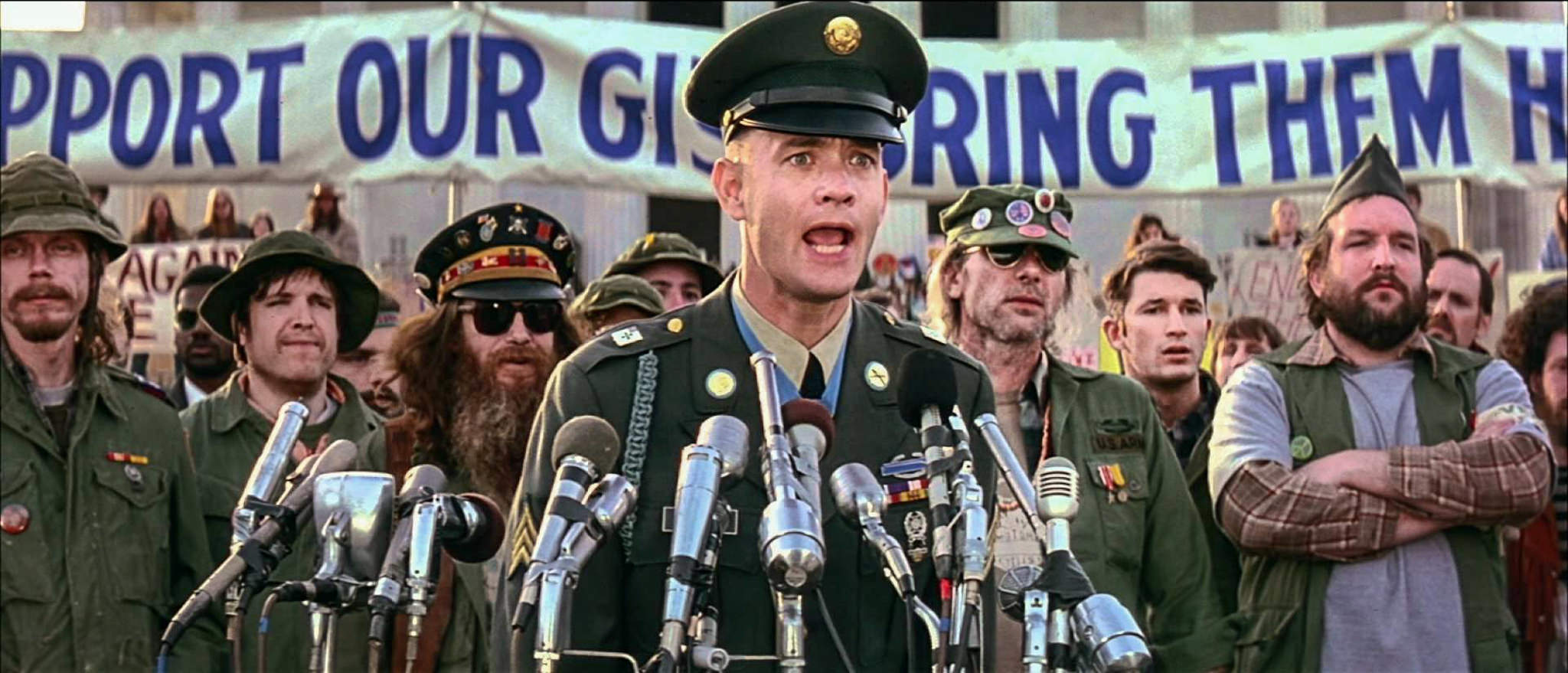
Not all of Salie’s favorite movie moments at the memorial have to do with patriotism or activism. Often, it’s simply a place where characters go to work through something. That’s the case for Reese Witherspoon in Legally Blonde 2, and for Lisa Simpson when she visits the nation’s capital in an episode of The Simpsons. In the 1993 thriller In the Line of Fire, the memorial’s steps are the backdrop for sunset ice cream and flirting between Clint Eastwood and Rene Russo.
“It’s interesting, right, to think of this very august place that’s modeled after the Parthenon as a place for romance,” Salie says. “But there is something that feels very hushed and intimate about it. And I think that’s just because it’s so special.”
Just before sunset on Saturday, Salie will join the National Park Service’s Mike Litterst to talk about how the Lincoln Memorial has been depicted in everything from Wonder Woman 1984 to Night at the Museum: Battle of the Smithsonian, and what popular media’s fascination with the monument reveals about its place in our culture. The event takes place at the Sylvan Theater next to the Washington Monument. Afterward, there’s nothing stopping you from walking along the Reflecting Pool and having a little Lincoln Memorial moment of your own.
“The Lincoln Memorial in Pop Culture” takes place at 7:30 p.m. on Saturday, May 14 at Sylvan Theater.