Martin Austermuhle
This story was republished by El Tiempo Latino. Puedes leer este artículo en español aquí.
The time has arrived: the D.C. Board of Elections will start mailing out ballots to most D.C. voters starting today, meaning that in the coming days you’ll be able to perform your civic duty ahead of the June 21 primary. (The ballot envelope is purple, so be on the lookout!) If you voted by mail back in 2020, this year won’t be much different. But if you didn’t, or you simply want to weigh your options on how and when should cast a ballot, read on for all the basics on voting in this year’s primary.
Who can vote in the primary?
Being that D.C. runs partisan primaries, only those voters who are registered as a Democrat, Republican, Libertarian, or Statehood Green can take part in the June 21 election. (Yes, that means D.C.’s roughly 80,000 independent voters will be sitting this one out.) You have until May 31 to change your party affiliation if you choose. That’s also the deadline for voter registration applications received by mail or online; there is same-day voter registration for new voters during early and day-of voting, though.
What races are on the ballot?
While not every voter will have a choice in all of the races on the ballot (Libertarians and Statehood Greens have no actual candidates on the ballot, so those voters will only have write-in options), these are the main races that many voters will weigh in on:
- Mayor of D.C.: The city’s chief executive. There are four Democratic candidates (Mayor Muriel Bowser, Councilmember Robert White, Councilmember Trayon White, and James Butler) and one Republican (Stacia Hall).
- Attorney General of D.C.: The city’s chief law enforcement officer, who is independent of the mayor. The Democratic candidates are Bruce Spiva, Brian Schwalb, and Ryan Jones.
- D.C. Council Chairperson: The leader of the D.C. Council. There are two Democratic candidates (Chairman Phil Mendelson and Erin Palmer) and one Republican (Nate Derenge).
- Delegate to Congress: The city’s non-voting representative in the House. There are three Democrats running (Del. Eleanor Holmes Norton, Wendy Hamilton, and Kelly Mikel Williams) and one Republican (Nelson Rimensnyder).
- At-Large Councilmember: One of four at-large members of the council. The winner of each party primary will then go up against independent candidates in November, when voters will be able to choose two candidates on their ballots. There are four Democrats running (Councilmember Anita Bonds, Dexter Williams, Lisa Gore, and Nate Fleming) and one Republican (Giuseppe Niosi).
- U.S. Shadow Representative: This is part of D.C. three-person “shadow” delegation to Congress, or the congressional delegation-in-waiting should D.C. ever get statehood. These are not paid positions, and are largely meant to advocate for statehood. There are two Democrats running (Oye Owolewa and Linda Gray).
- At-Large committee members of the D.C. Democratic State Committee.
The following races will be limited to voters in those specific wards:
- Ward 1 on D.C. Council: Three Democrats are running (Councilmember Brianne Nadeau, Sabel Harris, and Salah Czapary).
- Ward 3 on D.C. Council: Nine Democrats (Eric Goulet, Henry Cohen, Tricia Duncan, Matt Frumin, Ben Bergmann, Beau Finley, Phil Thomas, Monte Monash, and Deirdre Brown) and one Republican (David Krucoff) are running.
- Ward 5 on D.C. Council: Seven Democrats are running (Faith Gibson Hubbard, Zachary Parker, Vincent Orange, Gordon Fletcher, Kathy Henderson, Art Lloyd, Gary Johnson) and one Republican (Clarence Lee Jr.) are running.
- Ward 6 on D.C. Council: A sole Democrat (Councilmember Charles Allen) is in the race.
- Ward-based committee members of the D.C. Democratic State Committee.
The D.C. Democratic State Committee? What’s that?
It’s the formal name for the D.C. Democratic Party. The positions on the ballot are for party leadership. The actual party doesn’t play any specific role in vetting or allowing candidates to run for office, though it does choose interim councilmembers in the case that an At-Large member of the D.C. Council who is a Democrat resigns.
Wait, wasn’t there supposed to be a ballot initiative up for a vote?
There was, yes, on whether D.C. should get rid of its tipped wage. But the initiative has been bumped to the November general election ballot.
I received my ballot in the mail! Now what?
After you make your candidate choices, you can pop that ballot back in the mail and pat yourself on the back for completing your civic duty way ahead of time. (And yes, the ballot will come with an “I Voted!” sticker that you can wear until the actual primary, if you please.)
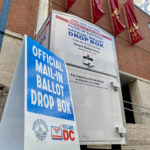
Alternatively, you can wait until May 27, when D.C. will open 55 ballot drop boxes located all around town. The ballot boxes will remain open until 8 p.m. on June 21. Oh, and remember to watch for the right box to put your ballot in, as the boxes for COVID-19 tests look pretty much the same.
If you opt for mailing your ballot, just know that it has to be postmarked by June 21 and the elections board has to receive it by June 28. Finally, you can also drop off a completed mail ballot at any Vote Center during in-person voting.
Mail ballots can be tracked here. You can check to see whether your ballot has been received, processed, and accepted.
[Sad-face emoji] It’s been a few days since they’ve been mailed out, and I still haven’t received my ballot. What do I do?
Give the elections board a call at (202) 727-2525. If you haven’t gotten one by June 16, though, you’re advised to vote in person.
[Confused-face emoji] I got a mail ballot for someone else who may have once lived at my address. What do I do?
This is bound to happen; many states’ voter registries are rife with old addresses and incorrect voter information, so mail ballots may well end up going to places where those voters no longer live. (It happened in D.C. during the 2020 election cycle.) If you happen to receive ballots that aren’t for you, the elections board asks that you write “Return to sender” on them and drop them in the mail or a ballot drop box.
And if you think those extra ballots you received give you some type of super-voting power, remember: you’re required to sign your ballot, and that signature is checked against what the elections board has on file. Oh, and voting more than once or with someone else’s ballot is voter fraud, so don’t do that.
If you recently moved and want to make sure your mail ballot doesn’t end up somewhere else, check and update your voter registration information here.
I’m more of the vote-in-person variety. What are my options?
Plenty. You can vote early between June 10-19 from 8:30 a.m. to 7 p.m. at any of the 40 Vote Centers that will be open. Check for locations here.
If you’re very tradition-oriented (or just like to procrastinate), you can of course take part in the primary festivities by casting your ballot at any of the 90 available Vote Centers on June 21, which will be open from 7 a.m. to 8 p.m. (Locations are here.) And unlike old-school voting precincts, you’re not tied to any particular Vote Center for early or day-of voting; you can cast a ballot wherever you choose.
You don’t need to bring any particular form of ID to vote in person, but if you are doing same-day voter registration, you’ll need to bring proof of residence. That can include a D.C.-issued ID, a government check or paycheck, a bank statement, a current utility bill, a lease, or any official document that includes your name and current D.C. address.
Oh, and don’t forget: D.C. mandates that your employer give you two hours of paid leave to go vote.
If I vote by mail, can I then go vote in person?
It should go without saying: Voting twice is a big no-no. It’s also a felony punishable by five years in prison and a $10,000 fine. And D.C.’s system is built to prevent it. Say you choose to vote by mail, and send your ballot back in. Once it’s scanned as part of the ballot-tracking process, the city’s voter registration system is notified and electronic poll books used at vote centers will flag you as having voted already. The same goes in reverse: If you vote in person and then try to mail a ballot in, the system will register that you cast an in-person ballot and nullify your mail ballot.
But seriously, don’t try to prove you can beat the system by voting twice.
But you’re saying it’s possible …
Seriously, just don’t.
When will results be tallied?
After polling places close on Election Day, the elections board usually quickly publishes results of mail and early in-person voting, followed by the day-of results. That’s usually the lion’s share of ballots, but if a race is very close it could come down to late-arriving mail ballots and any special ballots where a voter still has to come in to verify their identity. (The reasons for why you would be given a special ballot are here.) Either way, remember that no results are final until they are certified, which is expected to happen on July 8.
I’m still doing my research on the races and the candidates. What resources are out there?
For the citywide races (mayor, attorney general, At-Large councilmember), the candidates using public financing are required to participate in one official debate put on by the D.C. Office of Campaign Finance. The mayor’s debate is tonight, the attorney general’s debate is on Tuesday night, and the At-Large councilmember debate is on Thursday night. All the details are here. (A council chair debate won’t happen because Mendelson is not taking public financing and declined an invitation to participate.)
And keep your eyes peeled for our own DCist/WAMU Voter Guide, which should be dropping late next week.