 Milagros Meléndez
This story was produced by El Tiempo Latino. La puedes leer en español aquí.
Undocumented immigrants who are pregnant or have just given birth in Maryland will be eligible for Medicaid starting July 1. In April, the state enacted the Healthy Babies Equity Act to extend government health coverage to pregnant people regardless of their immigration status.
“This legislation is very important because we have seen in the state that there have been close to 6,000 pregnant immigrants who have not had prenatal care due to not having health insurance,” state delegate Joseline Peña-Melnyk (D-Prince George’s and Anne Arundel counties), author of the bill in the House of Delegates, told El Tiempo Latino. “On many occasions they have had complications during pregnancy or delivery.”
The bill became law without Governor Larry Hogan’s signature. The measure was passed by a veto-proof majority, Peña-Melnyk said.
Iris Rivera is one of the thousands of immigrants who would benefit from the measure. She recently gave birth. “Thank God this law has been passed. It has been very difficult to take care of myself,” she said.
Rivera, 26, who emigrated from Honduras in 2018, was among those who, while pregnant, testified at hearings held in legislative committees. She lives in Howard County.
“I don’t have health insurance and when I became pregnant it was difficult to get medical care, but I was able to get a discount from the Baltimore Medical System or [a clinic],” she said. “Although I didn’t have to pay a lot, the distance was a problem, since I don’t have transportation and I had to use Uber for my appointments, which was very expensive, or I had to bother people.”
Rivera paid $15 for each consultation and $150 for periodic exams. Spending that money meant tightening her budget. She also has a 6-year-old daughter who was undergoing treatment for kidney failure at the time.
Other uninsured immigrants have faced tremendous medical debt.
“Complications from my daughter’s pregnancy meant undergoing surgery and paying such an expensive bill,” said Nelly Campos, who testified in the Maryland Senate in favor of the legislation. Her daughter had not received prenatal care. “This law will help protect lives,” she added.
Who qualifies for Medicaid?
Medicaid is a government program that helps pay health care costs for people with limited income and resources. “It’s not for everyone. Only for economically vulnerable families,” Peña-Melnyk clarified.
Undocumented people do not have access to coverage nationally. Only U.S. citizens or permanent residents with five years of such legal status may access Medicaid, with exceptions for emergency medical services for low-income people who would otherwise qualify but cannot due to their immigration status.
Each state has its own financial requirements for Medicaid eligibility. The income limit ranges in Maryland have a wider margin, allowing more families to access the program.
For example, to be eligible, a person must receive an income limited to $1,564 per month. For a two-member family, $2,160; for a three-member family, $2,650.
The margin increases in the case of pregnant people. If they are a family of three, they could qualify with a maximum monthly income of $5,069.

More than 5,000 pregnant people without health care
The General Assembly’s fiscal analysis of the legislation estimates an average of 5,785 pregnant people rely on emergency Medicaid to give birth each year. Based on that, the analysis found the bill could save the state more than $13 million each year.
This is partly because it requires Maryland to apply for an expansion of Medicaid so that the federal government would cover a larger share of costs (65% instead of 50%). At the same time, access to prenatal care should reduce the volume of emergency costs by preventing some pregnancy complications and infant health issues.
“Pregnancy requires prenatal and postnatal care of the woman to prevent other more serious problems,” Peña-Melnyk said. “How is it possible that many of our immigrants do not visit a doctor until they are 8 months pregnant and close to giving birth?”
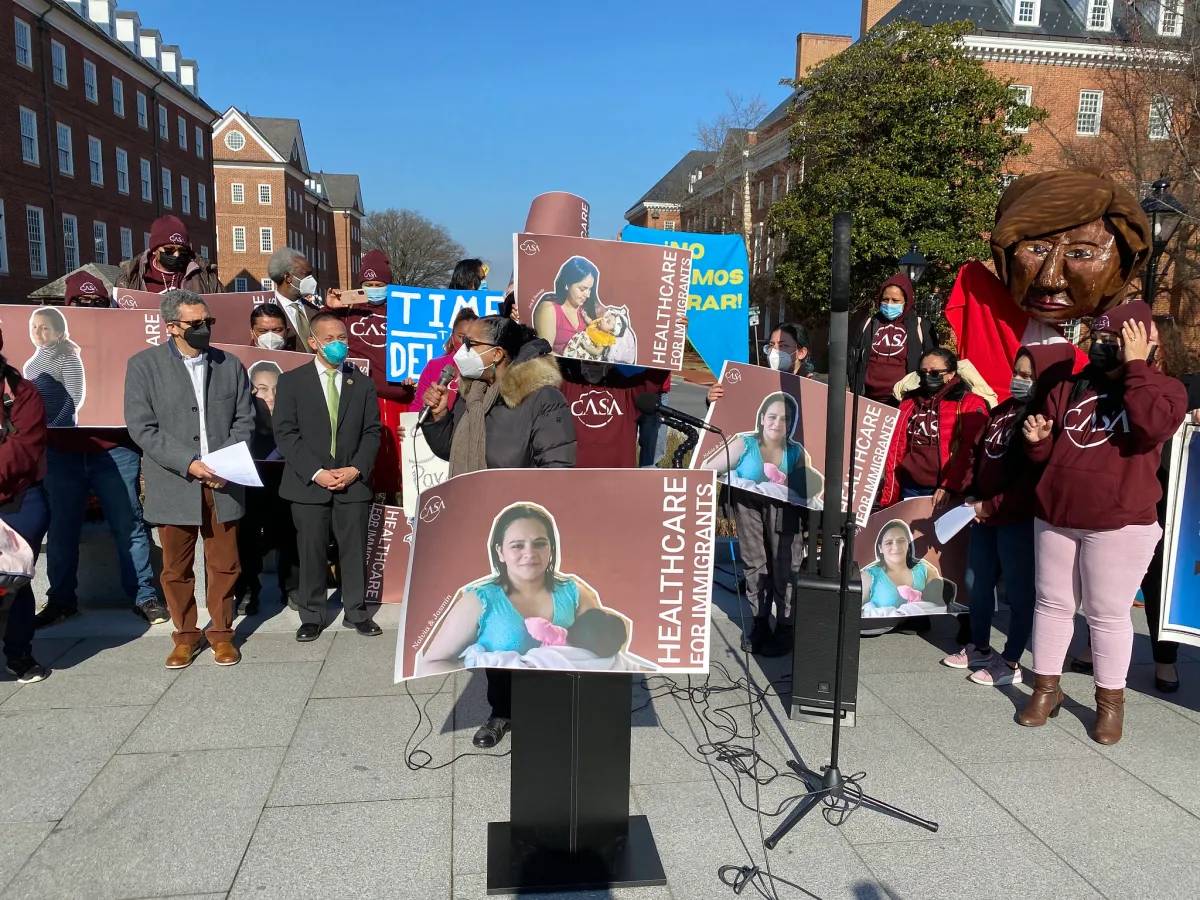
Activists who lobbied for the proposal celebrate the measure. Gustavo Torres, executive director of the pro-immigrant organization CASA, called passage of the bill a great step toward health care for everyone.
“Driven and led by immigrant mothers from across Maryland, this victory is attributed to the tireless efforts of the community demanding that mothers and their babies, regardless of their immigration status, be treated with dignity, respect and given the life-saving care each person deserves,” Torres said.