Colleen Grablick
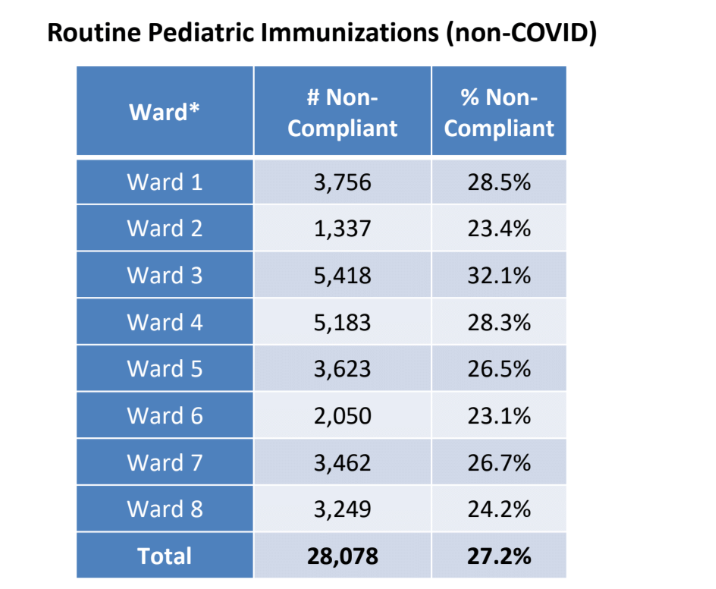
More than 27% of all students across D.C.’s public, public charter, parochial, and independent schools — roughly 28,000 pupils in all — are missing routine childhood immunizations according to data from the city.
The statistic underscores D.C.’s struggle to encourage routine vaccinations during the pandemic, and forecasts the challenge that lies ahead when the city attempts to enforce the newly adopted COVID vaccine mandate for students.
The D.C. Council’s Committee of the Whole held a public roundtable on childhood vaccinations Wednesday, to hear from city agencies on how they plan to ensure kids are getting their shots before returning to classrooms in the fall.
https://twitter.com/chenderson/status/1542155861463900161
Under current D.C. law, every child who goes to school must be up to date on vaccinations against several different illnesses (like measles and pertussis) with limited medical and religious exemptions. If a child is not vaccinated and has not gotten an exemption within the first 20 days of school, they cannot return.
“As of June 2022, the percentage of students in the District known to be in compliance with RPIs, based on data available to us, is only 73%,” said Asad Bandealy, a D.C. Health bureau chief who testified before the council. “That number makes the District’s schools vulnerable to outbreaks of vaccine-preventable diseases, particularly measles or whooping cough.”
The city’s compliance rate — 73% — puts D.C. well below the national average of roughly 93%, according to the Centers for Disease Control and Prevention.
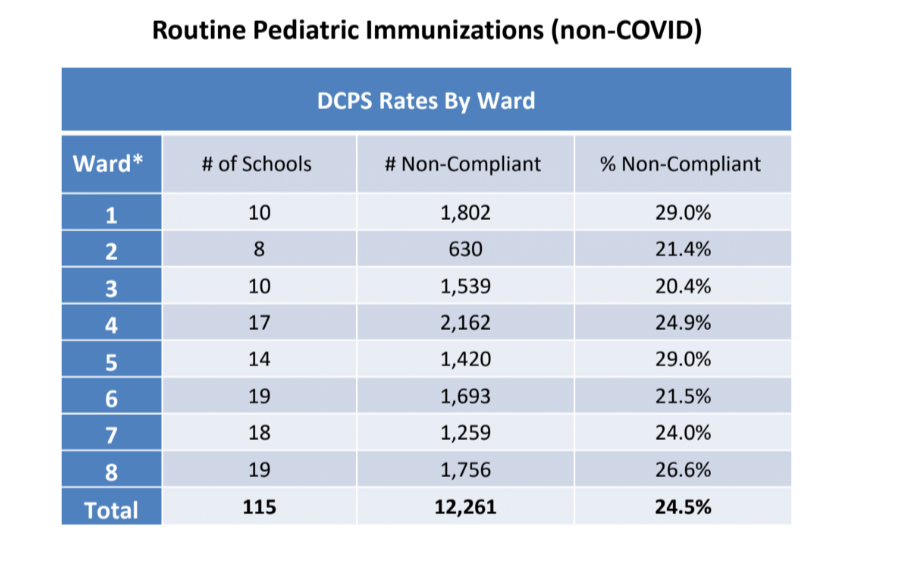
The Office of the Deputy Mayor for Education shared a breakdown of vaccination compliance by ward. Schools in wards 2 and 3 had the highest percentage of non-compliance as of this June, according to the city’s immunization information system. Out of D.C. Public Schools, though, those wards reported the lowest percentage of non-compliance, suggesting that students at public-charter, parochial, and independent schools in those areas could be pulling the compliance rates down.
D.C. Health, the Office of the Deputy Mayor, and the Office of the State Superintendent all testified to lawmakers that the agencies are coordinating a push over the next three months to ensure that kids are getting their vaccines before heading back into classrooms in September.
Bandealy described the plan as having four parts: outreach and awareness-raising, expanding access to vaccines, engaging providers, and engaging the community — essentially an extension of an outreach effort outlined by D.C. Mayor Muriel Bowser earlier this year. The city will be sending out rounds of mail and phone calls to families who have yet to comply, and setting up mobile vaccination clinics at schools with low compliance. They also plan to work with medical providers in the region who treat large numbers of children, to ensure those providers are encouraging vaccination.
D.C. Health also plans to work with Black Coalition Against COVID-19, Advisory Neighborhood Commissions, and faith-based groups to spread the word about vaccinations.
“We are fortunate to have widespread access to pediatric vaccines here in the District due to a robust network of hospitals, clinics, and other immunizations providers,” Bandealy said. “Even still, D.C. Health has long been concerned about the District’s children who are lagging their peers in other states. The COVID-19 pandemic added to this challenge of vaccinating our youth, as many families avoided in-person medical care over the past two years.”
The impact of COVID-19 on pediatric care, and specifically immunizations, has been well-documented and is not unique to the District — although the city’s particularly low rate for routine vaccination pre-dates the pandemic.
While officials are focused on boosting routine shots this summer, they also have to consider how to ensure that students are getting their COVID vaccines, following the council’s passage of a bill last year that requires all eligible students to be fully vaccinated by the start of the school year.
Per the language of the bill, only students who are eligible for a vaccine that is fully approved by the U.S. Food and Drug Administration would need to be fully vaccinated by the fall. Currently, only the Pfizer vaccine is fully approved for individuals 16 and over, while Moderna is fully approved for adults 18 and older. (According to D.C. Health, 78% of teens 16 and older are vaccinated against COVID.) In younger students, the vaccines are still operating with an emergency authorization, with toddlers through five-year-olds only becoming eligible for their first doses earlier this month.