Margaret Barthel
Fairfax County Public Schools added half a million dollars in this year’s budget to keep up with public records requests, which have more than tripled since 2016 and gotten broader in scope. The increase comes as the school system finds itself the subject of political vitriol over COVID precautions and racial equity programs, among other issues.
The funding will double the staff and add new technology to respond to the volume of Freedom of Information Act (FOIA) requests from the public. It will also bolster staff for responding to requests for student educational records from eligible parents, guardians, or students that fall under the Federal Educational Rights and Privacy Act (FERPA).
The investment will enable FCPS to combine those efforts into one public records office. In total, it will add the equivalent of three full-time staff to support the busy office: one extra staff member to help with Virginia FOIA requests, plus a FERPA officer and FERPA analyst.
“We have one FOIA officer,” says Helen Lloyd, the executive director of communications and community engagement for FCPS. “Typically, in years gone by, one FOIA officer might have been enough for a division that was getting the number of FOIAs that we were. But given the increase in the FOIAs plus the increase in the size of the FOIAs — it is just not sufficient.”
Currently, FCPS spends approximately $130,000 on its FOIA operations. Its total budget exceeds $3 billion. FERPA-related inquiries are handled by school division staff who do not have the function written into their job descriptions, which makes estimating current expenditures difficult, according to Lloyd.
The uptick in Virginia FOIA requests to the commonwealth’s largest school system accompanied highly political controversies over school reopenings, racial equity programs, inclusive policies for LGBTQ+ students and staff, and attempts to ban books by queer authors and authors of color from both class curricula and library shelves. Neighboring Loudoun County Public Schools has also seen a significant increase, and had to add staff to help fulfill the volume of requests, according to Loudoun Now.
DCist/WAMU reviewed data on public information requests received by FCPS since 2016 and analyzed the subject matter of the nearly 700 requests submitted between March 2021 and March 2022. (Information that, yes, we obtained via our own FOIA request.) We contextualized that information with interviews with more than a dozen school division staff, teachers, parents, activists and experts.
The content of the public information requests themselves provides a window into the political environment in which FCPS schools and their staff are currently operating, where the schools — and to a certain extent, their public records — have become a battleground between conservatives eager to criticize schools for so-called ‘wokeism’ and poor management, and liberals who support steps to make classrooms more inclusive. Public outcry at Fairfax school board meetings has frequently fed conservative media outlets, generating further anger and scrutiny. Some teachers say the pressure of the requests and the public anger they feed makes it harder for them to do their jobs.
“We need accountability on our elected bodies and our governments, but at what cost?” asked Melanie Meren at a budget presentation in the spring. She represents Hunter Mill district on the Fairfax School Board. Meren noted that the $500,000 the schools will now spend on public records resources could have otherwise gone to other priorities, including mitigating classroom overcrowding.
“There are other ways to get information, to make your voice heard, and to advocate,” she said.
But other parents and conservative-leaning groups say they feel dismissed by school officials — and so they’ve resorted to FOIA requests as a means of holding the schools accountable.
“We’re following the money. We’re checking the email trails. We’re following the bad breadcrumbs,” says Asra Nomani, a former FCPS parent and education commentator who has filed hundreds of FOIA requests to school districts across the country, including Fairfax. “We are kind of like Nancy Drew in each one of our school districts.”
The rise in requests received by FCPS is not surprising to Megan Rhyne, the executive director of the Virginia Coalition for Open Government, a group that advocates for transparency.
“What tends to happen is that when there are controversies or when there are areas of intense interest, that’s when FOIA requests are going to increase,” she says, noting that the government’s response to the pandemic likely provoked heightened scrutiny.
Schools, Rhyne says, have historically drawn high levels of interest.
Nationwide, there has been a steady increase in FOIA requests received by the federal government since 2012, though it declined slightly in the early part of the pandemic. Fairfax County government has also seen increases, including a 38% jump between fiscal year 2019 and fiscal year 2021.
There is universal support on both sides of the political conversation for the transparency and accountability that FOIA requests can provide for public institutions. People on both sides of Fairfax’s school debates have used FOIA to uncover contextual documents and data to support their messages.
However, Meren and others have expressed concerns that the breadth and content of the recent requests are effectively jamming the workings of the school division and intimidating school staff.
A significant increase
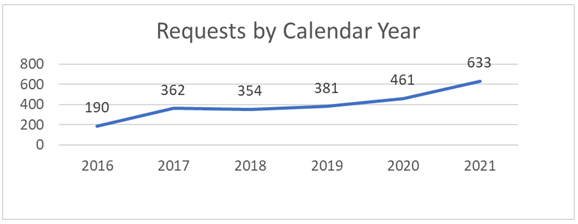
Public information requests to FCPS under the Virginia Freedom of Information Act law have risen from 190 in 2016 to 633 in 2021. Much of that increase came between 2019 and 2021, where requests climbed by 250.
“What this [budget allocation] is going to do is make sure that we are able to do double and triple checks internally to make sure our redactions are really 100%, to make sure that our single FOIA officer is able to be sick occasionally or take some leave off,” says Lloyd, the FCPS communications director. “Right now that is almost impossible, given the compliance requirements and the turnaround times.”
Lloyd expects what she calls the “continued barrage of requests” to increase even further in future, the result of legislation passed by the General Assembly that ends fees for scholastic records requests and tightens deadlines, starting July 1.
Rhyne, the open government expert, says government staffing and support for FOIA responses has generally shrunk in recent years.
“People started looking at FOIA as this extra thing that got in the way of them being able to do their work, rather than looking at FOIAs as, ‘Hey, this is just one of many statutory obligations that I’ve got,’” she says.
FOIA officers run searches in their agency’s archives for everything that might match a specific request, then review them page-by-page to determine if the documents do, in fact, respond to the original request, and to redact information that should not be released publicly, including student identifying information. In Fairfax, on average, the current FOIA officer reviews between 1,000 and 5,000 pages per month in response to FOIA requests, according to an emailed statement from the office.
Anecdotally, the number of pages has gone up as the office receives broader requests, according to Lloyd. That’s not a surprise, considering the content of some of the 683 requests the school division received in the year-long period DCist/WAMU analyzed. While some are quite specific — asking for certain student achievement data points or seeking emails between named staff or school board members — others are incredibly broad.
“Please provide the syllabus or outline for every course that you currently offer,” one request asks — a difficult question to answer for a school division with nearly 25,000 employees serving about 178,000 students in nearly 200 schools.
Another requester wants to know “What is being taught in English class and history. What are you teaching in terms of equity, and CRT.”
(FCPS maintains that it does not teach critical race theory, a graduate academic discipline that explores the workings of institutionalized racism in America, in its classrooms. The term has become a catch-all for conservative parents and politicians — including Virginia Gov. Glenn Youngkin — for racial equity programs.)
Rhyne calls overly broad requests “a technological problem.” She points out their size can balloon quickly, if, for example, a requester wants to see email traffic on a specific topic, and each email is threaded with previous replies. That’s a lose-lose scenario to Rhyne.
“The FOIA officers are swimming in responsive records that they have to go through,” she says. “And then the requester is ending up paying for a lot of stuff they don’t want.”
In those cases, Rhyne wants FOIA officers to discuss with the requester how to better target their request to make it less time-consuming and less expensive to fulfill. FCPS staff say that is their practice, though Nomani and others have expressed frustration with the charges the school division sometimes attaches to large requests.
According to some locals, the uptick in requests has paralleled a growing willingness among FOIA requesters to be open about making the requests in the first place.
“Three years ago, people didn’t want anyone to know they did a FOIA because they were afraid of retaliation,” says Diane Cooper-Gould, a special education advocate in Fairfax County. Parents worried the administration would make things more difficult for their families. “Now it’s very open. People are doing FOIAs all over the place.”
Cooper-Gould says she’s been invited to multiple workshops to teach people how to submit a FOIA. Years ago, she was asked to join a phone call with a similar purpose — but says everyone was required to use codenames to keep themselves anonymous.
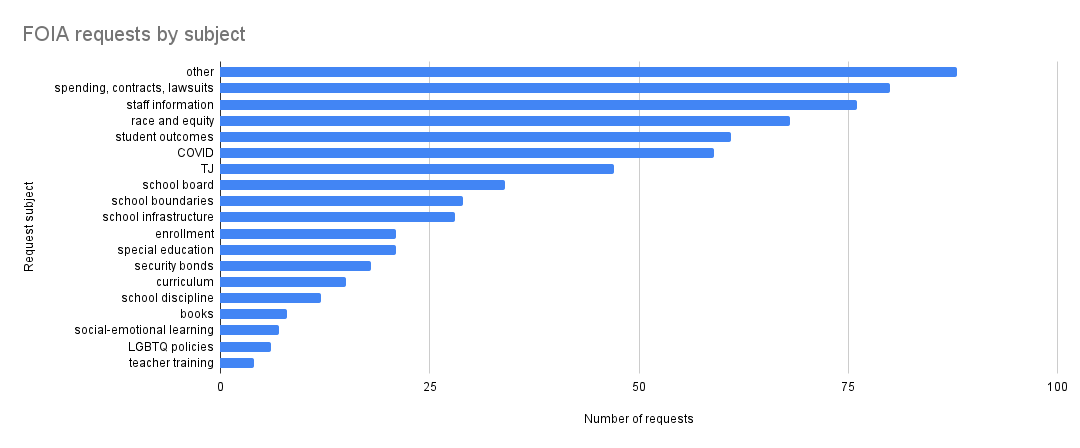
The year’s worth of requests reviewed by DCist/WAMU encompasses a wide range of topic areas, including school boundary and feeder patterns, school infrastructure issues, busing, cyberattacks, and more. Almost 13% defy easy categorization or have summaries that lack enough context to make a determination about the actual subject matter of the request.
Many of the themes in the FOIA requests — at least 40% — are tied to topics fueling conservative outrage over schools across the country, including race and equity programs, school system contracts and legal spending, pandemic response, and the admissions process of a highly selective local magnet school, Thomas Jefferson High School For Science and Technology (TJ). In the case of TJ, the public records requests come from the Coalition for TJ, an organization arguing against admissions changes intended to make the student body more diverse, as well as the TJ Alumni Advocacy Group, which supports the changes.
An “iron wall around our school districts”
Just as there are significant divisions in how people on either end of the political spectrum feel about school boards and school issues these days, there’s no shortage of differing perspectives on the significance of the uptick in FOIA requests submitted to FCPS.
The one thing most people agree on: FOIA itself is an important tool of transparency for public institutions, including the schools. People who are diametrically opposed in local political matters feel that FCPS should consider publishing more information up front, like admissions data and contracts, instead of requiring FOIA requests to obtain it.
In an ideal world, FOIA would be “a way for government and citizens to engage in a relationship rather than an adversarial contest,” says Megan Rhyne, of the Virginia Coalition For Open Government. She recommends that organizations subject to FOIA be “proactive” in sharing information of public interest.
“You can cut down on requests if you can point [requesters] to the website where you have posted this information, or if you are continually forthright with information,” Rhyne told DCist/WAMU.
But beyond that baseline, the political camps diverge. Conservative activists tend to point to FOIA requests as an essential means of investigating and exposing what they claim is malfeasance or “wokeism” in schools.
“I have filed about 300 requests around the country in order to understand the industry of consultants and contractors that have been hired to bring in this new phase of diversity, equity and inclusion and anti-racism training into our school systems,” says Nomani, of the Coalition for TJ.
Nomani is also a contributing writer at The Federalist, and a senior fellow at the Independent Women’s Forum, a conservative nonprofit with ties to the Koch brothers. Earlier in the year, she publicly split with Parents Defending Education, a nonprofit that says it is “fighting indoctrination in the classroom.” But while she worked with the group, she published her FOIA findings in its “consulting report card,” which examines what schools in all 50 states and D.C. have spent on racial equity programs (or “critical race theory,” the umbrella term used by right-wing groups to identify lessons and materials that deal with systemic racism).
Nomani says she’s filed about 15 FOIA requests with FCPS, and that she’s part of a group message chat on Facebook where about a dozen locals discuss FOIA strategy and share tips for drafting requests. She’s also publicly advised parents on Twitter about how to target requests.
Beyond her interest in school division contracts, Nomani has filed FOIAs regarding the admissions changes at TJ, where her child recently graduated. While the changes do not look at the race of different applicants, Nomani and other critics of the policy shift believe they are anti-Asian in intent — and have pulled passages from school administrator emails obtained under a FOIA request to try to prove their point, in public and in an ongoing lawsuit.
“I saw the back and forth,” says Nomani. “The principal lamenting that there weren’t enough Black and brown kids at the school, even though, as an immigrant from India, I’m as brown as can be.”
(In the emails, TJ administrators appear to be concerned about the low proportion of Black and Latinx students at TJ in comparison with the population of Fairfax County.)
Nomani believes the uptick in requests to FCPS and the subsequent budget allocation is “a direct result of the decision by bureaucrats running this school system to have this iron wall around our school districts,” to repel parent input.
“It just came like tragically home to me when the parents were outside the school in Texas trying to find out what was happening while this crisis unfolded and bullets were flying,” she said, referencing the school shooting in Uvalde, Texas, where parents and relatives clamored for police to take action. “That was a perfect metaphor for how so many of our parents feel… like we’re being pepper sprayed and handcuffed and spit on as we’re trying to ask simple questions.”
Nomani and the Coalition for TJ are part of a handful of parent groups, many formed to pressure schools to reopen in 2020, and some with ties to the Republican Party and funding from conservative sources. Their activism is now focused on a broader range of cultural issues, including advocacy against school equity programs and LGBTQ-inclusive policies. Many amplify each others’ frustrations with FCPS and teachers’ unions on social media and in angry public testimony at school board meetings, which frequently devolve into personal attacks and demands for board members to resign.
At a meeting in March, which by her account led to her dismissal from Parents Defending Education, Nomani called school board members “the new face of racism” and compared equity policies and changes to the TJ admissions test to the segregationist history of Massive Resistance opposing integrated schools in Virginia. She didn’t leave the mic when her comment time was up and continued to shout at school officials and security personnel near the front of the room until the school board took a short recess.
Theatrical public comments and viral tweets are routinely picked up by conservative media outlets, including Fox News, Breitbart, The Daily Caller, The Federalist, and more — and the results of FOIA requests have frequently been at the heart of these controversies. At a different school board meeting in January, Nomani wore a sign taped to the back of her jacket that quoted a text message sent by a school board member and unearthed in a FOIA request.
“There would be a video of a parent at a school board meeting, explaining why they think critical race theory is both bad and happening in their school system,” says Matt Gertz, a senior fellow at Media Matters who studies Fox News. “Then the video would be posted on social media. It would go viral. And then the next day, the person might be on Laura Ingraham’s Fox News show.”
According to Media Matters, Fox News ran 98 segments about Loudoun and Fairfax County schools — five and a half hours of programming — from March through June of 2021 alone. Often, Gertz notes, Fox News interviews members of these parent groups without disclosing their affiliations with prominent conservative organizations.
Two people labeled only as parents in this October 2021 interview with Fox News are also affiliated with conservative groups. Elizabeth Schultz is a former Fairfax school board member and ex-Trump administration Education Department official. Suparna Dutta chaired the group Educators for Youngkin. Archived video courtesy of Media Matters.
At least one group — the Fairfax County Parents Association, which grew out of a group called OpenFCPS and is now a critic of the schools’ pandemic response — took its complaints about FCPS’ handling of FOIA requests directly to the Youngkin administration (which itself has been averse to respond to some FOIA requests).
Immediately after state Attorney General Jason Miyares took office in January, the association sent his office a formal letter asking for intervention in what they allege is stonewalling by FCPS in producing text messages and emails between school board members.
“VFOIA requests for these electronic discussions, if we know about them at all, are rebuffed as too vague, burdened by thousands of dollars of fees, or hampered by over-enthusiastic redactions,” the group said in the letter, which it also tweeted.
Rhyne, with the Virginia Coalition for Open Government, says that there are a limited number of reasons for denying a FOIA request under Virginia law, including that the information is exempted from disclosure, doesn’t exist, or is not specific enough to be searchable. The rules governing redacting or withholding documents, Rhyne says, should be “construed liberally in favor of access.”
In one case in Fairfax, complaints about redactions skewed the other way. Parent and former special education teacher Debra Tisler submitted a FOIA request for more information about school district spending on legal fees and school district contracts — and then shared what she received with a special education advocate and critic of FCPS who runs the website SpecialEducationAction.com. The school board brought a lawsuit against both parents, saying the documents they had provided were not properly redacted and should be returned to the school division to correct the error. A judge recently found that the school board was unlikely to succeed on the merits of the case.
Lloyd, with FCPS, says the school division has since implemented new technology to coordinate redactions between the records office and legal counsel and to better track “who’s next responsible in that chain of sign off.”
Rhyne is cautious about the role of lawyers, particularly outside counsel, in the FOIA process.
“I think lawyers have gotten too involved, and I say that as a lawyer,” she says. “Their obligation is to protect the client. They are not looking at these things from the perspective of a public servant, which says, ‘What does my community need? What can I do to serve this citizen?’”
For her part, Tisler believes the lawsuit against her is an example of “a pattern and practice of Fairfax County Public Schools to fight the provision of services rather than to provide them,” a concern she feels is especially acute with respect to special education, including the schools’ approach to literacy education and services for dyslexic children.
Parent FOIA requests have a history of shedding light on widespread problems in the schools’ special education operations. Tisler and Cooper-Gould, the special education advocate who said parents used to be afraid to file FOIA requests, each independently pointed to FOIA requests as a significant part of uncovering the schools’ policies of secluding and restraining children with special needs. FCPS didn’t report their use of those practices to federal regulatory authorities, according to a 2019 WAMU investigation. The school district has now settled the subsequent legal case, committing to completely phase out the practice of seclusion by the upcoming 2022-23 school year.
“Weaponizing” FOIA
Nomani, Tisler, and others say their FOIA requests are meant to illuminate corruption and misuse of taxpayer money. Meanwhile, liberals suggest that some FOIA requests are political fishing expeditions for embarrassing content — what some call “gotchas” designed to sow distrust in the schools and create viral moments for conservative media.
They also worry fulfilling more and more FOIA requests will degrade staff morale, on top of the extra costs for the school district.
“Many of them are quite reasonable requests, some from news organizations and some clearly from concerned parents about IEPs and different things that affect the students,” says Holly Hazard, the founder of 4PublicEducation, one of the groups recently formed to advocate on behalf of public schools in Virginia. “But some of them have the taint of someone wanting to create work for the sake of creating work within an already overstressed system.”
“I hate the idea of these [FOIAs] being essentially weaponized and being a waste of taxpayer money,” says Jiunwei Chen, the vice president of the TJ Alumni Action Group, which was formed to advocate for diversity and inclusion at TJ, including in the admissions process.
Chen and the alumni group have themselves filed several FOIA requests for TJ admissions data — and used the information they received to publish an analysis of whether or not the admissions changes in fact discriminated against Asian students (the group argues they don’t, since the number of students in the class expanded, and the Asian acceptance rate was within the range of previous years).
For Hazard and Chen, whether or not someone is misusing FOIA comes down to their intent, or “if this is a legitimate issue of concern to them,” as Hazard puts it.
“Part of it, I feel like, is ‘What is the intent?’” Chen says. “But that’s just so hard to measure.”
Cooper-Gould, the special education advocate, sees the uptick in FOIA requests as a symptom of schools becoming “a pawn” in the “political arena.” She wants to see public information requests focused on further systemic advocacy for students.
“We don’t have perfect systems,” she says. “My focus is always, how do we improve them for everyone, not how do we tear them down?”
Hazard, an FCPS substitute teacher who ran for a seat in the General Assembly last year as a Democrat, says the viciousness of the political debates over schools in the past few years — in Fairfax County and nationally — is important context in examining the rise in requests and the question of their intent.
By way of example, Hazard cited an instance where a parent used a public comment period to accuse an openly gay member of the Fairfax School Board of being a pedophile — a common accusation leveled at LGBTQ+ people by cultural conservatives. She also pointed to a reporting mechanism set up by the Youngkin administration to encourage parents to complain about teachers.
“When you have people who are shrieking ‘Pedophile!’ and pointing at people on the school board in school board meetings, and you’ve got a governor’s tip line that encourages tattle-tailing and all the things that have gone on, the idea that someone could sit in the privacy of their own home and create disruption simply by typing a FOIA request into their computer should not be surprising,” she says.
Hazard and others don’t claim that local public schools are perfect, but they feel the criticisms of FCPS — whose high schools routinely rank among the best in the country — are overblown or lack context. They point out that arguing traditional public schools are failing is a politically useful jumping-off point for organizing for school choice options such as vouchers or charter schools, goals Youngkin first voiced on the campaign trail.
To find out more information on that front, Hazard has — you guessed it — filed a FOIA request, seeking correspondence between Attorney General Miyares and “people who may be involved in trying to have a negative impact on public education,” she says.
Asked about concerns that FOIA requests are being used to create public distrust in schools, Nomani, of the Coalition for TJ, says she’s “sympathetic,” but pointed to the relative wealth of FCPS as a reason to believe that “this school system should be able to withstand questions from parents.”
Hazard, for her part, thinks there’s no real solution to the influx, other than to keep responding to all valid requests.
“Once we start parsing who gets to be in the public square and who doesn’t, democracy loses,” she says. “And I think the same thing is true, unfortunately, for FOIAs.”
‘A bludgeon to try to silence people’
Some teachers in the school system say heightened FOIA scrutiny, coupled with the environment of online anger, has made them more cautious in the classroom. Several would only speak to WAMU/DCist for this story on condition of anonymity, citing concerns that they could become targets of online ire.
“Transparency is wonderful and it’s terrific that people know more about what their government is doing,” says Robert Rigby Jr., a recently retired FCPS teacher and one of the leaders of FCPS Pride, an LGBTQ+ resource group for parents, guardians, students and teachers in the schools. “My anecdotal experience is that the threat of FOIA is being used as a bludgeon to try to silence people.”
Rigby left his position teaching high school this spring, after decades with FCPS. He said the uptick in FOIA requests at times “stymied” his communication with school administrators, who were careful about putting things in email for fear of being misquoted out of context. Rigby generally advises fellow teachers to avoid sending long emails to administrators about school issues.
Other teachers, including one who has been actively involved in pushing for more equity programming at a high school, recounted concerns about having their emails turn up in FOIA requests and then taken out of context. FCPS staff are notified when their names turn up in documents that are responsive to a request.
As an advocate, Rigby says he has gotten into online arguments about LGBTQ+ policies with conservative Twitter accounts, only to have the accounts publish an outdated salary figure and information that he had filed for retirement. He’s not sure the accounts found any of it out via FOIA requests, but he said they claimed they did, which he thinks is damaging enough to people watching the exchange.
“The threat was there: ‘We have FOIA’d, therefore we can find out personal information,’” he says.
Rigby says the online and in-person backlash against LGBTQ-inclusive policies — and especially books written by LGBTQ-identifying authors — factored into his decision to retire this year.
“All of the public screaming about pedophilia made doing things like wearing rainbow shoes or rainbow shirts – to [a] degree in school, but also to a degree in community, going to the Safeway and the 7-Eleven — it just became painful to be openly gay in Fairfax County,” he says. “It was painful and more frightening than I needed to put up with.”
The FOIA requests, the online outrage, the anger at school board meetings — Rigby says it’s all damaging teacher morale and making people question whether they’ll stay in the profession.
“It’s part of a larger picture to make work in public schools so unpleasant that the public schools become dysfunctional,” he says. “And it’s succeeding.”