Colleen Grablick
After more than two years of operation, D.C. is dismantling its coronavirus contact tracing program — a network of more than 100 employees tasked with tracking the spread of the virus via interviews with infected and exposed residents.
The Washington Post first reported the news.
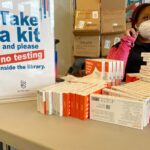
According to a DC Health spokesperson, the program is no longer necessary due to declining case counts and the wide availability of at-home tests. The city’s weekly case rate per 100,000 residents was 196 as of June 25, according to DC Health data — the lowest its been since a slight uptick in May. According to the Centers for Disease Control and Prevention, though, D.C. is still in the “medium” range for community transmission, a measure that’s determined by rates of new hospitalizations and COVID infections per 100,000 residents.
Senior DC Health official Patrick Ashley said that as the virus evolved, and the time between exposure and symptom onset shortened, the efforts of contact tracers sometimes became moot.
“The time from exposure to the time that people are testing positive is much shorter, and people are recovering faster,” Ashley told DCist/WAMU. “So when we actually talked to people, many times it was that they had already started to show symptoms, and so the value of actually doing that reach out was no longer there.”
In eliminating the program, the city is laying off 131 employees of the current 151-member contract trace force, according to Ashley. The remaining 19 have moved into other roles within the agency, including infectious disease intervention work related to monkeypox. The decision to end the program was made and communicated to the contact trace force employees earlier this year, according to DC Health, and the agency offered to work with employees to find new placements.
“For the past several months, these individuals have actually not been doing contact tracing,” Ashley said. “They’ve been doing other public health activities of outreach, and so throughout the time as we’ve been scaling down, we’ve been making sure that there’s opportunities to move over into other positions.”
The contact tracing force began in the spring of 2020 with 65 members, and grew to more than 300 members by that June. D.C. Mayor Muriel Bowser used $2.3 million from the city’s cash reserve fund to build out the team of contact tracers, with a plan to eventually onboard more than 900 members, but at its most, the force employed 450 tracers, according to Ashley.
An epidemiological tool not unique to COVID, contact tracing works to contain outbreaks by getting in touch with people who have tested positive for COVID, and asking them questions about their recent activities — where they were, who were they with — and other personal information, like living situations and health conditions. Tracers would instruct infected residents on how to isolate and quarantine to avoid exposing other individuals, and then reach out to individuals who were considered close contacts of the resident who tested positive. They also followed up with infected residents in the days after their positive test.
At least, that’s how it was supposed to work.
D.C. — along with the rest of the U.S. — struggled to effectively manage the spread of the pandemic with contact tracing over the past two-plus years. At some points, the level of virus in the community was simply too high for local contact tracers to keep up, given ever-present pandemic staffing problems. (Plus, there was never a concerted and large-scale federal contact tracing apparatus.) There was also the issue of trust and getting residents to pick up the phone; no one wanted to be the COVID “patient zero” of the friend group, while some residents harbored concerns about the government collecting personal data. (D.C. contact tracers did not share the names of infected residents with their close contacts.) According to Ashley, as the pandemic wore on and fatigue set in, people were less and less likely to participate in the process once they tested positive.
“We’re thankful for the people that did provide that information, which was able to help us to do contact tracing in 2020, and 2021. But what we saw is that many people, as the disease evolved and people became pandemic fatigued, they weren’t willing to provide that information anymore,” Ashley said.
By spring 2022, with the advent and proliferation of at-home rapid tests, it also became likely that some residents testing positive on their own would not report their results to the city, thus flying under the contact tracing radar all together.
Still, the program had its benefits. It was helpful — albeit not perfect — in identifying outbreak settings, and in the later stages of the pandemic was predominantly used in congregate settings like jails, health care facilities, and nursing homes. According to DC Health, the city will still be monitoring spread in these places.
Ashley said the program also served a purpose on a human, individual level, especially during the first months of the pandemic when little was known about the virus. It allowed DC Health officials to learn more about how and where the virus was spreading, and who it was impacting most — a facet of infectious disease investigation that is also crucial to the city’s current monitoring of monkeypox, according to Ashley.
“Individuals were able to talk to somebody and understand that they might have been exposed, and how they could get access to testing. People were scared, and they were able to talk to somebody to provide that reassurance, both if they were contact and also if they were a case,” Ashley said.
Residents will still receive notifications from the DC CAN exposure system — a program on cellphones that alerts users when they may have been in close contact with an individual who has tested positive.
Maryland and Virginia have also scaled back contract tracing efforts this year. In January, Virginia’s health department moved away from investigating every COVID-19 infection and instead moved to focusing on outbreaks and infections in high-risk settings. Maryland has taken a similar approach, but now reaches out to most residents via and automatic system when they test positive. Mayland and Virginia also have their own exposure software systems.