Elliot C. Williams
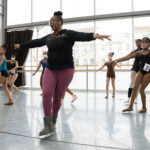
It’s a Tuesday evening in May, and three rows of Black girls ages 11 through 17 are lined up on the second floor of the Dance Loft on 14. The girls are students of the Jones-Haywood Dance School in Petworth — a historic dance school that just celebrated its 80th year in the District — and they’re struggling through an intense rehearsal for their summer recital, a few short weeks away.
Three instructors stand near a floor-to-ceiling mirror and watch intently, catching any slouched backs or lazy jumps, even in the back row where some of the less experienced dancers are attempting to hide from their teachers’ all-seeing eyes.
“Step, step, step, up! And step, step, step, up!” artistic director Sandra Fortune-Green commands. The ballerinas-in-training move in synchronization with her voice, their eyes set dead ahead on their movements in the mirror. Jones-Haywood rents this rehearsal space at Dance Loft three nights a week, while most of the school’s classes happen at its home base a few blocks away, on the corner of Georgia Avenue and Delafield Place NW, now a historic landmark.
For decades, Jones-Haywood has been quietly teaching hundreds of Black D.C. youth in the art of ballet. In recent years, that effort has grown into a collective of teachers across several schools, led by Fortune-Green, a former professional ballerina who learned ballet from the Jones-Haywood founders, and Lauri Fitz-Pegado, a retired ballerina, career diplomat, and author of the memoir, Dancing in the Dash. The teachers support Black ballerinas across D.C., specifically at five institutions: The Washington Ballet, the Dance Institute of Washington (DIW), Jones-Haywood, Howard University, and the Duke Ellington School of the Arts.
They call themselves The Collective and organize masterclasses, summits, and host discussions with leaders at major institutions including Juilliard, the New York City Ballet, and the Richmond Ballet. The group includes DIW’s Kahina Haynes, Howard University’s Royce Zackery, and Duke Ellington’s Adrian Vincent James, among others. Many of them have studied or taught at Jones-Haywood, and they’ve all been “firsts” at some point in their careers; James, for example, was the first Black dancer with the Houston Ballet.
Rather than dance around equity issues, they seek to educate whenever possible. Earlier this year, for instance, The Collective hosted a symposium called “Addressing Racialization in Ballet” in collaboration with Canada’s National Ballet School, part of an ongoing partnership with that institution. Students under their tutelage go on to join professional dance companies as dancers or administrators, teach, consult, start businesses of their own, or become leaders in other careers, Fitz-Pegado says.
“In our day, this was not something that we could even think about,” Fitz-Pegado says of the dozen or so Black teachers across the D.C. area she can name. “We’ve had this group for about two years and provide opportunities, not only for the teachers to coordinate and collaborate and to learn from each other, but also for the students of color of all of those institutions to come together for masterclasses and for programs.”

The European artform of ballet was not created with Black dancers in mind or set up in a way to allow Black dancers to succeed, the teachers explain.
“Mary Day was the [founding] artistic director of the Washington Ballet, and she unfortunately held some of those incorrect, stereotypical views of black bodies,” says Fitz-Pegado. “She said that Black bodies were not conducive to classical ballet. That was really very hurtful to many of us who were growing up at that time.”
Any Black ballerina who learned their craft from the 1960s through the early 2000s will mention The Dance Theatre of Harlem and its iconic founder, Arthur Mitchell. He took many a ballerina under his wing, including the D.C. teachers in this local collective. But the Jones-Haywood Dance School was just as instrumental for Black students in “Chocolate City.”
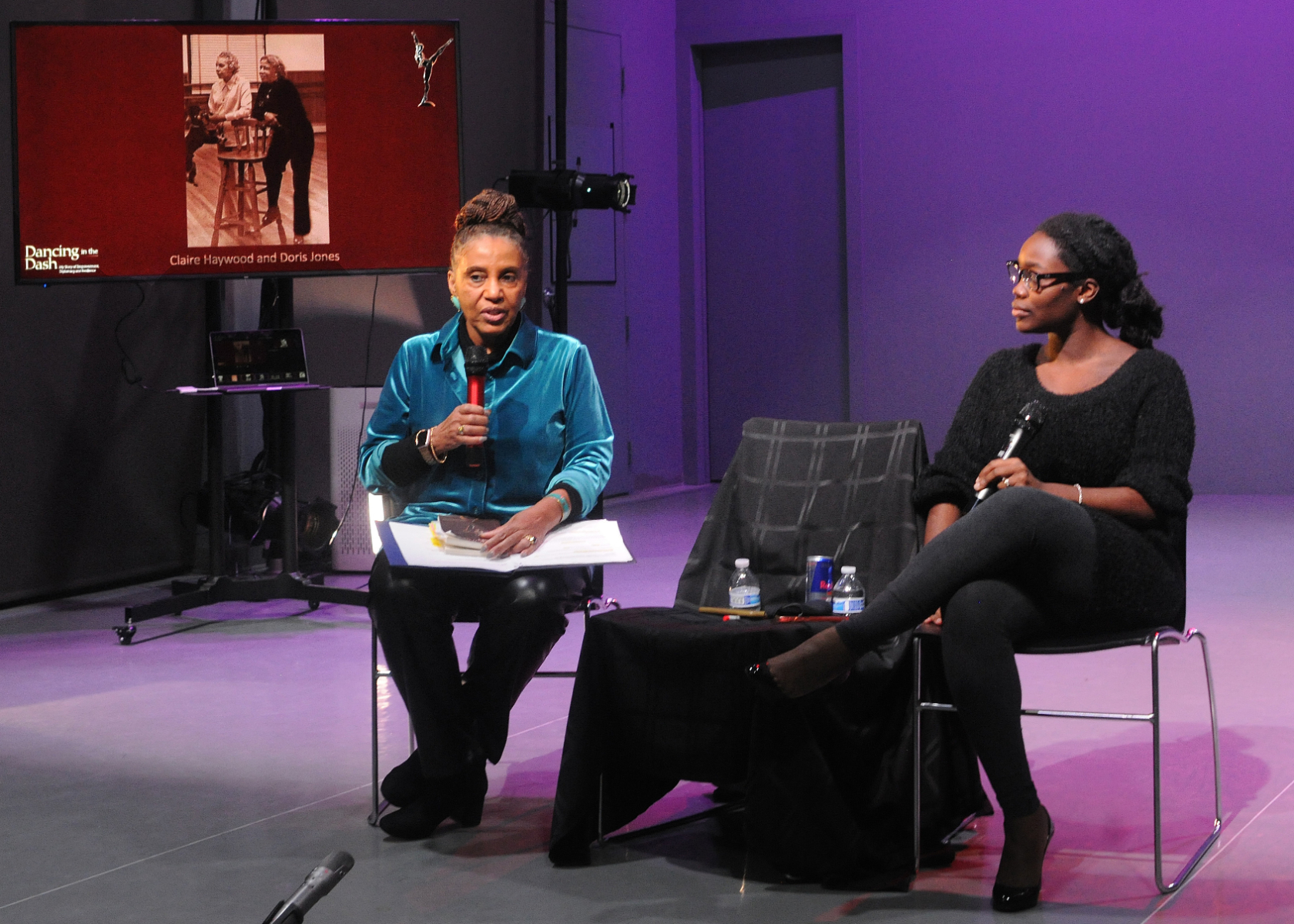
When Doris Jones and Claire Haywood founded their ballet school in 1941, the city was still segregated. Ballet was considered a white-only artform. Jones, a tap dancer by trade, had countless doors shut in her face when trying to learn ballet — Fitz-Pegado, who also studied with the founders, says that while white students left out the front, a teacher allowed Jones to sneak in the back door so she could receive lessons.
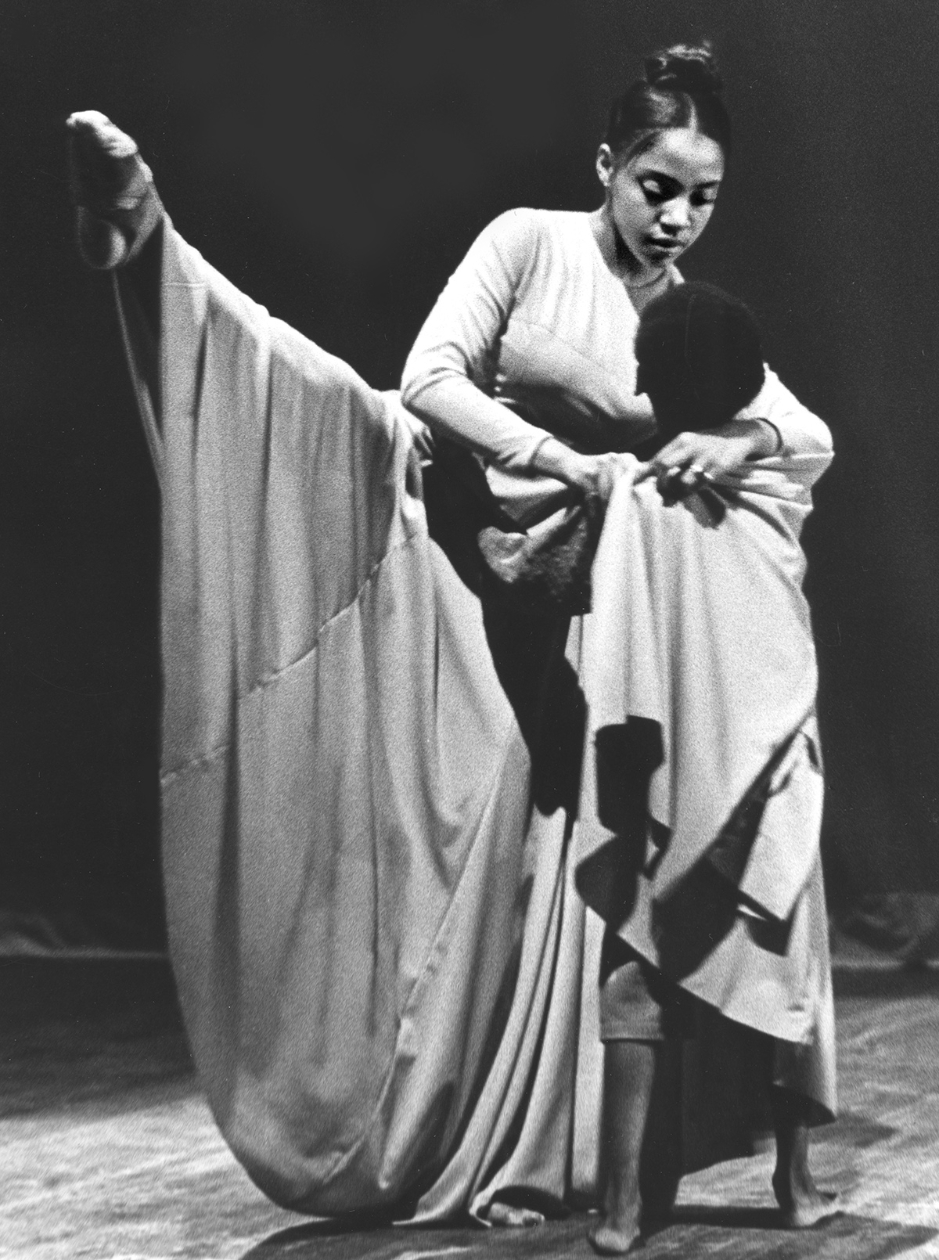
The dancers of Jones-Haywood and its professional wing — the racially-integrated and now-defunct Capitol Ballet Company — changed the future of ballet. Sandra Fortune-Green became the first African American woman to compete in an international competition, twice in Moscow and once in Bulgaria.
Now, as instructors, The Collective will tell you that rigid training is what brought them their success.
“We had very tough teachers, and they let us get away with nothing,” says Fitz-Pegado. “They explained that the discipline and the toughness that we grew up with was what was going to help us through life, living in a culture that was majority white.”
Brandye Lee, a dancer who studied at Jones-Haywood and now teaches the school’s most advanced cohort, says the rehearsals are still very demanding for the same reason.
“I think it’s even more important for our students to understand what they’re up against when they leave this safe haven or bubble and go out into the larger world of ballet that isn’t necessarily going to just fling open the doors, even just because they’re good,” Lee says. “They have to often show that they’re even more prepared, even more qualified than their white peers would necessarily have to show in order to be included.”
Ashley Murphy-Wilson, a dancer with The Washington Ballet, says she is still working to reverse the stereotypes that exist within the art form. And they aren’t subtle: As recently as 2017, a blogger took issue with Murphy-Wilson’s role as the bride-to-be Caroline in Antony Tudor’s Jardin Aux Lilas at the Kennedy Center, arguing that the “racially neutral casting” added a “distracting dimension” to Tudor’s depiction of England at the turn of the 20th century.
Murphy-Wilson hasn’t let such vitriol hold her back. With her recent performance of Giselle at The Warner Theatre, she broke barriers as a Black woman in a principal role within a major classical ballet.
She isn’t an official member of The Collective, but Murphy-Wilson teaches young Black ballerinas at THEARC in Anacostia on Saturday mornings and encourages them to be proud of how they look and what they represent.
“There are certain things about Black bodies that are just different,” Murphy-Wilson says. “A lot of my students, because I teach from age 12 to 15, their bodies have started to develop. And a lot of them always walk around with their chests sunken in because they’re ashamed of their breasts … they’re ashamed of their butts … because somebody has been telling them to tuck it under. And so, things like that, I really have to try to train out of them.
“I used to feel the same way,” she continues. “But you have to find pride in that. And I always say, you have to pretend like you’re wearing the most expensive necklace. You wouldn’t concave your chest if you want to show off this beautiful necklace. So you always have to wear your diamonds no matter what. I always tell them that.”

The Collective can see payoff in their efforts in events taking place on larger stages than ever before.
The Kennedy Center recently put on a weeklong ballet program called Reframing the Narrative to acknowledge “that Black ballet dancers have been pillars of the field for decades,” according to the program’s description online. It featured 11 Black dancers — including Murphy-Wilson — from different companies across the world performing in multiple shows. Fitz-Pegado says the program was unlike anything she’s seen before.
“That was historic and wonderful, and unprecedented to have at the Kennedy Center, to have this Black-everything performance,” she says. “These are the things that are encouraging, that show that people are coming together and trying to do the things that need to be done.”
No longer is Misty Copeland the only household name that young ballerinas strive to emulate — newer names like The Washington Ballet’s Nardia Boodoo are making headlines for pirouetting around the expectations set for them, and setting new standards for what a ballerina looks and acts like.
Dancers and teachers in D.C. say they see progress in smaller ways, like when they actually convince ballet companies to find tights and pointe shoes that match their skin tones. Fitz-Pegado says there are at least four or five companies making flesh tone attire to match any ballerina — it may not sound like a lot, but it’s an improvement from years ago when virtually no companies made such attire.
Fitz-Pegado recently connected with a Howard University student and dancer named Nia Faith Betty who, with her sister Justice, created a company called Révolutionnaire that seeks to “revolutionize nude apparel.” The company has a social media platform based around social justice and an online shop where dancers of all skin tones can buy everything from nail polish to nipple pasties and kinesiology tape.
It’s part of a greater arc toward a more inclusive future that began a century ago, the teachers say.
“Our existence in this art form in this country dates back to the 1920s and 1930s. There’s evidence of us participating,” says Brandye Lee, of Jones-Haywood. “So the fact that we are here is not a myth and never has been, and we absolutely deserve to be in these spaces.”