Amanda Michelle Gomez
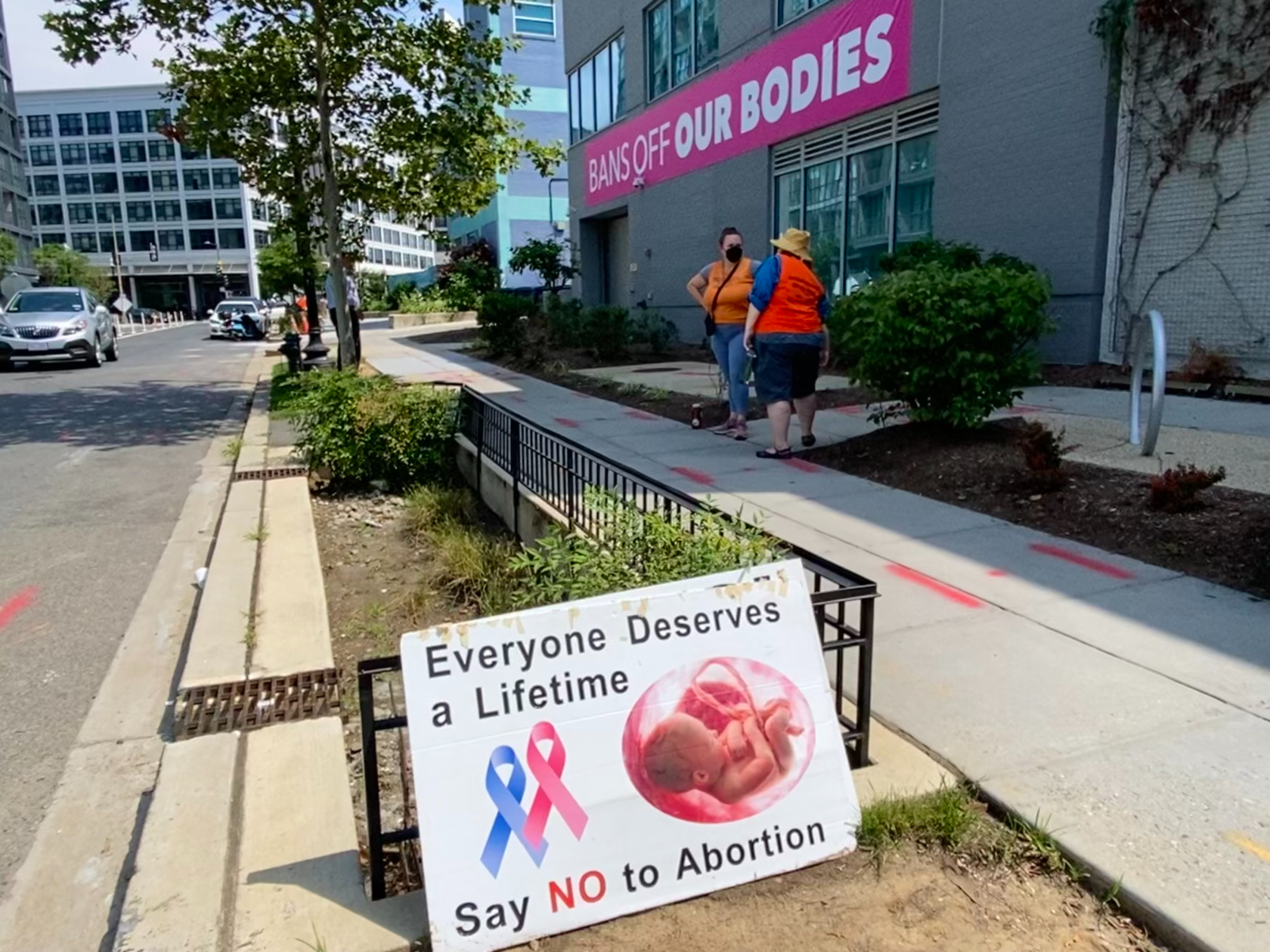
A small crowd of anti-abortion protesters lingered a mere feet away from the entrance of D.C.’s Planned Parenthood clinic for several hours Saturday morning.
While a few out of the seven or so protesters shouted bible verses or prayed silently along the sidewalk, most waited near the front door and approached anyone who entered or exited the clinic in NoMa, even a delivery food worker. They shared materials that contained misleading information about abortion and disparaged Planned Parenthood to whoever was around.
Protesters crowded a young woman exiting a car that pulled up to the entrance on 4th Street NE. One protester shouted “They are not safe here”, as she tried to hand her a flier. Volunteer escorts wearing orange vests that coordinate with the clinic cleared the woman’s path and accompanied her to the front door. Seemingly overwhelmed by all the people, the woman shouted: “I don’t need y’all in my face.” Later, on her way out of Planned Parenthood, she told the crowd she was not even pregnant.
Protests outside Planned Parenthood are not a new phenomenon, but the one on Saturday could become standard. In the three weeks since the Supreme Court eliminated the constitutional right to an abortion, the local Planned Parenthood affiliate says their clinics have noticed an increase both in the number of protesters and frequency at which they’re showing up.
Other providers in the D.C. region anticipate anti-abortion protesters to be emboldened after their recent court victory, so they are taking extra precautions and increasing security. They all share concerns about protesters escalating their actions. According to the National Abortion Federation, providers across the country experienced an increase in threats last year, including stalking, blockades, and suspicious packages.
“There’s been an increase in protest activity and in their level of aggression. Patients and staff are constantly bullied, threatened, and intimidated by these anti-choice activists,” says Anne Cavett, the co-director of clinical services at Planned Parenthood of Metropolitan Washington, DC. The national provider has three clinics in D.C. and Montgomery and Prince George’s counties that offer abortion services.
Anti-abortion protesters reject the provider’s characterizations. “I wouldn’t say that I’m necessarily getting in anyone’s face,” said Kristin Turner, the communications director for Progressive Anti-Abortion Uprising, outside the clinic. “I think that we have a right to approach people. It’s our First Amendment right to go and speak to people about what we believe.”
She said she decided to protest outside the Planned Parenthood Saturday while visiting from California to appear in local court: She has been charged with trespassing in the waiting room of an Alexandria clinic in November 2021.
Turner said more people became interested in joining her group and participating in actions where they enter a clinic in order to prevent an abortion after the Supreme Court overturned Roe v. Wade. She called the “rescue” nonviolent, but media coverage shows these actions can be extreme, particularly in states hostile to abortion care: “rescuers” in other groups have chained themselves to clinic doors and poured glue into the locks.
A handful of local clinics have long worked with volunteer escorts from the Washington Area Clinic Defense Task Force to guard patients into and out of clinics and past protesters. The group says they have not yet noticed a change in size or behavior among anti-abortion protesters at the Planned Parenthood in D.C. or most other clinics they’re supporting. “They’re the same people,” says Megan, a volunteer trainer who requested her last name be omitted for safety concerns. “They’re being their same old, aggressive, shaming, obnoxious selves.”
The escorts are trained to not engage with protesters. “One of my mantras is, no minds will be changed today so there’s no point in any discussion between me and any anti’s,” says Bill Mosteller, who’s volunteered for at least eight years. “My job is, first off, to stand and be witness to the fact that the anti’s position is not universal and to make it easy for people who want to come into the clinic to do so.”
Volunteer escorts are at clinics about two to four days per week, but some clinics also employ security guards. Since the Dobbs decision, police have been stationed outside PPMW in the event things escalate, according to an officer at the scene on Saturday. The Metropolitan Police Department did not respond to a request for comment.
Several people passing by the clinic yelled at anti-abortion protesters at Planned Parenthood on Saturday, telling them “You are going to hell” and to “Shut the fuck up and go home.” One passerby told protesters to stop because they already won, alluding to the Dobbs decision. Turner said her movement hasn’t won yet because abortion is still legal in places like D.C.
A federal law known as the FACE Act prohibits anyone from physically obstructing, interfering, or intimidating patients seeking reproductive health services. Nine people who blocked access to a clinic offering abortion services in D.C. were charged in March for violating the FACE Act.
A few states have passed legislation further protecting both patients and staff of clinics that offer abortion care, establishing a “bubble zone” around them if they are near an entrance, according to the Guttmacher Institute. In Colorado and Montana, laws require people (protesters included) to remain outside of an 8-foot “bubble” around someone who’s 100 feet from entering or exiting a clinic. Massachusetts law creates a 25 foot “bubble” around someone entering or leaving a clinic but only if police are called and make the order.
Elizabeth Nash, who tracks state reproductive health policy for the Guttmacher Institute, says cities including Burlington and Columbus have adopted buffer zones, which are barriers around a clinic instead of an individual. The Supreme Court struck down Massachusetts’ 35-feet buffer zone because they reasoned the law infringed on free speech, but allowed for narrower protections, says Nash.
“The issue around clinic protection is going to become more prominent because we are seeing more harassment at clinics providing abortions,” Nash says. “So we will see jurisdictions and perhaps states weigh in with more protections for patients and providers.”
The D.C. region does not have buffer or bubble zones. D.C. and Maryland codified the federal FACE Act, and D.C. also prohibits telephone harassment. Several regional providers tell DCist/WAMU that local lawmakers should consider passing bubble or buffer zones, as well as other protections against in-person or online harassment. While polling shows most residents in the area support abortion rights, there are some who do not and regularly demonstrate.
At least two local crisis pregnancy centers have also been vandalized in recent weeks. These centers look like standard reproductive health clinics but do not offer the full range of services so opponents accuse them of tricking pregnant patients.
Amy Hagstrom Miller, the CEO and president of Whole Woman’s Health, says her clinics in Alexandria and Baltimore have not seen an increase in the number of protesters, but she expects to, particularly more out-of-state visitors.
“When we ban abortion in half the states in this country, the protesters are then going to focus on the remaining states,” she says.
It’s not unusual for anti-abortion protesters to travel. For example, a clinic in Shreveport, Louisiana sees protesters from East Texas after all the clinics there closed. Local clinics already see out-of-state protesters when national anti-abortion rallies are scheduled.
Over the last year, Miller says, her Baltimore staff has noticed protesters to be more aggressive than they used to be. Her clinics have the advantage of being located in commercial complexes, where protesters could be told to leave private property. People who protest far away from the clinic’s entrance look like they’re protesting against Carrabba’s Italian Grill instead, she says, but that hasn’t stopped them. They just try to get closer to the clinic itself. “Going behind the fence, trying to get access to the parking lot, and [using] super verbally abusive language that they’re screaming at patients and stuff,” Miller says.
Meanwhile, Whole Woman’s Health patients and staff appear to be under tremendous stress because of increased demand. Miller says the Alexandria and Baltimore clinics are seeing patients who would have gone to their Texas clinic, but the state effectively banned all abortions last year. The recent uptick in demand has meant Whole Woman’s Health is looking to add additional physicians in their Alexandria clinic. She’s hoping to have some of the physicians from her Texas clinic join the east coast team but getting them licensed in a new state is a slow moving process.
Abortion providers have recently taken steps to protect their patients and staff. Falls Church Healthcare Center is having volunteer escorts come two days a week as opposed to one, according to their development director Mike Scheinberg. Washington Area Clinic Defense Task Force noticed a slight jump in the number of protests there. Metro Area Advanced Practice Healthcare in Bethesda also hired a security consultant, according to the nurse practitioner who provides medication abortion there.
Robin Tucker of Metro Area Advanced Practice Healthcare says they had to report a threatening email to the police in February. They are accustomed to receiving hate mail or angry posts on their Facebook business page, says Tucker, but what was concerning about this particular email was the angry person writing it appeared to have visited their office: They attached a photo of the front of the building at the end of a block of text with bible verses. They got the impression that the police weren’t going to conduct an investigation, so they later sought advice from a third party on how to keep patients and staff safe.
“It’s just a really difficult time,” Tucker says. “My staff are kind of on edge and nervous.”
Meanwhile, Tucker is also concerned about whether they’ll be criminalized for providing medicinal abortion via telehealth. They are confident in their medical intake process, but they ultimately can’t control what happens once abortion pills are mailed to their patients’ homes. “Could I get into legal trouble if I prescribe these meds into Virginia, which is legal based on my license, and then somebody winds up in Kentucky with those pills and somehow law enforcement gets wind of that?” they ask. “Lawyers don’t really have good answers either.” More people have requested the abortion pill via asynchronous telehealth since Roe fell, Tucker adds. “People are very scared.”
In the view of the local Planned Parenthood affiliate, providers are calling for the same protections afforded to Supreme Court justices, whose decision led to more protests on both sides. An eight-foot high gate around the Supreme Court had been erected ahead of the Dobbs decision. Maryland Gov. Larry Hogan and Virginia Gov. Glenn Youngkin also called for tighter security at the homes of justices after they witnessed more abortion rights protesters.
“It is incredibly frustrating,” says Cavett of Planned Parenthood of Metropolitan Washington, DC. “You can stand right outside [a clinic] and be yelled at and intimidated. And yet the Supreme Court, who made this decision, they have a huge buffer. They won’t let you on their steps.”