Colleen Grablick
 Cydney Grannan
 Margaret Barthel
Update: The contest for Maryland’s governorship will be between Democratic political newcomer Wes Moore and Trump-backed Republican Dan Cox, but local races — like the Montgomery County Executive race — still remain too close to call.
Cox was declared the winner of the Republican nomination on election night, even as mail-in ballots had yet to be tallied. Moore, meanwhile, emerged as the frontrunner in a crowded field of Democratic candidates after polls closed on Tuesday, but it was too early to call without the mail-in ballot count. On Friday, the Associated Press projected Moore to maintain that lead, clinching the nomination for the general. As of Saturday, Moore had 34% of the vote. Former U.S. Secretary of Labor Tom Perez is trailing behind with 28%, and current Maryland comptroller in third with 21%. If elected, Moore, a veteran, author, Rhodes scholar, will be the first Black governor.
Other local races are still too early to call, as election officials work to count mail-in ballots. (Due to a Maryland law, mail-in ballots could not be counted until Thursday at 10:00 a.m.) The race for Montgomery County Executive is at a razor thin margin — as of Saturday at 10 a.m., incumbent Marc Elrich led opponent David Blair by only 295 votes. On Wednesday, candidate and current county councilmember Hans Riemer conceded in the race, not foreseeing a way forward even with the number of outstanding mail-in ballots.
Original: After months of legal challenges and partisan fighting over newly drawn congressional maps, Maryland’s delayed Primary Election Day is over, but a majority of local races – including the competitive race for county executive in Montgomery County – remain undecided, and are likely to be so for days or weeks to come.
The results of some less competitive contests became clear shortly after polls closed, however. The Associated Press called the race for Prince George’s County Executive in favor of Angela Alsobrooks just before 10 p.m. Tuesday. Alsobrooks racked up what appeared to be an insurmountable lead early in the night, with about 90% of the vote with 47% of precincts reporting. AP also called the Republican gubernatorial nomination in favor of Dan Cox, a Trump-endorsed Maryland delegate representing Frederick who embraces much of the former president’s talking points and rhetoric, including the lie about a stolen 2020 election. (Cox even organized buses to Trump’s rally on Jan. 6.) Maryland Delegate Brooke Lierman of Baltimore also clinched the primary race for state comptroller, ahead of her Democratic competitor Tim Adams.
So many contests will remain in the air for weeks because of a Maryland state law — the only one of its kind in the country — that prevents election officials from processing mail ballots until “after the election.” These ballots won’t begin to be counted until Thursday, and the process could go to the first week of August in some local jurisdictions, a Maryland election official told the New York Times.
With more than half a million voters across the state requesting mail-in ballots this election cycle, it’s likely that those ballots will decide several elections.
Jump to results: Statewide, Montgomery County, Prince George’s County
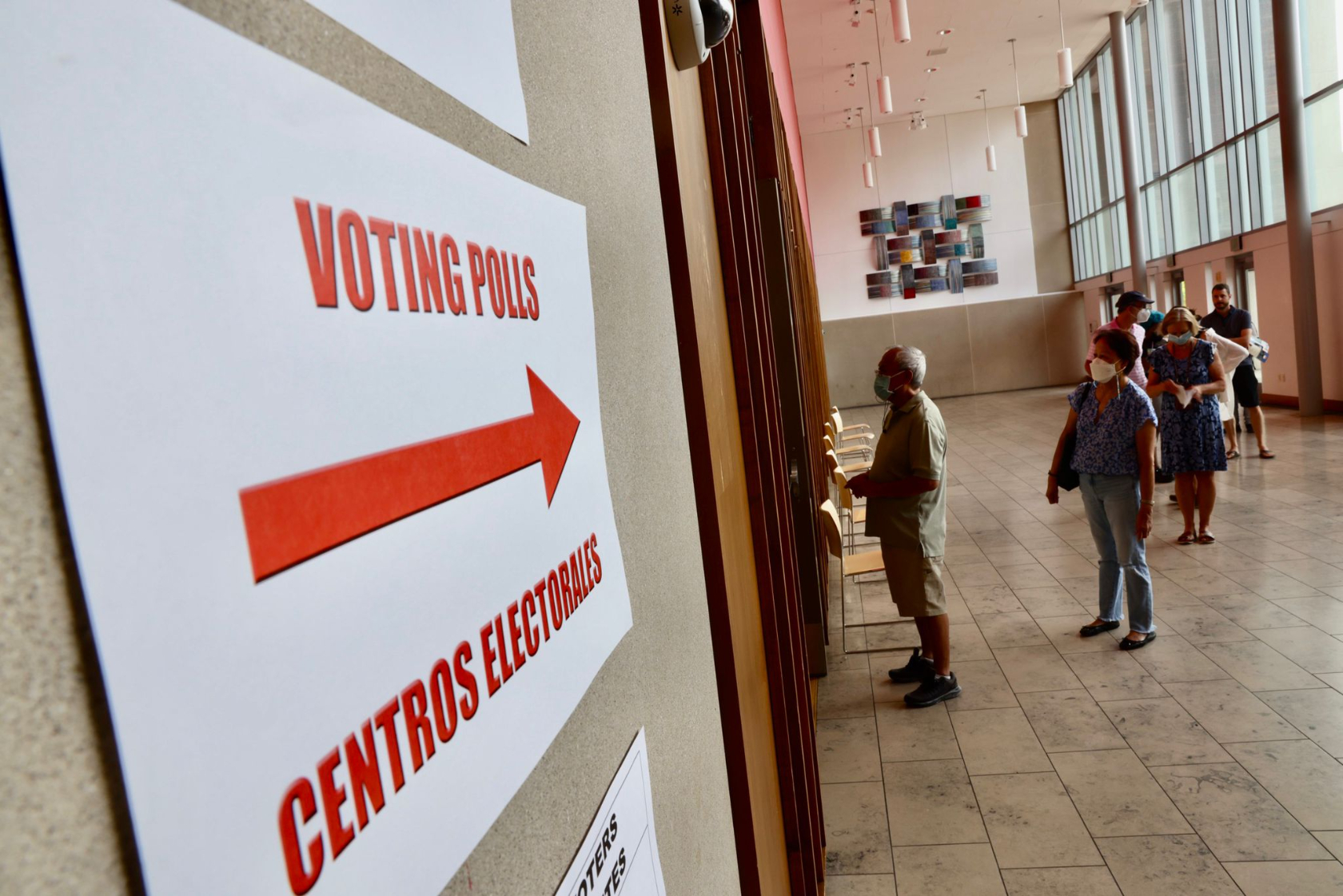
Statewide
No winner has been declared yet in the Democratic primary race for governor, where nine candidates are hoping to take the seat as GOP governor Larry Hogan reaches his term limit. Recent polling had current Comptroller Peter Franchot neck and neck with author, former non-profit CEO, and former U.S. Secretary of Labor Tom Perez. As of 10:30 p.m. on Tuesday, with 47% of election day precincts reporting, Wes Moore had 38% of the vote, with Perez trailing at 25% and Franchot at 20%.
On the Republican side Hogan-backed Kelly Schulz is projected to have lost to Trump-endorsed Dan Cox, who held 56% of the vote with 82% of precincts reporting shortly after 11 pm. on Tuesday. The Republican nomination was perceived as a test of Trump’s lasting influence on the party, while national Democrats see the race as their best shot at flipping a governorship this cycle. Despite outnumbering Republicans two-to-one in the state, Democrats haven’t been able to get someone in the governor’s mansion since Martin O’Malley in 2010. “Democrats got the …candidate they wanted,” tweeted director of the UVA Center for Politics Larry Sabato. “He’s far-right, Trump-endorsed, was at the Jan. 6th Capitol insurrection, and STILL thinks the 2020 election was stolen … Dems = automatic favorite to win in November.”
Schulz, speaking on Tuesday night around 11 p.m. shortly after the race was projected in Cox’s favor, did not officially concede to Cox.
“It is not over,” Schulz said, referring to the remaining mail-in ballots that will not be counted until Thursday. “I have fought for everything in my life that I’ve ever had, and I’m not going to stop fighting for this.”
The Associated Press called the Democratic race for state Attorney General just after 1 a.m. Wednesday, projecting that Democratic Rep. Anthony Brown (D-4th District), former Lieutenant Governor under Martin O’Malley, was projected to win the race. Brown was leading opponent Katie Curran O’Malley – a former judge who won the endorsement of the Washington Post (and is the wife of his ex-boss) 60% to 40% as of 4:15 a.m. Those totals do not include mail-in ballots. If he wins in November, Brown will be Maryland’s first Black attorney general.
The Associated Press also called the Republican attorney general race for Michael Peroutka on Wednesday, a former Anne Arundel County councilmember and Southern secessionist with ties to white supremacist groups. As of Wednesday afternoon, he had 58% of the vote to the 42% held by his opponent Jim Shalleck, an ex-prosecutor and former president of Montgomery County Board of Elections.
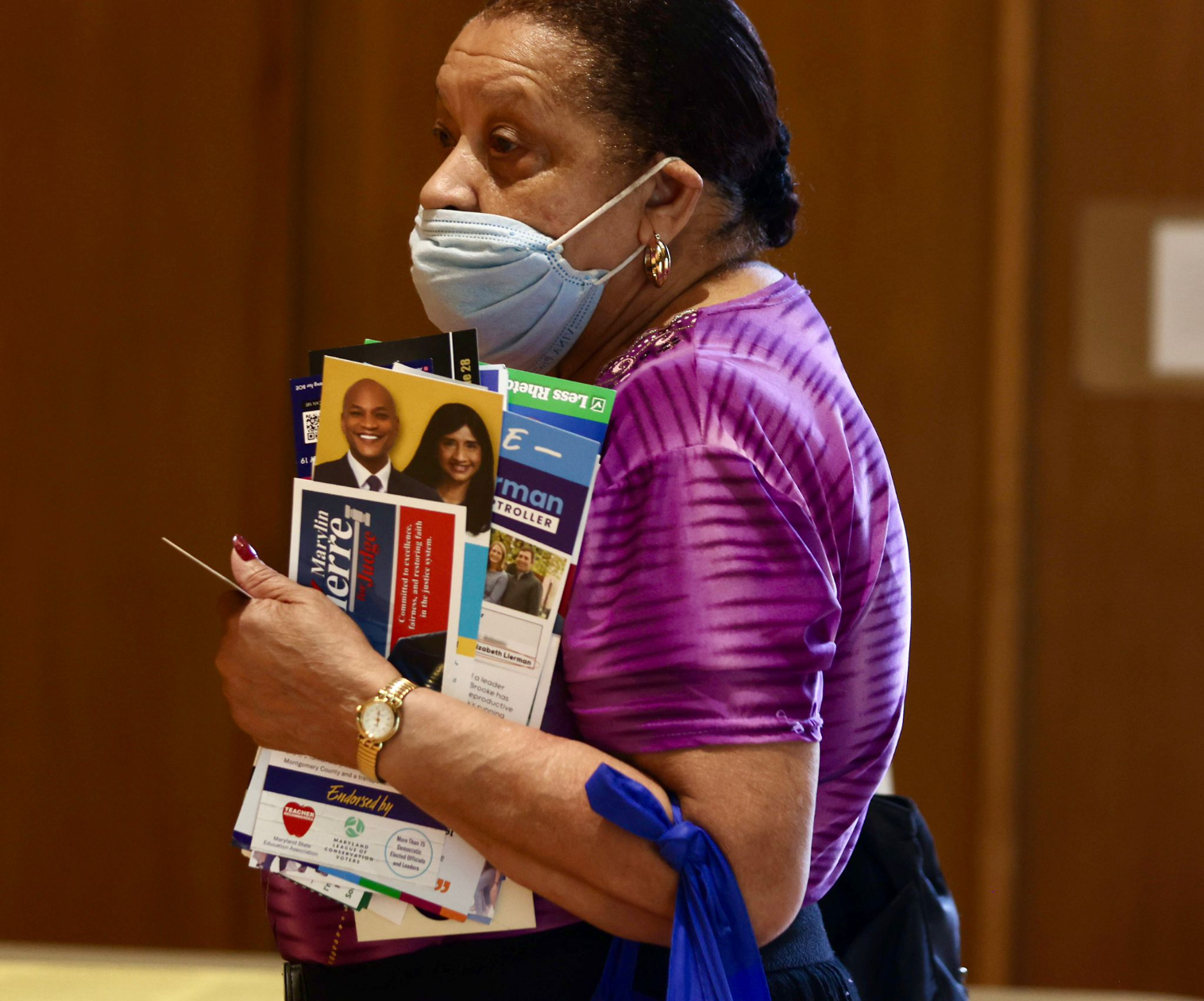
In the race for state comptroller, Democrat Brooke Lierman, a state representative from Baltimore, was declared the winner in her race against Tim Adams around 11:00 p.m. Tuesday. Harford County Executive Barry Glassman is running unopposed for the Republican nomination. The comptroller serves as the state’s tax collector, and is one of the three voting members on Mayland’s Board of Public Works, in addition to the governor and state treasurer.)
A handful of significant congressional races were also on the ballot. So far, Chris Van Hollen has been called as the Democratic nominee for senate, and Jamie Raskin of the 8th District was declared the winner in the nomination for his House seat. For more congressional results, see here.
Montgomery County
The intensely watched race for Montgomery County Executive was undecided as of Wednesday morning, though challenger David Blair’s lead widened overnight. Incumbent Marc Elrich is reporting 38% of votes, and Blair, a business executive, ahead with 39.51%. Montgomery County Councilmember Hans Riemer, who managed to out-fundraise Elrich’s campaign recently, had 21%. That represents tallies from 246 of 258 election day precincts so far, but no mail-in ballots.
On Wednesday afternoon, Riemer told the Bethesda Beat that he doesn’t expect the mail-in ballots, which won’t be counted until Thursday, to “change the outcome in a significant way.” Asked if that was a concesssion, Riemer told the Beat, “I suppose, yeah.”
With mail-in ballots still oustanding, it could be a case of deja vu for Elrich and Blair. In 2018, Blair, a wealthy businessman who pumped millions of his own dollars into his campaign, lost to Elrich by just 80 votes — a result that came two weeks after the election as mail-in and provisional ballots were counted. In the heavily blue county, the results in the primary all but certainly decide who will lead Montgomery County for the next four years.
Blair, who launched a nonprofit geared towards educating residents on local issues following his loss in 2018, won an endorsement from the Washington Post, while Elrich, only three days before the election, received an endorsement from high-profile congressional representative Jamie Raskin (D-Takoma Park.)
Earlier polling showed Elrich in the lead, but the latest polls released last week put him in a dead heat with Blair. Conducted by left-leaning think tank Data For Progress, the survey found that 34% of voters backed both Elrich and Blair, with Reimer taking 20%. Eleven percent of respondents were undecided.
Elrich, who bills himself as a progressive, has won praise leading the county through the COVID-19 pandemic, but has also faced a chorus of critics on the left during his four-year term. He’s set lofty climate goals that haven’t been met, and is frequently at odds with councilmembers – namely Riemer – over how to solve the increasingly unaffordable county’s housing crisis. He’s lobbied against an affordable housing resolution, arguing that more housing for low-income residents isn’t needed in the county, and has expressed skepticism about the housing policy points included in Thrive 2050, an update to the county’s general plan.
A fourth candidate, tech CEO Peter James is also in the Democratic race for county executive, though he had received only 2% as of Wednesday morning. He ran and won the Republican primary for Maryland’s 4th congressional district in 2008, but lost in the general election. According to an interview with the Bethesda Beat, he is an independent voter, but switched his party affiliation to run as a Democrat this year.
Also on the primary ballot in Montgomery County: seats on the county council. This is the first election since the county expanded the council size from nine seats to 11 by adding two new districts.
As of Tuesday evening, most of the Democratic primary races have yet to be called. All Republican council candidates ran uncontested for their party’s nomination. But in left-leaning Montgomery County, they’ll be long-shots in the general election.
Here’s what we do know: Nearly half of the council seats don’t have an incumbent seeking reelection, so we should expect to see at least five new councilmembers after the November election.
The big primary to watch is the Democratic race for the four at-large seats on the county council. Eight Democrats are seeking their party’s nominations: Incumbents Gabe Albornoz, Evan Glass, and Will Jawando; current District 5 Councilmember Tom Hucker (who dropped out of the county executive race at the last minute to join this one); and activist Brandy Brooks (who faced sexual harassment allegations during her campaign), former teacher Dana Gassaway, Montgomery County Democratic Central Committee member Scott Goldberg, and former Gaithersburg City Councilmember Laurie-Anne Sayles.
Though the race is still too close to call, as of Wednesday morning, the incumbents had the strongest showing. Glass led with 18% of the votes, followed by Jawando with 17% and Albornoz with 15.5%. Sayles was next in line with 13%, with 246 of 258 election day vote precincts reporting.
On the Republican side, the three unopposed at-large candidates will be continuing on to the November general election: Christopher Fiotes, Lenard Lieber, and Dwight Patel. Green Party candidate Dan Robinson is also seeking an at-large seat in the general election.
In Montgomery County’s District 1, which includes Potomac and Bethesda, incumbent Andrew Friedson ran unopposed in the Democratic primary. No Republican candidates are running for the seat.
The Democratic contests in Districts 2, 3, 4, 5, and (newly created) 6 and 7 were all too early to call as of Wednesday afternoon.
In District 2, Marilyn Balcombe was ahead of two competitors with 47% of the vote, with 32 of 35 election day precincts tallied as of Wednesday morning. In District 3, incumbent Sidney Katz was far in the lead with 58% percent, with 33 of 39 precincts reported. In District 4, Kate Stewart was in the lead in a crowded field, with 45% and 32 of 33 precincts reporting. Candidate Al Carr issued a statement, congratulating Stewart as the “likely nominee,” although the race hasn’t been called officially.
Kristin Mink was leading in District 5 with 40% and all 30 precincts reporting. In the new 6th District, Natali Fani Gonzalez holds a large lead with 54% and all election day precincts reported; District 7 was far closer, with Dawn Luedtke in the lead with 32% and 43 of 44 precincts reported.
Since all Republicans in the council races are running uncontested in the primary, they’re expected to easily win their party’s nomination. The Republican candidates you can expect to see on the November ballot are: Air Force veteran Dan Cuda for District 2; database developer George Hernandez for District 3; public relations professional Cheryl Riley for District 4; lawyer and real estate broker Kate Woody for District 5; attorney Viet Doan for District 6; and economist Harold Maldonado for District 7.
Incumbent Montgomery County State’s Attorney John McCarthy held the lead Wednesday morning in a field of three Democratic challengers: deputy state’s attorney in Prince George’s County, Perry Paylor, Silver Spring attorney Bernice Mireku-North, and Rockville-based attorney Thomas DeGonia II. With 74 of 258 precincts reporting, McCarthy held 49% of the vote, with Mireku-North in second at 21%, Paylor in third at 16% and Tom DeGonia at 14%.
McCarthy, looking to hold onto a fifth term, touted his track record of criminal justice reforms, like commissioning a study to investigate racial biases in his office’s prosecutorial decisions, and his efforts to divert substance use and mental health cases out of traditional criminal justice systems, while his challengers said he wasn’t doing enough.
In the County Sheriff’s race, ex-NFL player and former sheriff’s deputy Robert Bass and current deputy of the county’s sheriff’s office, Maxwell Uy, are vying for the seat. (Current sheriff, Darren Popkin, did not seek reelection, and endorsed Uy.) As of Wednesday morning, Uy had 54% of the vote, to Bass’ 47%. The race remains too early to call. The county sheriff’s office is the enforcement arm of the county’s court system (think serving civil papers and transporting people within the court system.) It’s also responsible for protecting survivors of domestic violence, by serving orders of protection to alleged abusers.

Prince George’s County
County Executive Angela Alsobrooks, a Democrat, was declared the winner in her primary by a wide margin, giving her excellent odds for a second term in office. She captured just over 90% of the vote tally so far, with a majority of in-person election precincts reporting and the results of early voting in, too. Alsobrooks is the first Black woman to hold the post in the majority-Black county, and her name was frequently cited as a potential gubernatorial candidate before she confirmed last year that she planned to seek re-election instead.
“Tonight is an amazing victory,” Alsobrooks said in a speech at an election night party hosted by ATU Local 689, a local union. “We came through some really trying times over the last few years, but we never gave up on our values and our vision.”
Alsobrooks faced a handful of challengers in the Democratic primary race, including former NFL player Leigh Bodden, realtor and police reform advocate Sherman Hardy, attorney and small business owner Tonya Sweat, and Billy Bridges, a two-time county executive candidate. Alsobrooks far outraised the rest of the field, and also received endorsements from The Washington Post, multiple unions, D.C. Mayor Muriel Bowser, and immigrant advocacy group CASA in Action.
In her first term, Alsobrooks steered the county — the state’s second-largest by population — through the COVID-19 pandemic, often choosing to lag behind the state in lifting reopening restrictions (and sometimes even reinstating them) as cases in the county surged past the rest of Maryland. In her speech, Alsobrooks touted the county’s achievements in bouncing back from high infection rates to get residents vaccinated.
“We went from the bottom to the top,” she said. “We have one of the highest vaccination rates in the country.”
Alsobrooks has taken steps to invest in mental health services, put forward a plan to develop the Blue Line corridor near FedEx field, and pledged to adopt police reforms recommended by a county task force in the wake of George Floyd’s murder — though some advocates believe the county hasn’t gone far enough in reacting to police brutality and workplace discrimination in the county’s police department. Alsobrooks has also faced criticism from Latinx county residents, who feel they were left behind in the county’s pandemic response.
It’s unlikely that Alsobrooks will face a significant challenger in the general election in November, given the county’s strong tilt toward Democrats.
State’s Attorney Aisha Braveboy ran uncontested in the Democratic primary and is similarly expected to win re-election in the fall.
But who Alsobrooks and Braveboy will work with on the Prince George’s County Council is less certain. Of the eleven council seats, just two had unopposed Democratic candidates, both incumbents: District 1 (Tom Dernoga) and District 5 (Jolene Ivey).
Outcomes in the rest of the seats appear to still be up in the air, including several which have no incumbents running. As of 3 p.m. on Wednesday with all precincts reported, current Council chair Calvin Hawkins Jr. led the at-large race with 37% of the votes. Fellow at-large incumbent Mel Franklin is next with 31%.
District 7 Council member Rodney Streeter is currently behind challenger Krystal Oriadha, who has 57% of the vote to Streeter’s 28% with all election day precincts reporting. District 8 council member Edward Burroughs III was far in the lead in his race as of Wednesday afternoon with 73% of the vote. Similarly, District 9 councilmember Sydney Harrison had 68% of the vote on Wednesday afternoon, with all precincts reporting.
In District 1, incumbent Tom Demoga was running unopposed. As of Wednesday afternoon, Wanika Fisher led the District 2 race, but Victor Ramirez is less than two percentage points behind. In District 3, Eric Olson is in the lead with 51%, and Ingrid Harrison is in the lead with 52% in District 4. Wala Blegay is in the lead in District 6 with 31%.
In the race for County Sheriff, John D.B. Carr, who enjoyed wide support from the county’s law enforcement officials, holds a comfortable lead with 47% of the vote, as of Wednesday afternoon, well ahead of second-place Loryalyn Mayo, with 24%.
The county council race was further complicated by an unusually dramatic redistricting process. Last fall, six county council members — including three running for re-election this year — attempted to replace an independent redistricting commission’s proposed map with their own version. Residents objected, calling the replacement map a gerrymander that would influence this year’s elections by pushing progressive candidates into new districts. A Maryland Court of Appeals ruling in March — well into campaign season — ordered the county to use the maps originally put forward by the redistricting commission.
This story has been updated.