Jacob Fenston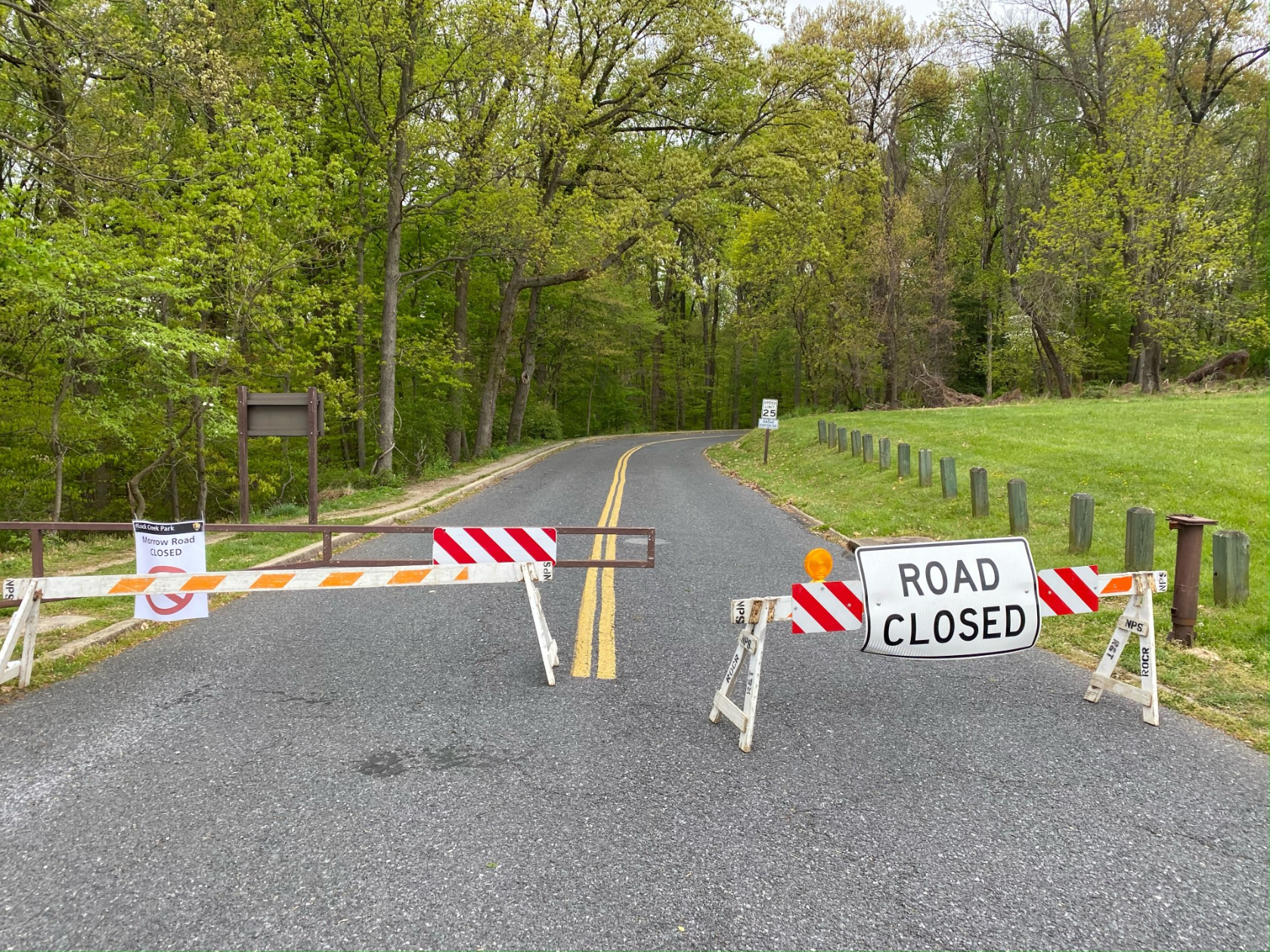
Allowing more than 5,000 cars to drive through D.C.’s largest park every day will improve forest health, and help endangered and threatened species thrive, according to National Park Service officials. Faced with a confused, skeptical and sometimes angry virtual audience during a lively meeting Monday evening, officials explained their reasoning behind reopening Rock Creek Park’s Beach Drive to commuter traffic.
“It is counterintuitive to think that cars on Beach Drive actually help the forest,” acknowledged Rock Creek Park Superintendent Julia Washburn, answering the same question for the umpteenth time. Cars whizzing through the woods on Beach Drive “create a deterrent,” preventing people from cutting through the park on unofficial trails, Washburn said.
Officials say they’ve tried other deterrents, like putting up signs telling people to stay on the official trails. “We’ve had people just steal the signs or bend them in half,” said Nick Bartolomeo, a program manager at the park. Bartolomeo said the unofficial trails fragment the forest, invite invasive species, and cause erosion, which can harm water quality and threatens a type of endangered crustacean that lives exclusively in Rock Creek Park.
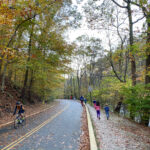
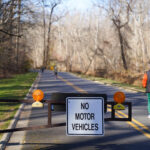
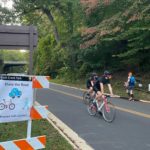
Just over 3.5 miles of Beach Drive has been closed to cars since near the beginning of the pandemic, in April 2020. At the time, residents were desperate for open space, when just about everything else – including District-owned parks – was closed due to the public health emergency. NPS originally planned to bring cars back when the city started reopening in June 2021, but decided to reconsider, in large part due to pressure from local residents and officials.
NPS released an environmental assessment earlier this month, recommending that all of Beach Drive reopens to cars for most of the year on weekdays, with a seasonal closure in the summer months. Upper Beach Drive would remain closed to cars on the weekends year-round, as it was pre-pandemic.
This, despite the fact that the D.C. Council and Montgomery County Council both asked NPS to keep the road closed to cars, and that public comment overwhelmingly favored keeping cars out. Out of 4,100 people who weighed in during a public comment period, more than 1,800 people wanted a year-round closure, while 343 people wanted the road reopened to cars on weekdays.
“We are trying to strike a balance,” said Washburn. NPS is again seeking public comment online, through August 11, before finalizing its decision.
Many people in Monday’s meeting questioned why that balance appears to tip so far in favor of car commuters, apparently counter to popular public sentiment.
“Are commuters really park users?” wrote one person who said their name was Troy. “Just seems like a pretty highway then.”
A handful of people in the meeting backed the NPS’ decision, saying that the closure of Beach Drive caused spillover traffic on nearby neighborhood streets. “Great compromise,” wrote Patience Singleton, an ANC commissioner in Ward 4. “I’d prefer a permanent reopening of Beach Drive but understand the need for compromise.”
NPS noted during the meeting that a new traffic analysis from the District Department of Transportation shows a permanent closure of Beach Drive would cause 2 minutes additional slowdown for commuters on 16th St. NW by the year 2045.
NPS also contends that cars have a historic place in Rock Creek Park, though the park was created 18 years prior to the first Model T Ford. “Beach drive was originally envisioned as a road for pleasure driving,” Washburn said.
Many commenters in the meeting noted that “pleasure driving” is still an option in the scenic upper portion of Beach Drive: while three sections of the road are closed to cars entirely at the moment, between Blagden Ave. and the Maryland border, a 1.5 mile section is open to cars, just not through traffic. And, of the park’s more than 20 miles of roads, less than 5 miles are closed to drivers.
NPS says they also considered two other options: a year-round closure, or a return to the pre-pandemic, weekends-only closures. Washburn explained that the reasons for supporting the seasonal road closure are “layered.” It would not only provide protection for the sensitive forest habitat in the cooler months, by using car traffic to deter hikers and dog-walkers, but it would also alleviate traffic in neighborhoods nearby. Washburn also noted that NPS heard from many people arguing that the road should be reopened to cars to make it more accessible to people with disabilities. But many people also commented that cars should be kept out so that people with disabilities could use the road in wheelchairs, she said.
NPS officials during the meeting struggled to keep up with the hundreds of questions and comments posted in the chat, where the vast majority of people opposed or questioned the decision to reopen Beach Drive to drivers. Many appeared to be incredulous at the argument that car traffic would improve forest health.
“They are literally inviting cars back to drive away people from using a park to walk their dogs,” wrote one commenter, under the name ‘Concerned Citizen’.
“Just to make sure I understand, you want less people using the park, so you’re trying to make the park worse so less people will come?” wrote Chris Schiefer.
NPS officials said that there has been an increase in unofficial trails recently, and provided a map of the park, showing a vast network of unofficial trails, marked in red. However, officials did not provide data to back up the claim that more cars would limit off-trail hiking. Indeed, many of the unofficial trails are well-established and have been there for years, indistinguishable from the official ones without consulting a map.
Others mocked the NPS preoccupation with “pleasure driving.” “PLEASURE DRIVING. IN A TIME OF CLIMATE CHANGE. THAT IS YOUR CONCERN,” wrote Ryan Flemming.
Indeed, numerous people commented on the seeming contradiction between the NPS preference to open the park to more car traffic, and the Biden administration’s ambitious climate goals. President Biden wants to cut greenhouse gas emissions in half in less than eight years. Achieving that would require a quick transition away from cars.
D.C. has its own climate goals too, and they include sharp reductions in car use. The Sustainable D.C. plan has a goal to cut the percentage of commuter trips made by car from 43% to 25% by 2032. According to the city’s Carbon Free D.C. plan, which aspires to be carbon neutral by 2050, reducing trips in gas-powered vehicles will be one of the biggest ways to cut emissions — greater than transitioning to electric vehicles.
Washburn said a final decision on the future of Beach Drive won’t come until fall at the earliest, possibly in September or October, depending on the number of comments NPS receives. In the meantime, she said, the closed portions of Beach Drive will remain closed to cars.
Washburn urged meeting attendees and other members of the public to submit their comments online, but also said public opposition would not stop the change.
“This is not a vote,” said Washburn. “We take all comments into consideration, but as National Park Service managers, we have to take into consideration multiple points of view, and we also have to take into consideration what we think, at the moment, is best for the resources in the park.”