Colleen Grablick
When temperatures reach between 90 to 95 degrees or higher, many localities in the region activate heat emergency plans, opening cooling centers and other resources for vulnerable residents. While all of D.C. heats up in the summer, neighborhoods that lack trees and instead have high concentrations of pavement, asphalt, traffic, and buildings will be insignificantly hotter than others — a phenomenon known as an urban heat island.
During extreme heat waves, everyone should take the threat of heat exhaustion seriously, especially those who may be more vulnerable to heat-related medical events. Infants and young children, people over 65, those with certain illnesses or on medications, and residents experiencing homelessness may be more susceptible. Signs of heat exhaustion include extreme fatigue, sweating, shallow breathing, pale skin, and vomiting. If untreated, heat exhaustion can progress to heat stroke, which is characterized by a body temperature above 103 degrees, chest pain, confusion, and a rapid pulse.
Here’s a look at how the region is responding to this summer’s intense heat, and how to look out for loved ones and neighbors:
D.C.
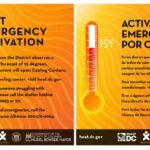
D.C. Mayor Muriel Bowser activates the city’s heat emergency plan any time temperatures reach at least 95 degrees, opening cooling centers at recreation centers, schools, and homeless shelters during “regular business hours.” To receive transportation to a cooling center or to help someone else get to a center, residents can call 311 or the shelter hotline at 202-399-7093. There’s a digital map of cooling centers that will show residents the center closest to their current address. (Splash parks and public libraries are also resources for residents needing to escape the heat.)
A July 2021 report from Street Sense Media found that, while beneficial, D.C.’s cooling center system wasn’t fully operable in practice. Of the 37 facilities designated as cooling centers, staff at only 19 of those locations knew of the heat emergency, or that their facility was a cooling center. The plan also presents several issues for unhoused residents, who are particularly vulnerable to extreme heat conditions. For those who live outdoors, it can be difficult to pack up their belongings in high temperatures, or too risky to head to a center out of eyesight of their belongings. (Despite a spate of 90-plus degree days last summer, the city carried out a clearing of a NoMa homelessness encampment.) It can also be a challenge to preserve certain medications in the heat, like insulin, as Axios DC has reported. Separate from cooling centers, the city also activates lower barrier shelters 24/7 during heat emergencies: Adams Place Shelter, New York Avenue Shetler, Community for Creative Non-Violence, DC General Building 9 (Harriet Tubman) and 801 East Shelter.
To keep residents, and especially unhoused neighbors safe, residents can read up on the ways to identify and treat heat-related illness until help arrives, and get in contact with their local mutual aid group, drop off cold water bottles for residents, or offer to purchase Metro cards.
Check on unhoused neighbors! Cold water is cheap & super appreciated at most camps! Battery powered fans, metro cards for rides in A/C, cold juice.
Also figure out where nearby cooling centers are & how we can get unhoused folks to them.
In the end, demand housing now!
5/5— Remora House DC (@RemoraHouse_DC) May 19, 2022
Maryland
Prince George’s County: Prince George’s County opens cooling centers for residents when temperatures climb past 90 degrees. You can find a map and list of them here. Senior citizens who do not have a cooling system in their homes are particularly encouraged to utilize the centers.
Residents experiencing homelessness can seek emergency shelter — although there is an extensive list of requirements and paperwork necessary for admission into a temporary shelter.
Montgomery County: The county issues a Hyperthermia Alert anytime forecasted temperatures or the heat index in at least one part of the county reaches at least 95 degrees. A Heat Emergency Alert is issued when “dangerously hot conditions” are present, including a sustained heat index of at least 105 degrees, and residents can find relief in county-run buildings.
Families experiencing homelessness can access services at the Silver Spring and Rockville offices, Monday through Friday, but are encouraged to call first. Adults can contact the Montgomery County Crisis Center at 240-777-4000.
Virginia
Alexandria: Residents are encouraged to visit Alexandria’s recreation centers or libraries to cool off. Residents are encouraged to check in on older adults who are more susceptible to heat-related illnesses, and neighbors and family who may not have air conditioning.
Loudoun: The county’s public libraries, community centers, and recreation centers open as cooling centers during heat advisories. The Loudoun County Animal Shelter also operates as a cooling facility for residents seeking escape from the heat with their pets.
Fairfax: As with all other localities, Fairfax opens recreation centers, libraries, and the Fairfax County Government Center as cooling centers during heat emergencies.
Arlington: Residents can visit one of the county’s recreation or community centers to escape the heat. Arlington’s spray parks are also open, with varying hours of operation.