Colleen Grablick
With cases rising rapidly and vaccine supply still severely constricted by federal shipments, D.C. is shifting its monkeypox vaccination plan, delaying second doses and instead focusing on getting first doses to high-risk residents.
DC Health announced the change on Monday, reporting 172 cases of MPV in the city, up from the 122 cases reported the previous week. The District maintains the highest number of MPV cases per capita out of any state since reporting its first case in early June. Nationally, the U.S. is reporting roughly 3,500 cases of the virus, which was declared a health emergency by the World Health Organization over the weekend, but current case counts are likely underestimates, given the limited testing in the initial weeks of spread.
“This decision is based on the available scientific evidence, the acceleration of the outbreak, the demand for vaccine from the high number of eligible people, and the extreme shortages of the JYNNEOS Monkeypox vaccine nationally,” reads a statement from DC Health.
Previously, the city was preparing to reserve a portion of its vaccine supply for second doses for already once-vaccinated individuals. Now, residents who had already received one dose of the JYNNEOS vaccine will be notified that their second shot — scheduled around four weeks after the initial inoculation — will be postponed indefinitely. (Individuals are considered “fully vaccinated” two weeks after the second shot, but studies have shown that one dose of the vaccine can afford up to six months of protection.) The exception is recipients with pre-existing conditions or compromised immune systems caused by something like lupus, cancer, or an HIV infection: They will not have their second shot delayed, according to the city.
As of last week, more than 2,700 people in the District had received JYNNEOS doses, according to DC Health.
“DC Health is confident that additional vaccine doses will be available when needed for those who have received their first dose,” reads DC Health’s statement on Monday.
In delaying second doses, the city is freeing up its current vaccine supply to target first doses for individuals at the highest risk of contracting MPV; 5,000 additional appointments went out in the city’s online booking system on Saturday. Under DC Health’s current criteria, eligible individuals include gay, bisexual, and other men 18 and older who have sex with men and have had multiple or anonymous sexual partners in the last 14 days; or transgender women and nonbinary persons assigned male at birth who have sex with men; sex workers; and staff at establishments where sexual activity occurs. (DC Health has not provided a clear answer to the question of why transgender men who have sex with men or have multiple sexual partners are excluded, but DC Health senior officer Patrick Ashley has explained that the current eligibility group is determined by the demographics of D.C.’s caseload.) The city has previously encouraged all individuals, regardless of whether or not they are currently eligible, to pre-register for a vaccine appointment in the online portal, in the case that more vaccine becomes available. Individuals will be notified via email when an appointment opens for them, and given 48 hours to claim it.
Monkeypox, a virus in the same genus as smallpox, spreads through contact with an open sore, rash, or lesion caused by an infection, or through prolonged face-to-face contact, like during kissing cuddling, and sex. The virus can also live on materials like blankets, towels, or clothing that was used by a person infected with the virus. While anyone can get monkey pox — a statement public health officials in D.C. and across the U.S. continue to repeat, and was proven by the recent diagnosis of the virus in a child in D.C. — gay and bisexual men make up an overwhelming majority of the cases identified nationally, and in the District. As of last week, DC Health director LaQuandra Nesbitt said that 96% of the city’s cases occurred in people who identified as male, and 82% identified as gay. (Gender identity or sexuality alone do not make an individual more at-risk for contracting the virus — a potential exposure to MPV does.)
The District’s new vaccination posture — reserving first doses at the expense of second shots — mimics that of New York City, where more than 1,000 people have contracted the virus. Like all other states experiencing outbreaks, D.C.’s vaccination plan is constrained by the amount of vaccine the city is given by the federal government, whose delayed response to the initial outbreak has left the country playing catchup with the rapidly spreading virus and quickly losing the chance to contain it. According to a New York Times report published Monday, the federal government was slow to order bulk shipments of the JYNNEOS vaccine — originally made to protect from smallpox — from a manufacturer in Denmark. The U.S. owned more than 300,000 doses when monkeypox began spreading, but instead of ordering them in bulk, officials took a piecemeal, wait-and-see approach, requesting only 72,000 of the 372,000 available doses to be shipped to the States in the first weeks of the American outbreak, per the Times.
Now, federal officials are doling out doses to states based on the number of confirmed cases and the population of high-risk individuals working there who may be particularly vulnerable to MPV.
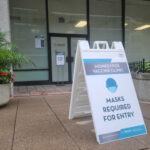
During a press conference last week, Nesbitt said D.C. had received, in total, 8,300 doses from the federal government, with 4,000 more expected throughout the week. This, though, is far below what the city needs to meet demand. In addition to reserving doses for the pre-registration portal, the city sets aside doses for individuals who have been in close contact with a probable or confirmed case. D.C. has also stood up select vaccination clinics for targeted groups, but more of these pop-up events will be dependent on vaccine supply, according to DC Health.
Meanwhile, Maryland has received a total of 3,363 doses of the vaccine from the federal government, according a spokesperson for the state health department. With 87 confirmed cases state-wide, according to the Centers for Disease Control and Prevention’s tracker, the state is using a “hub-and-spoke” vaccination model, distributing 3,000 doses to local health departments, which then vaccinate individuals. For example, Montgomery County health officials announced last Wednesday that they had received a limited number of vaccines from the state, and would be distributing them to highest-risk residents, meaning those who were identified as close contacts of a MPV case, and presumed contacts who know that a sexual partner in the past two weeks was diagnosed with monkeypox pox, or had multiple sexual partners in the past 14 days in a jurisdiction with known monkeypox. The county is also working with community-based non-profits to identify at-risk individuals, and offer them a vaccine.
Maryland’s remaining 363 doses are reserved to provide to “other jurisdictions as needed,” according to a spokesperson. As of July 25, Virginia has reported 72 cases of the virus, with 54 of those occurring in Northern Virginia. Much like Maryland, Virginia’s state health department is distributing doses to local health departments, who then provide vaccines to the most at-risk individuals. At first, these vaccines were reserved for close contacts, but jurisdictions including Fairfax and Alexandria are developing a plan to offer doses to residents who are high-risk but have not been exposed, similar to D.C.’s system. According to the Virginia-Mercury, Virginia was recently allocated 3,500 doses of the JYNNEOS vaccine.
According to DC Health, the agency meets regularly with Virginia and Maryland. Asked Tuesday if D.C. will be receiving any doses from neighboring jurisdictions, a spokesperson said “at this time, each state has very limited product and are prioritizing doses to their respective residents.”
Previously:
A Child Who Traveled To D.C. Has Been Diagnosed With Monkeypox, Officials Say
D.C. Has The Highest Number Of Monkeypox Cases Per Capita In The U.S.
D.C. Launches Pre-Registration System For Monkeypox Vaccinations
What To Know About Monkeypox Vaccination In The D.C. Region
D.C. Is Making Limited Number Of Monkeypox Vaccines Available
What To Know About Monkeypox In The D.C. Region