Colleen Grablick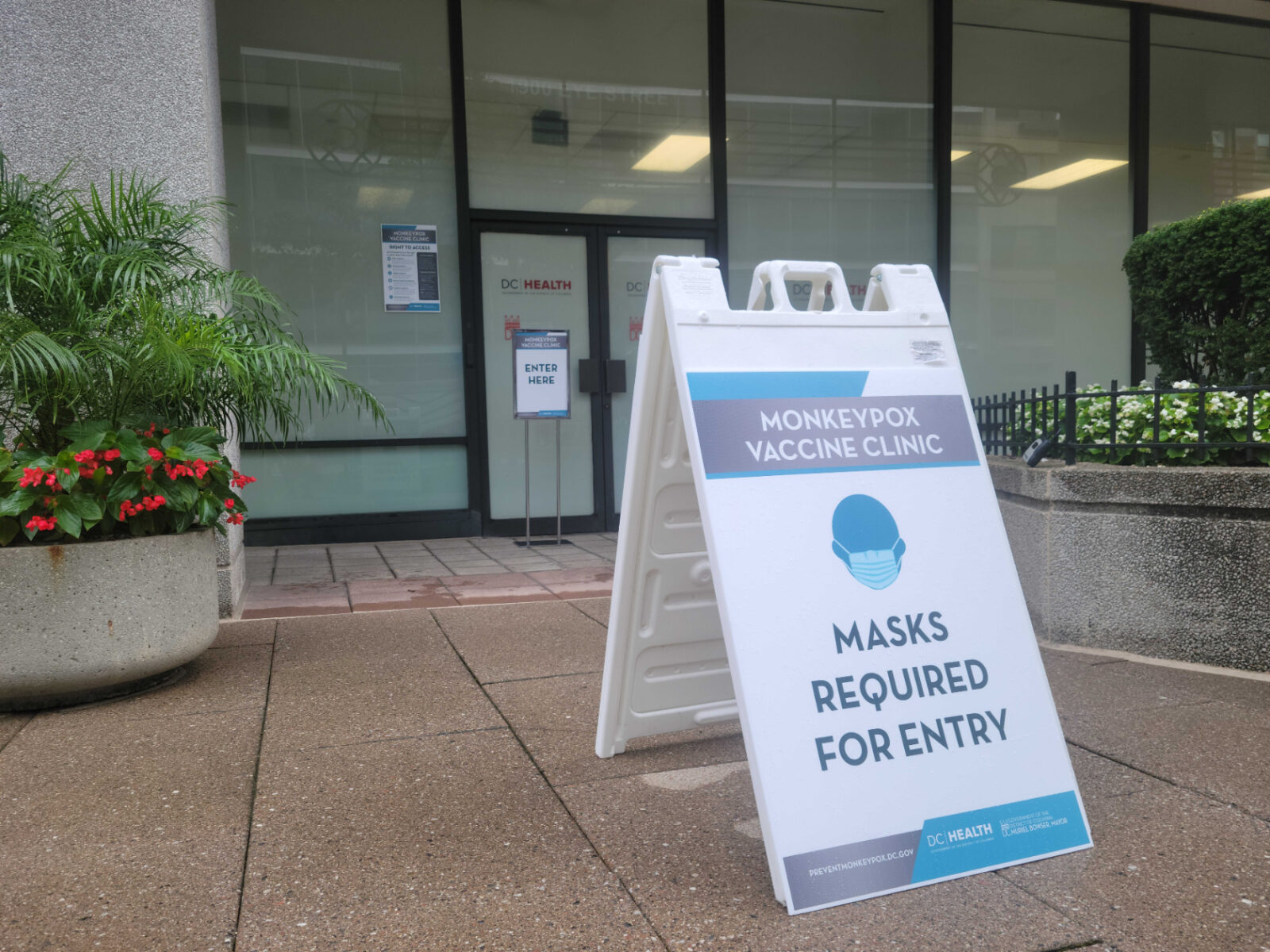
More than one month after the first monkeypox case was reported in D.C., former DC Health director LaQuandra Nesbitt issued a warning.
“This is not a disease of the LGBTQ+ community. Anyone can contract monkeypox,” Nesbitt said at a July 18 press conference, echoing a now common refrain amidst rising cases.
Like public health experts across the U.S., D.C. officials are attempting to thread a fine line between ensuring resources and messaging are directed to the most at-risk community, men who have sex with men, while combating the misinformation and stigma that suggests only gay men can get MPV.
Hampered by a sluggish federal response that failed to secure testing and vaccines in the early days of the outbreak, local officials are trying to contain the virus by targeting limited vaccine supplies to those they’ve deemed most at-risk. But D.C.-area LGBTQ+ residents and health advocates say that officials need to do a better job – especially since D.C. currently has the highest per capita instances of the virus in the U.S. As of August 2, the city had over 260 reported cases with the majority occurring in men who identify as gay. (DC Health could not immediately provide updated demographic data on MPV cases but in late July the city reported that around 80% occurred in men who identified as gay.)
“We have certainly a challenge in terms of the public health messaging that we need in order to control the outbreak: first, we have to have specific messages for the populations that are at increased risk right now, including gay and bisexual men,” says Dr. Carlos Rodriguez-Diaz, an associate professor of community health and prevention at George Washington University’s Milken Institute of Public Health. “But at the same time, we have to have targeted messaging for the rest of the community.”
As cases continue to rise, local experts and advocates say that information about MPV transmission needs to be clearly communicated to the general public while D.C. officials also build partnerships with LGBTQ+ community groups and healthcare providers to get resources and treatment where they’re needed most.
Monkeypox, a disease endemic to countries in Central and West Africa, was first identified in the U.S. in mid-May and has now become a global health emergency, according to the World Health Organization. Initial symptoms include fever and muscle aches, and a rash of fluid-filled pustules develops within a few days. While it’s less deadly than smallpox, a virus in the same genus, sores can be incredibly painful and take between two to four weeks to heal fully.
The impact on men who have sex with men has been overwhelming, with an international study in late July finding that between April and June, 98% of people who contracted the virus were gay or bisexual men. But it’s not sexuality or gender identity alone that put someone at a greater risk of contracting MPV – coming into contact with the virus does. While it can be transmitted through sexual activity, MPV is not an STI.
The virus can be spread through contact with open lesions or rashes, or prolonged face to face contact, like during kissing, sex or cuddling. Respiratory spread is also possible when someone is exposed to an individual with monkeypox over an extended period of time, like sharing a living space. Objects that a person with MPV has used – like clothing, towels, or blankets – can also transmit the virus.
“The biggest thing that I’ve been stressing to my patients is just the most common mode of transmission for this virus, which is skin to skin contact, and the more prolonged skin to skin contact, the more likely that it is to be transmitted,” says Dr. Keith Egan, a physician with Kaiser Permanente’s new Pride Medical center in D.C., a primary care office specifically serving the LGBTQ+ community. “So any circumstances where that can come up, whether it’s having sex, which is often associated with it, but also dancing, spending time at a party.”
According to Egan, communicating these distinctions clearly to both at-risk communities and the general public is critical to combatting the virus — and the stigma that can come from it being associated with a marginalized group. It’s also important that all health professionals, whether or not they specialize in treating LGBTQ+ patients, understand symptoms and offer testing (which can now be ordered and processed through Labcorp and Quest).
“I hope that we can get information out through all avenues possible in a non-stigmatizing way, to arm people with information to make decisions about their day-to-day life,” Egan says.
Egan says the vaccine is a crucial tool in containing the outbreak locally but that its effectiveness has been restricted by the federal government’s failure to act quickly.
When cases began popping up in the U.S., the government already owned hundreds of thousands of doses of a vaccine effective against MPV: the JYNNEOS vaccine, manufactured in Denmark. Instead of ordering some 300,000 available doses, however, federal officials decided to wait-and-see, requesting only 72,000 be sent to the U.S. initially. Those doses were then distributed to states based on their population of high-risk individuals and the number of confirmed cases (which were likely undercounts, due to limited testing), leaving local health departments with a paltry supply of vaccines as cases continued to rise.
The Health and Human Services Secretary Xavier Becerra recently called on states and Congress to do more in response to the outbreak. Months since the first case, there is no comprehensive national strategy and no federal emergency money to address the virus.
“Would the rollout of the public health response to MPV have been different if it wasn’t primarily vectored in first among gay, bisexual, and homosexual men and transgender or non-binary people?” says Jason Cianciotto, the vice president of the Gay Men’s Health Crisis. “It’s hard not to say that that response was hampered by the fact that it was this particular population that was primarily affected.”
These national failures are hitting the local response hard.
As of Friday July 26, the city had just under 5,000 doses to distribute, and have ordered another 8,000 that should be distributed when they arrive in the city, according to a DC Health spokesperson. Even with an additional 800,000 doses coming to the U.S. shortly, D.C.’s allotment likely still won’t be enough to meet demand. Last week, the city announced it would be postponing resident’s second doses (JYNNEOS is a two-dose vaccine) to free up supply to target first doses to high-risk individuals.
To contend with the limited supply, D.C. officials have employed strategies that some advocates say risks stigmatizing some of the most at-risk populations.
Currently, only certain residents are eligible in the city’s vaccine pre-registration system: gay and bisexual men; men who have have recently had multiple or anonymous male sexual partners; transgender women; nonbinary people assigned male at birth who have sex with men; sex workers; and staff at establishments where sexual activity occurs. (DC Health senior officer Patrick Ashley has said that the eligibility criteria is determined based on the demographic data of the cases they’ve recorded.) The city has not provided DCist/WAMU an answer about why trans men, who may also be at a higher risk, are excluded from the current group. Some residents fear that the strict criteria may be turning away residents who are at high-risk of contracting the virus.
“I think it’s ridiculous they’re basing it on [these criteria],” says James Sullivan, an outreach specialist with HIPS, a D.C.-based harmed reduction and sex-worker support organization. “It frustrates the hell out of me, because I am a trans man. It has nothing to do with your genitals, it has to do with being close to another person.”
Similar to the early days of the COVID-19 vaccine rollout, D.C.’s online booking system has been criticized for its inaccessibility, which experts say risks further deepening inequities. At first, the city was announcing same-day registration for appointments that were booked up within minutes. While the city has since switched to something closer to a waiting list, advocates say any online system still favors those with access to technology and a flexible schedule.
“Having to go online and register, and then wait for an email, and having the time to go to [an appointment] at one of the specific times…speaks to a lot of privilege,” says Dr. Carlos Rodriguez Diaz of George Washington University’s Milken Institute of Public Health. “It would be good to have pop-up vaccine clinics near where the communities are, but certainly in order to do that, we have to have enough vaccines and so we have to combine strategies.”
The current online system also requires information about one’s personal life and sexual activity, which experts say that sex workers and people from other marginalized groups may be reticent to answer.
“People are like, ‘well you can go get a vaccine or a test because you’re a sex worker.’ Well, people don’t want to go tell the government they’re sex workers,” Sullivan says. “Our clients, especially people who are not in stable housing or are in drug using circles…they may still not have access [to a vaccine] because it’s harder for them to get access to any sort of healthcare, especially emergency stuff like this.”
Advocates say one way to reduce the likelihood of these targeted efforts further marginalizing the most at-risk populations is using credible messengers, with information coming from individuals and organizations who are a part of or have longstanding ties to an affected community. This is especially important when that community may be distrustful of a government-run public health response due to medical and structural racism and homophobia.
“We need to make sure that the messengers that are reaching populations at highest risk for infection represent those populations, and that the information also comes from a source that is trusted,” Cianciotto says. “I think we need to do a better job of choosing messengers for the information, and the way that public health agencies continue that is to provide that information as well as funding to support community based organizations that have built that trust in those communities.”
Earline Budd, a case manager with HIPS, says that the city is partnering with the organization to hold an MPV vaccine clinic on Friday, Aug. 5 — the exact kind of partnership that experts say is crucial to equitably reaching the most at-risk communities, without stigmatizing MPV or individuals who contract it. Egan also hopes that, as supply allows, the city distributes vaccines to providers like Pride Medical, who may have stronger and more trusted relationships with patients.
Experts say that this type of targeted, grassroots response can and should coexist with community-wide communication. Last week, D.C. reported the first of two pediatric cases in the U.S., sparking worry for classroom spread in the fall. Already, universities in Texas have been preparing for potential spread on campus when the new semester starts.
University of Maryland public health professor Neil Sehgal says that while it may be too early to know the trajectory of MPV, it’s still possible to contain the outbreak with clear public health messaging and targeted vaccine outreach.
“It’s still possible that we’ll get far enough ahead of transmission that we may be able to curtail transmission as we move into the fall,” says Sehgal. “I don’t think we’re at the point right now where it’s too late.”
Previously:
Amid Supply Constraints, D.C. Postpones Residents’ Second Monkeypox Vaccine Doses
A Child Who Traveled To D.C. Has Been Diagnosed With Monkeypox, Officials Say
D.C. Has The Highest Number Of Monkeypox Cases Per Capita In The U.S.
D.C. Launches Pre-Registration System For Monkeypox Vaccinations
What To Know About Monkeypox Vaccination In The D.C. Region
D.C. Is Making Limited Number Of Monkeypox Vaccines Available
What To Know About Monkeypox In The D.C. Region