Margaret Barthel
The Virginia Department of Education is putting the finishing touches on a draft policy that outlines the process for schools to notify parents of sexually explicit instructional materials, and to give them the opportunity to opt their children out of using them.
Today is the last day for Virginians to submit a public comment on the regulation, which has stirred controversy over the role of parents in the classroom. It also raises concerns that the new policy will become a means to block books and other materials that reflect the experiences of LGBTQ people and people of color from schools.
The department is required to put together the model policy under a bill that passed the General Assembly in the spring. The model will ultimately serve as a guide for local school divisions, who must put in place their own policies by January 2023.
The policies – the department’s model and the final versions that eventually will be voted on by local school boards — will govern the process. That will include identifying “sexually explicit content” in instructional materials; giving parents the opportunity to review the materials; and offering alternatives if a parent objects to their child being exposed to the original content.
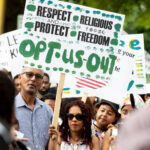
Comments on the policy are posted publicly online. Some supporters hailed it as a return of rightful decision-making power to parents invested in their children’s education, pointing to a section of Virginia code that gives parents “a fundamental right to make decisions concerning the upbringing, education, and care of the parent’s child.”
“Parents are the first and most important in deciding what is best for their children. Teachers and school administrators need to work with parents and not be threatened by them,” one commenter notes.
Others felt that sex-related topics should not be addressed in school at all.
“Sexuality is an issue for parents and churches to address, teaching children according to the Judeo Christian values upon which this country was built,” one commenter suggests.
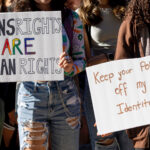
The draft policy comes amid a local and national uproar over school policies designed to be inclusive to LGBTQ students and staff — policies that conservatives have labeled “indoctrination” or “grooming,” words linked to homophobic attacks. Locally and nationally, right-wing activists have also sought to ban books by LGBTQ authors, and there’s a brewing debate over proposed changes to Fairfax County schools’ family life curriculum.
The bill behind the new policy states that the explicit content guidelines “shall not be construed as requiring or providing for the censoring of books in public elementary and secondary schools,” the legislative summary asserts.
But that’s exactly what some believe could happen, based on the broad definition of “sexually explicit” in Virginia law, which is also used in the draft policy. The definition includes images or video that show “sexual conduct,” which is further defined elsewhere in Virginia law to include “homosexuality.” As a result, advocates worry the new requirements could limit schools’ ability to include a number of books and other content deemed unacceptable.
“Such a broad definition is likely to lead teachers, librarians, and school administrators to restrict access to instructional materials that include or are written by LGBTQ people,” the Virginia ACLU wrote in a comment submitted to the education department. “The impact would not only be LGBTQ students being treated as “other” and pushed into the shadows, but removing such a broad category of literature detracts from the richness and diversity of our nation and potentially prevents LGBTQ youth from accessing life-saving information about themselves.”
Pride Liberation Project, a student-led LGBTQ advocacy group in Northern Virginia, called for the Board to “develop guidelines that explicitly state that instruction about LGBTQIA+ people is not inherently sexual.”
“Virginia surveys suggest that Queer youth are disproportionately impacted by harassment and discrimination, and legal gray-areas like these lead to the stigmatization of Queer youth,” the group said in an Instagram post.
Rivka Vizcardo-Lichter, one of the group’s leaders, said the group agrees that a number of other types of content cited in the draft policy — including bestiality, pornography, fetishism — have no place in schools. But “discussing a transgender neuroscientist in history class or something like that should not be considered sexual content,” she says, nor should talking about the history of the Stonewall riots, the HIV epidemic, or Supreme Court cases relevant to LGBTQ rights.
Access to that information at school, Vizcardo-Lichter believes, is especially critical for LGBTQ students who may not be out at home.
“Closeted queer students who don’t come from supportive households and rely on schools to represent them and to be safe spaces for them could be opted out of any curriculum that involves, quote-unquote homosexuality, which is what they’re labeling as sexually explicit content,” she says.
It’s already rare for Vizcardo-Lichter, who attends school in Fairfax County, to see herself represented in the curriculum at school.
But when her classes do cover a topic or person related to it, it’s a special moment. “I feel that I’m being recognized in some way, that there are people out there in history who are like me,” she says.
The ACLU also suggested that literature and depictions of people of color could similarly fall prey to the broad definition.
“The definition of ‘sexually explicit content’ does not include race or racism,” the organizations’ public comment continues. “However, we have unfortunately witnessed several school districts in Virginia target books for removal that address race and racism and have sought to do so by reducing rich and complicated stories to mere sentences void of context.”
In fact, the origins of the push for a parental opt-out for explicit material in Virginia centers around Beloved, a novel by Nobel- and Pulitzer Prize-wining author Toni Morrison. The book depicts the horrors of slavery, including sexual violence. A parent’s complaint about the explicit content in the book, which was part of her son’s high school curriculum, ultimately led to a 2016 bill to create a parental opt-out. The legislation passed with support from both parties in the General Assembly, but was ultimately vetoed by then-Gov. Terry McAuliffe. The Youngkin campaign foregrounded that veto and the concerned parent — though not Beloved itself, which is widely considered a classic — in an attack ad against McAuliffe in the 2021 gubernatorial race.
More recently, three school districts in Virginia have tried to ban another book by Morrison, The Bluest Eye. That novel also appears on the American Library Association’s list of top ten most-challenged books, one of several on the list that deal with themes of racial identity and racist experiences.
“These stories help students understand how BIPOC bodies are objectified and used by an oppressor,” the ACLU’s public comment argues. “These stories happened and still happen today. What valuable lessons will be missed if students only have access to sanitized versions of reality, deprived of real people’s lives and experiences?”
Other commenters expressed frustration with the policy’s potential burden on teachers, many of whom have felt attacked by previous controversies over critical race theory and other issues. Teacher retention is an ongoing source of concern for officials across the state.
“Teachers, librarians, and education experts have years of experience and are well equipped to introduce diverse and sometimes difficult subjects into the classroom while mitigating the harm and trauma these subjects may cause their students,” wrote one commenter, a former teacher. “They are trained professionals whose jobs are to put the students’ interests first. The proposed model policies would make it harder for these educators to do their job.”
This story has been updated to include comments from Rivka Vizcardo-Lichter.