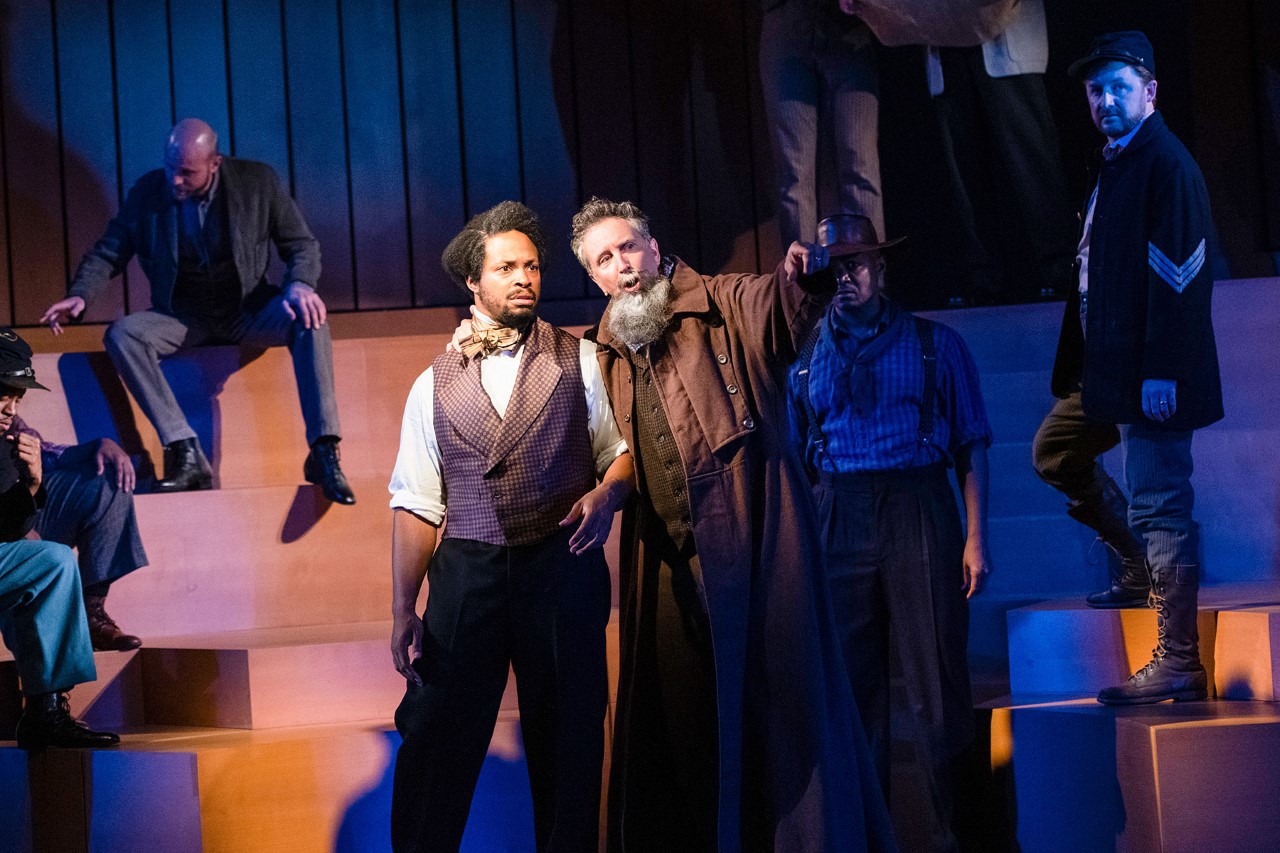
One bright stage light shines on Cornelius Smith Jr. — an actor best known for his role as Marcus Walker, sidekick to Kerry Washington’s Olivia Pope in the hit TV show Scandal — who stands on a minimally designed set in Arena Stage. Smith begins reciting the words from Frederick Douglass’ 1845 memoir about his earliest years being born a slave with no real birthdate and separated from his mother who would die early in his life.
If you didn’t know what show you were seeing, this could come off as a quintessential D.C. performance: a live reenactor delivering a historic speech. But then Smith breaks into song — because he’s starring as Douglass in American Prophet: the world premiere musical biopic of the trailblazing abolitionist written by Grammy winner Marcus Hummon and directed by Charles Randolph-Wright.
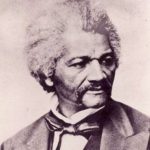
Douglass is a man often portrayed as observant, intense, stoic. But in this musical that spans a little more than half his life, from 1818 until about 1865, we see him pining for a mother he’ll never really know. We watch him fall in love with his first wife, Anna Murray (Kristolyn Lloyd). We see him when he’s playful, stubborn, funny, sad and cocky.
“I hoped the music would move people,” said Chris Roberts, who plays John Brown in the show and has been working with Hummon on this project for over five years, “But then you add all the other elements and it’s pretty obvious that crowds are very moved by Frederick’s words and by the music.”
Hummon began working on this project in 2015. He originally conceived it as a concert, “but the more he researched, he knew that he had to expand it. Frederick Douglass’ words are poetic and lend themselves to music,” said Randolph-Wright. When it was finally ready to come to life, it had to be DC, the director adds.

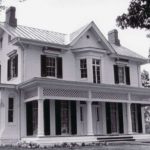
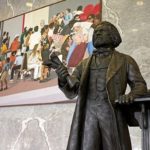
That’s not only because Frederick Douglass moved into the city exactly 150 years ago this year, but because this play has big ambitions to reach every “school, university, city, and town,” which includes a run on Broadway, Randolph-Wright says.
“At a time when history is being challenged and taken away from schools, I want the stories in this musical to break through that censorship and find a place in people’s hearts and minds,” he says. “Our children especially need to hear it — and sing it!”
D.C. is a great launch pad because it’s “a great theater town,” says Edgar Dobie, executive producer and president of the Corporation for Arena Stage. “D.C. audiences are smart and discerning and very knowledgeable about theater,” he said.
If American Prophet does get a Broadway break after debuting here, it would follow many others, including, recently, Dear Evan Hansen, The Mean Girls musical, Come from Away, The Great White Hope and other Tony-award winning Broadway productions. They all premiered in D.C. and went on to enjoy commercial success and longevity.
“D.C. has a vibrant theater scene, one of the best in the nation,” says Nolan Williams Jr., who wrote and composed GRACE, which premiered at Ford’s Theater earlier this year and which Williams and co-book-writer Nikkole Salter hope ultimately makes it to Broadway. “We have respected critics and a diverse audience base in this region, folks who love and support theater and have discerning taste. The life of a new show here becomes a good bellwether for how that show will likely fare in NY and beyond.”
D.C.’s theater scene is long-engrained — just check out the National Theatre’s archive. “And Washingtonians have been trend-setters,” notes local historian and tour operator Rachel Tracey. “If we look back to the U Street Corridor at the turn of the century, we can see the very roots of the Harlem Renaissance taking foot first here in D.C.”
The U Street corridor was a bastion for Black art in the early to mid 1900s. An entertainment destination nicknamed Black Broadway, the strip ;, boasted over 300 Black-owned theaters, clubs and restaurants at its height. In the 1970s, D.C.’s music scene gave rise to punk and gogo (a derivative of funk) genres.
The District has changed in many ways, but what has remained is the ability to cultivate creativity, Williams says. A preponderance of quality working actors, thanks to the region’s vibrant professional theater scene, also helps.
“Our regional theaters have committed to this work. From the Kennedy Center and Ford’s Theatre to Signature and Arena Stage and, most recently, Woolly Mammoth. Our regional theaters understand the value of partnering with commercial producers to nurture projects that will have a long life,” Williams said.
The nurturing relationship between a theater and a new production can yield immense value to both parties. The production gains human and financial resources from the theater and the theater may negotiate something like a royalty for future commercial use of the production’s rights. And of course, the audience gains the best possible show, and the bragging rights of being able to say “we saw it first” about what may become a national hit. It’s in the best interest of the theater to help get the production as far along as possible.
It seems there is always something new in the works. In the spring, the Kennedy Center closed out the world premiere of The Other Side and this summer Woolly Mammoth Theatre Company debuted There’s Always the Hudson after two pandemic delays.
“These theaters are just incredible in their development of shows. It’s the love, the nurture, what they put into it. I think it’s super helpful,” says Walker. “It’s a good, safe place to make mistakes, learn from them and continue to tell the story the best possible way.”
GRACE the musical is going through the editing stage now, with the goal of launching a revised version of the show in a different market in 2023. After American Prophet finishes its run, it will follow a similar process. But that part is down the road; for now, the team is just enjoying seeing the fruits of the last seven years of work.
“Watching the audiences viscerally experience this show has been amazing,” said Randolph-Wright, “What Marcus and I wanted is for people to leave the theater galvanized to do something to help the mess we have made of this world. Frederick’s words written over 170 years ago incite us to make a change.”
The goal is made clear in, “We need a fire,” the soaring and catchy anthem which closes both acts of the play. With its dance number and swelling chorus of voices, reminiscent of a contemporary Christian and R&B blend, cleverly delivering a serious message, it most exemplifies the tone of the play – optimistic, but grounded in the realities of the moment and at every turn identifying what changes need to be made to improve society.
American Prophet is playing at Arena Stage through Aug. 28. Runtime is 2 hours and 15 minutes with a 15 minute intermission. Tickets start at $86.