Colleen Grablick
D.C. expanded eligibility criteria for the monkeypox vaccine over the weekend to include anyone with multiple partners in the past two weeks, regardless of gender or sexual orientation, giving D.C. one of the broadest vaccination criteria in the U.S.
DC Health officials announced late last week that individuals could pre-register under the new expanded criteria starting on Saturday, Aug. 13, as other local health departments nationwide struggle with limited vaccine supply. However, these guidelines more closely resemble those of the Centers for Disease Control and Prevention, which do not mention gender or sexuality in their descriptions of high-risk individuals. Per the CDC, those most likely to contract MPV include close contacts of a known case, people who are aware that one of their recent (in the past two weeks) sexual partners has been diagnosed, and people with multiple partners in recent weeks in an area with MPV cases.
Eligible individuals in D.C. also include sex workers of any gender and staff at establishments where sexual activity occurs. The city is also opening vaccinations to select groups of non-D.C. residents who fit the expanded criteria, including anyone who works or attends college in D.C., or who receives care through a DC Health program.
The decision comes as the city continues reporting the highest number of per capita cases in the country, with more than 320 instances reported as of Friday, Aug. 12, and as public health officials across the nation attempt to stretch the current vaccine supply.
In an emailed statement to DCist/WAMU, a spokesperson for DC Health said the department changed the criteria to ensure that high-risk populations, including men who have sex with men, have access to the vaccine while also removing barriers for people who may be reticent to share personal information with government and public health officials. Previously, vaccine availability was reserved for gay, bisexual, and other men who have sex with men, non-binary individuals, and transgender women with multiple recent sexual partners.
As DCist/WAMU previously reported, LGBTQ+ health advocates expressed concerns that requirements to disclose personal information about sexuality or sex work could be a barrier to vaccination for some of the city’s at-risk populations.
Going forward, residents will just have to attest that they are eligible for one of the criteria, without specifying exactly what qualifies them, a change intended to reduce stigma and encourage those who are not yet vaccinated.
“Monkeypox can impact anyone, not just those in the [men who have sex with men] community. More specifically, [expanded eligibility] encourages individuals who may be at high risk, but do not identify with a specific gender/sexual orientation to obtain protection,” wrote a DC Health spokesperson to DCist/WAMU on Monday.
Senior DC Health officer Patrick Ashley told the Washington Post that the “natural assumption is we’ve hit everyone who is interested,” and that this expansion will reach communities who may be interested but “may not feel comfortable presenting at a clinic with very specific information or criteria that is necessary.”
Local health departments around the country are struggling to contain the virus’ spread with limited vaccine supplies — largely a result of sluggishness and miscalculation on the part of federal officials. Last week, the Food and Drug Administration announced a new vaccination strategy to contend with supply constraints which will require a fifth of a dose of a vaccine for each individual. (Instead of injecting the needle into the arms’s fat, the needle is injected between layers of skin, a method called intradermal that requires a fraction of a dose to reach the same efficacy.)
“That scale up of essentially five times, we’re likely going to be able to meet a lot of the demand,” says Neil Sehgal, a public health professor with the University of Maryland.
However, the new vaccination method requires additional training and equipment and may not be implemented immediately.
“Staff training and additional supplies are being procured currently to enable a quick pivot once a final strategy has been determined,” a spokesperson told DCist/WAMU.
At the end of July, the city indefinitely delayed residents’ second doses (the MPV vaccine JYNNEOS requires two doses) in order to prioritize first shots in at-risk residents. DC Health has not yet announced when it will resume the two-dose strategy, but Sehgal suggests that if D.C. can successfully pivot to the 1/5 dose strategy, enough vaccine may be available to double-back for second doses.
“As we start to scale up the number of doses that we can provide because of that change in administration strategy, it is likely that we’ll be able to start chipping away at that waiting list that DC Health has, and even start providing second doses which have been delayed,” he says.
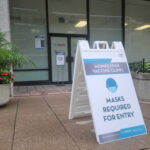
As of Monday, August 15, D.C. has vaccinated 15,671 people with a JYNNEOS vaccine and more than 28,700 people have pre-registered for an appointment via the city’s online booking portal. The city is also staging walk-up clinics every Friday that do not require an appointment, instead operating on a first-come, first-served basis. They’re also partnering with community groups to host pop-up clinics.
Sehgal says that this expanded eligibility strategy is “reasonable,” so long as first doses are still prioritized to high-risk residents — specifically men who have sex with men. But, he says, there’s no guarantee that MPV will stay within communities — already, D.C. has reported one of the first two pediatric cases of the virus in the country.
“It’s important to remember that anyone can get monkeypox and as we think about transmission networks, they’re not exclusive,” Sehgal says. “Casual contact hasn’t been the driver of the outbreak yet but that’s not to say thing are going to stay this way indefinitely, especially if we don’t get ahead of transmission.”
Previously:
D.C. To Open Walk-Up Monkeypox Vaccine Clinics Every Friday
How Monkeypox Messaging And Response Is Failing, According To Local LGBTQ+ Advocates
Amid Supply Constraints, D.C. Postpones Residents’ Second Monkeypox Vaccine Doses
D.C. Has The Highest Number Of Monkeypox Cases Per Capita In The U.S.
D.C. Launches Pre-Registration System For Monkeypox Vaccinations
What To Know About Monkeypox Vaccination In The D.C. Region
D.C. Is Making Limited Number Of Monkeypox Vaccines Available
What To Know About Monkeypox In The D.C. Region