Colleen Grablick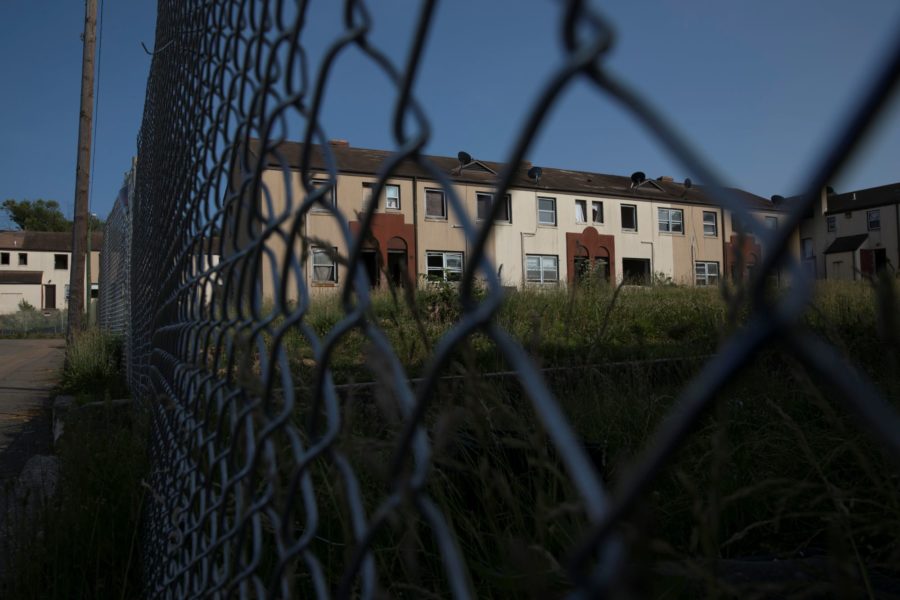
The first phase of a years-long redevelopment project at the Barry Farm housing complex in Southeast D.C. is set to begin next month, Mayor Muriel Bowser’s office announced on Wednesday.
In September, construction will start on The Asberry, a mixed-use building along Sumner Road with 108 affordable rental units for adults ages 55 and older, and about 5,000 square feet of commercial space. It will mark the beginning of what the city expects to be a nearly eight-year-long redevelopment project — one that has been more than a decade in a making, as longtime residents and D.C. officials grappled with concerns over equity, displacement, and preservation of the historic site.
The Barry Farm community traces its roots back to the 1860s: After the Civil War, a group of formerly enslaved and free-born Black people settled at the site and founded what became a formative hub of Black history, politics and culture. In 1943, the National Capital Housing Authority seized a portion of the Barry Farm land through eminent domain to create 432 units of of public housing. Over the following decades, the neighborhood went on to serve as a center of political action during the Civil Rights movement. It also played a pivotal role emergence of the homegrown D.C. music genre go-go in the 1980s with the creation of the Junkyard Band. Barry Farm is also home to Goodman League basketball, a community fixture and staple of summer on the court along Sumner Road.
By the 2000s, the Barry Farm units were deteriorating, with residents dealing with mold, lead, rodents, as well as a combination of poverty and crime. With federal support for public-housing revitalization waning, the city launched the New Communities Initiative. The project, created in 2005, aimed to revitalize several public housing complexes around the city — one of them being Barry Farm — but for years the program has been criticized and challenged legally for displacing residents long before replacement units are finished. In 2006, the D.C. Council approved plans for the redevelopment of Barry Farm, and later in 2014, the city’s zoning commission gave the greenlight to demolish the property and forge ahead with a redevelopment that would create 1,400 units of mixed-use housing — 344 of which would replace the more than 400 units that originally existed.
Fearing that families would be permanently displaced in the redevelopment, the Barry Farm Tenants and Allies Association filed a class action lawsuit against the city’s Housing Authority in 2017, and won a small victory when the judge vacated the zoning commission’s approval of the project and sent it back for further consideration. Tenants, most of whom had moved out of the area by 2019 with no clear idea when they’d be able to return, also successfully won a historic landmark designation that encompasses five properties on the site, preventing their demolition. A spokesperson for the Preservation of Affordable Housing, the non-profit that’s co-leading the redevelopment with the D.C. Housing Authority, told the Washington Business Journal at the time that the historic landmark designation might prompt developers to scrap plans for an entire apartment building, or around 200 units.
It’s still unclear if the city’s current plan for Barry Farm will have a replacement unit for every tenant who has been displaced. According to Wednesday’s press release, the completed revitalization project will bring 900 new affordable rental and housing units tenants can purchase — 380 of which will be replacements for the demolished units, dozens short of the 444 units that existed pre-demolition.
A spokesperson for D.C. Housing Authority told DCist/WAMU that the 380 units come in addition to 100 replacement units that were added during projects between 2011 and 2015, at nearby buildings like Sheridan Station and Matthew Memorial Terrace.
“Once completed there will be 480 total replacement units included within the Barry Farm redevelopment plan,” the spokesperson wrote in an email.
For Detrice Belt, the chair of the Barry Farm Tenants and Allies Association, she says she isn’t holding her breath to get back into the neighborhood she misses. She told DCist/WAMU on Wednesday that she wasn’t aware that the city had plans to begin construction this fall, and didn’t know the new timeline included a completion date in 2030 until DCist/WAMU informed her of the mayor’s press release.
“DCHA says a lot of different things … I’ll believe it when I see it,” says Belt, who moved out of the Southeast complex in 2018 to Northeast D.C. Previously, she lived in a unit with her daughter, across from Belt’s mother. Now, she and her daughter are on the opposite side of the city from her mother.
“I had a house with a front and backyard, and now I’m in an apartment building up with armed security guards,” says Belt. “I felt safe in Berry Farm with my community and friends and family there. In this building, I don’t know anyone, I’m isolated. I’m on a different side of town from my family and friends.”
The Asberry is set to be completed in early 2024, according to the mayor’s office.
Previously:
Amid Threat Of Demolition, Displaced Residents Will Soon Learn Whether Barry Farm Receives Landmark Status
Barry Farm Residents Still Don’t Know What’s Going To Happen To Their Home
Barry Farm Residents File Lawsuit Against D.C. Housing Authority