Elliot C. Williams
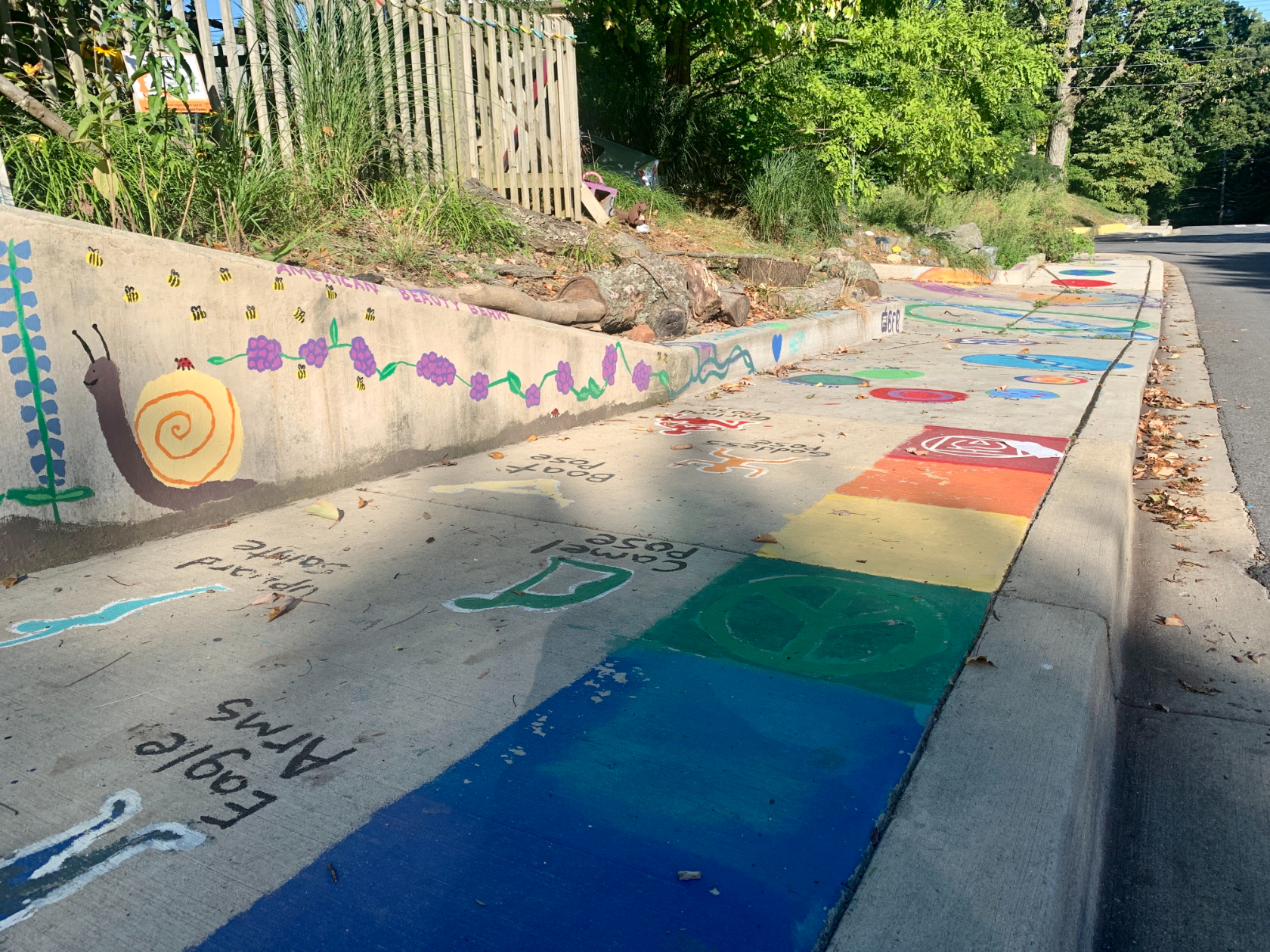
Over the past few days, Susan Comfort, a wellness consultant and Takoma Park resident, has taken to Twitter and put up multiple posts on Medium to defend the “Proud Plants Mural” and “movement sidewalk” project after city officials asked for its removal.
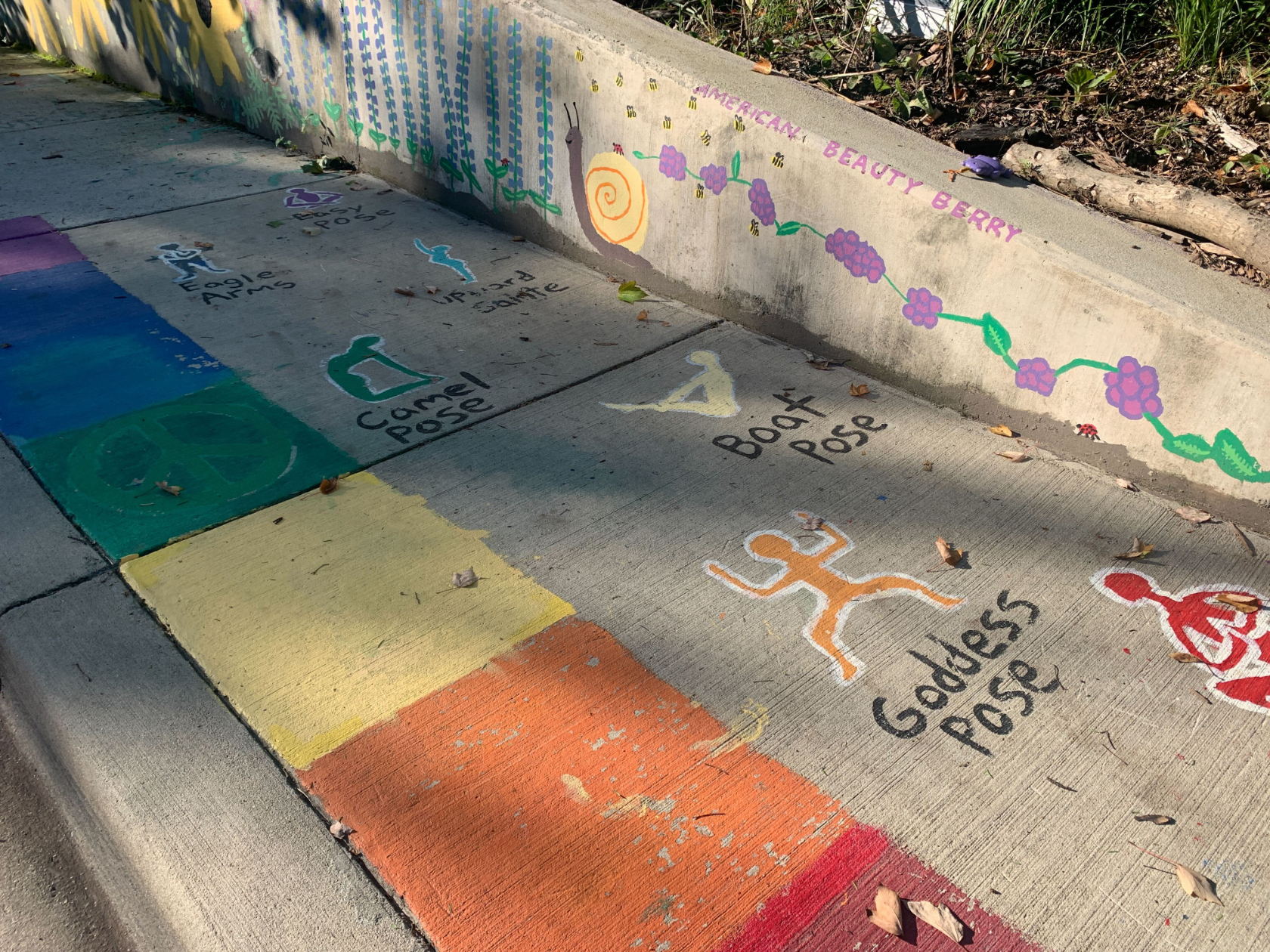
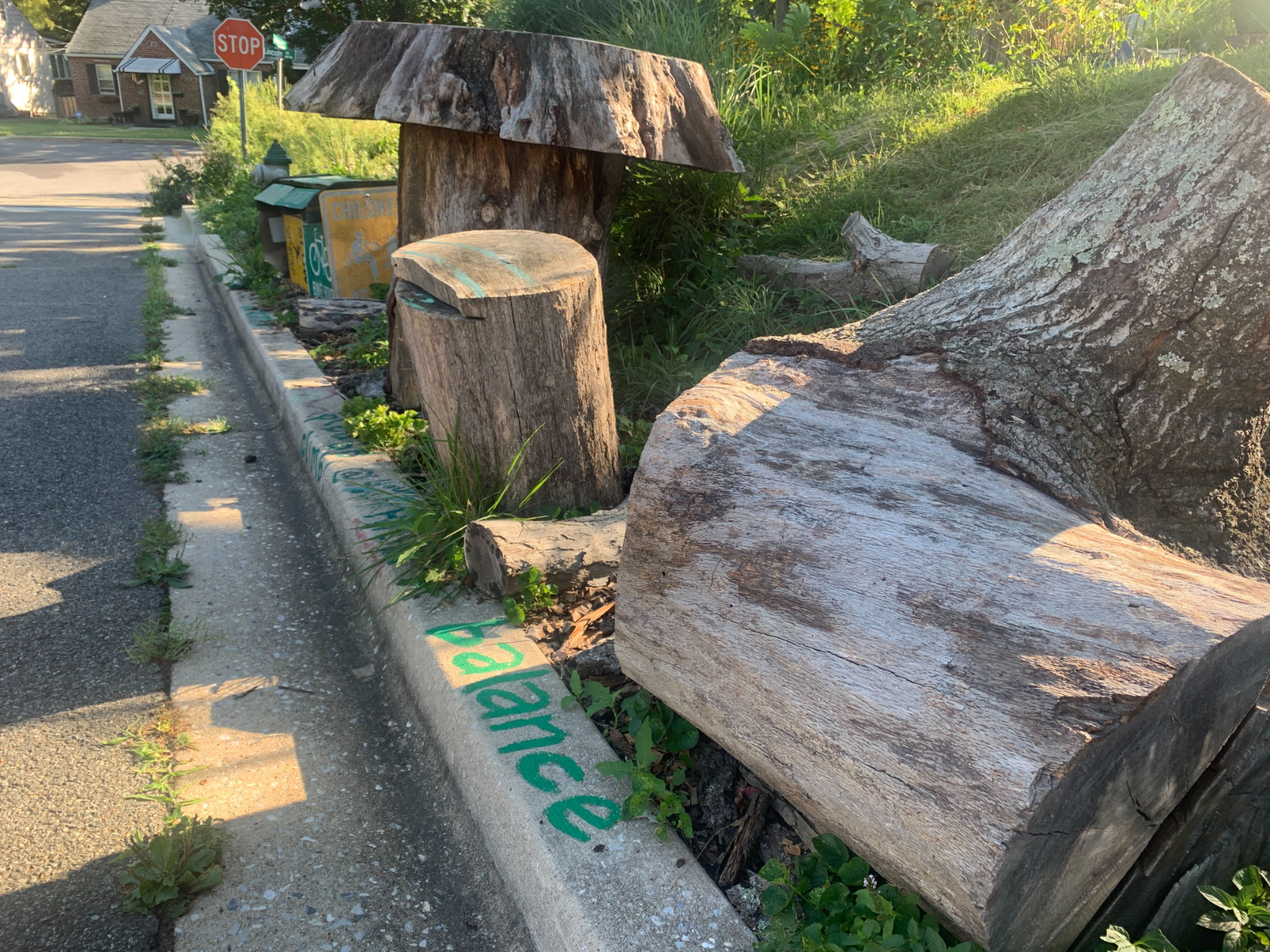
The bright and multi-colored mural, painted by local youth, features paintings of native plants and a kid-friendly obstacle course along a sidewalk and cement wall that spans two properties on Lincoln Avenue and around the corner to Aspen Ave. Comfort lives on the corner property, and part of the obstacle course includes rocks and tree stumps in her yard. Some of the sidewalk paint has faded away, but much of it remains.
City officials say the street art counts as graffiti, though Comfort has argued it should be granted an exemption due to the public benefit. Takoma Park officials say the painting isn’t eligible for an exemption, since the latex paint the artists used isn’t water soluble or temporary, which Comfort disputes. (A spokesperson for Takoma Park’s government said that city code “permits temporary, easily removable chalk or other water-soluble markings used in connection with traditional children’s activities or city-approved public art projects.”)
https://twitter.com/ComfortSpeak/status/1563267694270357505
Anatomy of a neighborhood fight
Naturally, many of the hallmarks of a classic Takoma Park citizen spat are involved. Of course, there’s the ‘keep Takoma Park weird’ vibe.
“Takoma Park is supposed to be this funky, artistic place. But it’s becoming exceedingly less funky,” says Comfort, who adds that she has the neighborhood’s support and wants to create a better process for approving public art in the community.
Says another resident who signed a petition Comfort started: “Takoma Park is unique,” the resident wrote. “Our community generally celebrates quirkiness, creativity, and artistic expression — we should not be writing nor enforcing laws that do away with these. Takoma Park is a place where diversity is embraced.”
Detractors counter that there is a system for adding public art and that Comfort just wants an exemption for violating city laws after defacing public property.
“I know Susan’s heart is in the right place, and she’s trying to do something nice for the community, but that doesn’t gave her the right to unilaterally decide that this art project that she likes is going to be painted on a public property in my neighborhood,” says Richard Fawal, a Takoma Park resident of 20 years who has become sort of a de-facto leader of the opposition to the project.
Then there’s that petition: Comfort collected more than 100 signatures, including from some who commented that the city government’s response is out of character for a community that boasts multiple public art projects. Many said in the survey the art has brought them joy during the pandemic.
Don’t forget the surprisingly heated rhetoric: The situation led to bullying and name calling in private Facebook groups, according to Eric Saul, who writes satirical website The Takoma Torch and poked fun at the graffiti situation in a recent post.
“What could have been a very civil debate on public space turned into just a big fight,” Saul says. (He’s not above the fray; Saul himself called Comfort and her supporters “entitled brats” in lengthy Twitter threads.)
Henry Messias lives next door to Comfort and has two kids who love the sidewalk art. He says he wishes there was an application where residents could get approved to do art projects directly in front of their homes. But he admits the situation has gotten a bit out of hand.
“This is kids’ artwork. People are having fun. It definitely doesn’t lower the property value,” he says. “I don’t see what the problem is here other than some folks in Takoma who sometimes wish this place was a gated community.”
The origin story
The ordeal dates back to spring 2020, when neighbors were looking for a way to relieve pandemic-induced stress.
The city had scrapped a $25,000 mural project that was planned for the wall outside Comfort’s property in order to shift resources to pandemic relief. A neighbor asked Comfort if she could paint an obstacle course for her kids on the sidewalk instead.
“I didn’t realize how much I’d benefit from passing kids and families exclaiming with laughter and joy,” Comfort wrote on her blog. “I got undue credit for the simple brilliance of the course.”
That one obstacle course sprouted into a collaborative art project. By spring 2021, kids were asking about plans to repaint the sidewalk.
She ran the initiative by the Takoma Park Ward 2 Councilmember, Cindy Dyballa. According to Comfort, the councilmember said there wasn’t an official process for getting it approved, and it wouldn’t be deemed graffiti unless someone complained. (Dyballa was out of office this week and couldn’t be reached for comment.)
Comfort solicited ideas from local kids on how to expand the mural, hoping — she admits — to avoid a complaint if she got the community involved. Over the summer of 2021, neighbors donated latex house paint and painted a multi-lingual section honoring the Juneteenth holiday, as well as a Pride-themed native plants mural.
Opposition mounts
Meanwhile, Fawal, who lives around the corner, says he heard from other neighbors who were not fans of the project. Some thought it was ugly, he says. Others felt it broke the fabric of civic society — that a resident can’t take over a two-property stretch of a public walkway without government approval simply because they think it’s a beautiful concept.
“She’s trying to do something good for the community, and I respect that,” Fawal says of Comfort. “But there’s a right way to do it and a wrong way to do it.”
This past June, someone filed a complaint with the Housing and Community Development Department. (Fawal says he didn’t contact the city, but another disgruntled resident did.)
On June 27, Comfort received a notice that the street art violated the graffiti law, and that she had to remove it by July 5, according to a letter she posted to her Medium page. She then sought an exception or a hearing from David Eubanks, the director of Housing and Community Development, she says. On Aug. 24, the city sent her a letter saying the request was denied and that she had a week to remove it or the city would power-wash it and charge her with the bill.
Over the weekend, Comfort went with a group to protest at city hall to see if there was a way to delay the removal. They learned it was too late and they needed to go through city council — which is out of session until September — to change the policy.
That may be an uphill battle. In response to Comfort’s inquiries, Takoma Park Mayor Kate Stewart wrote in an email that she can’t exempt an ongoing code violation anymore than she can “fix” a parking ticket. A spokesperson for the city told DCist in a statement that the city council could consider changing the code, but that “should not be rushed.”
A waiting game
These types of controversies aren’t uncommon in Takoma Park, where issues like solar panels and the proposed development of a parking lot have sparked beef between neighbors and led to legal action.
Comfort says she hopes the end result of all this is a clearer process to create more street art, from local kids and professional artists alike.
“If we’re the sacrificial lamb, and we can get eight projects out of this because a process is in place, that would be great,” Comfort says.
As of Wednesday morning, the mural had not yet been washed away. Both the supporters and detractors of the project agree that it could take weeks, given government bureaucracy.
Messias, the nextdoor neighbor, just wishes people would move on. It’s not like anyone has spray-painted hate speech or anything controversial on the wall, and if they did, Messias says he’d personally remove it.
“Why is this the hill we have to die on?” he asks. “It’s some art. Kids enjoy it.”
Saul, the Takoma Torch blogger, says this is just another day in Takoma Park:
“My articles from three-and-a-half years ago are the same as today,” he says. “We’ve been doing this for years.”
This story has been updated to reference previous debates that occurred in Takoma Park, Maryland, not the D.C. neighborhood.