Martin Austermuhle
A seemingly simple-looking bike lane and road reconfiguration in-the-making has spawned an election battle in a small portion of Capitol Hill that could see a current official recalled from office in November — and possibly re-elected once again on the same day.
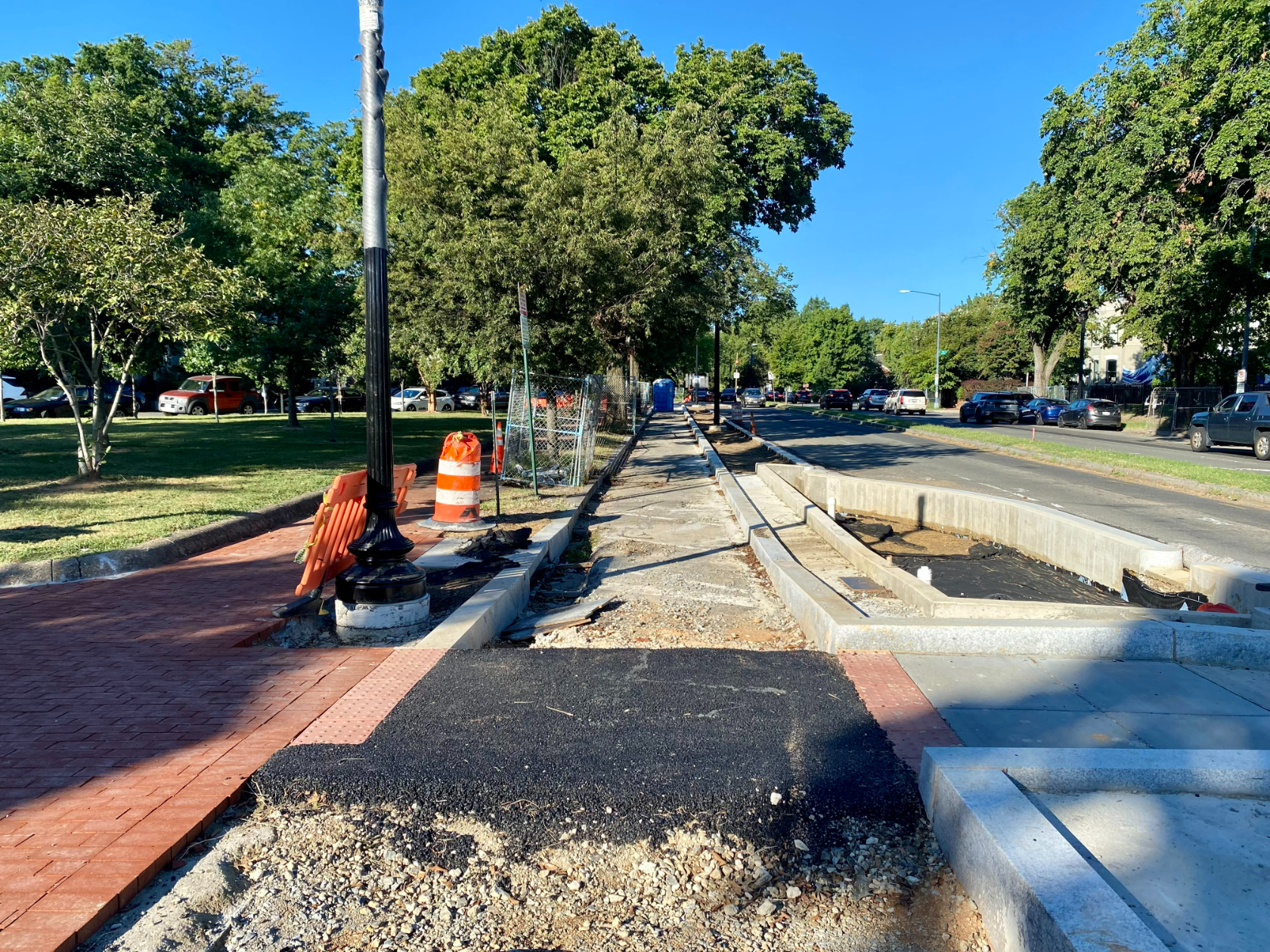
The hyperlocal fight revolves around a block-long bike lane that the D.C. Department of Transportation is set to build along a short stretch of North Carolina Avenue NE to connect a longer, protected bike lane on C Street NE to Lincoln Park. The current plan would see the avenue converted to one-way car traffic, with the bike lane running between existing on-street parking and the sidewalk.
Opponents of the design say that their current Advisory Neighborhood Commissioner, Amber Gove, did not listen to their concerns when she cast votes in favor of the proposed plan. Earlier this summer they filed a petition to recall her from office — a mechanism by which voters can effectively un-elect someone — and this week the D.C. Board of Elections cleared it for the November ballot.
Now, recall efforts aren’t anything new for Advisory Neighborhood Commissioners, the corps of elected volunteers who represent districts amounting to roughly 2,000 of their neighbors and advise the city on everything from liquor license applications to more complicated zoning changes. (Gove represents the 6A04 district, which sits on the northeastern edge of Lincoln Park.) In fact, no recall effort against a mayor or member of the D.C. Council has ever reached the ballot, while they have for a few ANC commissioners.
But the recall effort against Gove is complicated because it will align with the normal November general election, when all ANC seats are up for grabs. Gove had already planned to run for re-election and will appear on the ballot alongside a challenger, Alexandra Kelly. But that means Gove’s name will also appear on a separate ballot asking voters whether she should be recalled from office. Kelly, meanwhile, led the charge to get the recall question on the ballot in the first place.
All of that raises the possibility — unlikely, but not impossible — that Gove could be both recalled from her current term and re-elected for the next. Were that to happen, she would likely lose her seat for a single month, December, before retaking office in January. Gove could also be recalled and not re-elected, or not recalled nor re-elected.
And all of these electoral machinations will involve different sets of voters, largely because of the decennial redrawing of ward and ANC boundaries that occurred earlier this year. Voters who lived within the 6A04 boundaries last year and remained in them after redistricting will get to cast ballots in both the recall and the normal ANC election. But there will be a smaller number of voters who were redistricted out (meaning they get only get to vote on the recall) or redistricted in (meaning they only get to vote in the normal ANC election, not the recall). And it’s worth noting that before redistricting, Gove won her last election handily. In her re-election race in 2020, she received 1,022 votes, or 79% of those cast. A challenger got 252.
“The recall is basically a waste of resources and meant to embarrass me,” says Gove, stressing that the matter could simply have been settled as part of the normal election cycle.
But Kelly says she and a group of neighbors decided earlier this year that a recall was necessary after they felt excluded and ignored during the process that led to the approval of the changes to North Carolina Avenue. Kelly says the recall attempt is less about whether a bike lane will be built and more about whether her elected commissioner was willing to listen to concerns from her constituents about it.
“We have high bike use in our neighborhood. We all own bikes and ride bikes. We have a number of older residents who rely on their cars but still have their treasured bikes. We were very open to [the bike lane] as part of the solution,” she says. “On the other hand it was not an inclusive process. [D.C. officials] pretended we had options but we had no opportunity to affect the outcome. We don’t want a one-way street. We don’t think it’s improves traffic safety or reduces speed.”
As for the timing of the recall, Kelly said her and her neighbors had hoped to vote on it earlier in the year. Under D.C. law, though, the elections board is allowed to pair a recall with a regularly planned election, provided there’s one scheduled within four months. The petition to recall Gove received 206 valid signatures, just over the 193 required to get the measure on the ballot.
Gove has argued that the bike lane and one-way configuration will be safer for all road users, but she agrees with Kelly on one point: The recall election isn’t so much about the decision that was made, but rather how any decision on a hyper-local issue is made — and who gets to make them.
“It is incumbent on all elected officials to be aware of who is in the room and who the loudest voices are,” she says, noting that her fellow commissioners in ANC 6A also voted to support the city’s plan. “And frequently those loudest voices are not representative of the community. We need to do extensive outreach to ensure that we are hearing all voices, not just the loudest ones in the room.”
Kelly echoes a similar concern, though she says Gove is to blame for only listening to certain voices on certain issues. “I want to be part of making our neighborhood the best place it can be, and that includes the most inclusive,” she says. “I’m concerned that the range of issues we’re addressing is narrow and doesn’t include the whole community.”
Regardless of how the recall and the election turn out, Gove says the bike lane and one-way traffic pattern are coming — she’s been told D.C. plans to start work on the block-long stretch of North Carolina Avenue in November or December.