Martin Austermuhle
Standard protocol when meeting Queen Elizabeth II held that you’re only to touch her should she offer her hand; under no circumstances should you hug her. But on a warm spring day in 1991, D.C. resident Alice Frazier threw all norms out the window and embraced the United Kingdom’s then-monarch as she walked into Frazier’s home in Ward 7.
“I’m used to hugging people,” she told the Washington Post at the time. “I would do her [the queen] the same. After all, we are both mothers.”
The protocol-prohibited hug, memorialized in a picture showing Queen Elizabeth II smiling pleasantly but not returning Frazier’s surprise embrace, came in the midst of the monarch’s official 12-day visit to the U.S. more than three decades ago. The queen’s trip included stops in Texas, Virginia, Maryland (where she attended a Baltimore Orioles game), as well as the White House. But the monarch also visited a new affordable housing development on Drake Place SE, where Frazier had recently moved.
The queen died Thursday at age 96.
The brief foray to the troubled three-block-long residential street in Marshall Heights came with the usual pomp and circumstance: 100 D.C. school children were on hand to greet the queen, trash was picked up and lawns mowed, and Frazier prepared a meal befitting of royalty — despite strict norms that made it highly unlikely that Queen Elizabeth II would have savored it.
“Alice was so innocent and so proud of her new home. And of course, everyone had told us that the queen can never eat in public. The only time, you know, is a state dinner or something. Alice had prepared all this food for the queen, and she kept insisting that Queen Elizabeth come in here and have some fried chicken and deviled eggs and potato salad. And Queen Elizabeth was clearly amused by it,” recalls Sharon Pratt, who was D.C.’s mayor at the time and accompanied the queen on the visit to Drake Place. “She was enjoying it in her restrained fashion.”
First Lady Barbara Bush was also there, as was Secretary of Housing and Urban Development Jack Kemp. Pratt doesn’t recall exactly how the queen came to visit the housing development on Drake Place, but she assumes it was because H.R. Crawford, who represented Ward 7 on the D.C. Council, had also worked at HUD under President Richard Nixon and later became involved in property management.
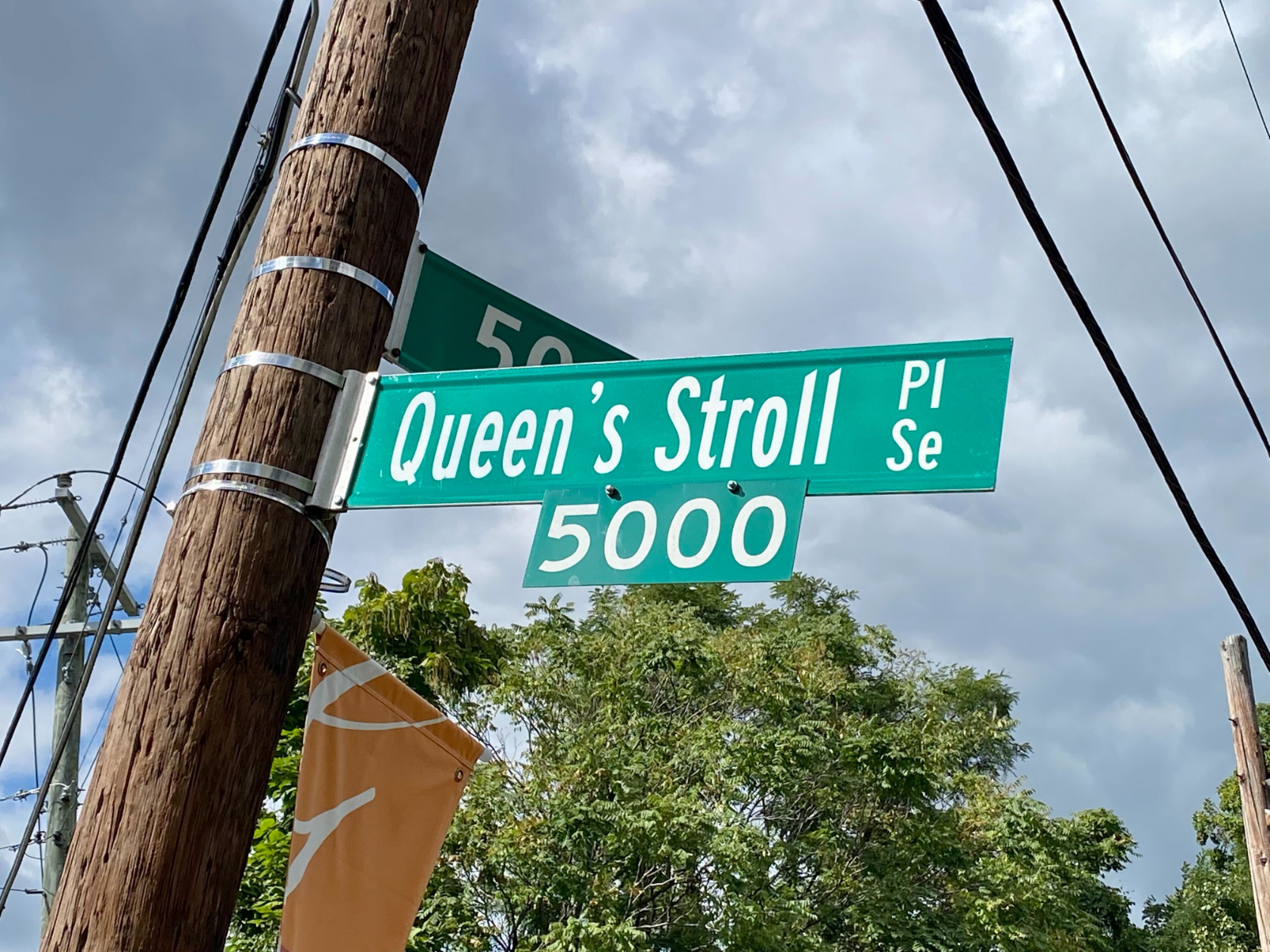
Crawford later moved to memorialize the visit by symbolically renaming Drake Place “Queen’s Stroll Place,” a name that still exists today.
“This is an effort to upgrade the image of the community,” he said at the time. “The queen did stroll there, so I thought it was a good idea. The neighborhood is on a roll. This is a way to keep the momentum going.”
And Crawford wasn’t the only one who thought the honorary renaming would lend some good fortune to the neighborhood. Residents and civic leaders said as much in letters to the council obtained by DCist/WAMU urging it to approve the renaming.
“The passage of this bill will go a long way in improving morale in the community by immortalizing an event that will be recounted for generations to come,” wrote Sandra Ford Johnson, who lived on Southern Avenue.
“It was evident through news reports the people in the community were enthused when Queen Elizabeth visited,” offered Ulysses S. Glee Jr., the chairman of the Ward 7 Democrats. “The residents demonstrated pride in their community by taking time out to clean and make other preparations. It is also evident that the area is plagued with crime. Hopefully, some small changes in the community such as changing the street name can set the tone for a different image for the community.”
John S. Woodson, who also lived nearby, said at the time the name change might facilitate his broader plan to encourage foreign embassies to locate east of the Anacostia River. Additionally, he wrote, the name change wouldn’t be that dramatic a shift. “The only Drake that I can think of is Sir Francis Drake, also a noted Englishman, so [this] changes nothing for me,” he wrote.
Of course, not everyone was enthused with the idea. According to The Washington Post, some nearby residents called the idea “insulting” or “asinine,” while others questioned whether anyone else would have received the same treatment. “I think it should stay the same because if it was a famous Black man who walked down the street I don’t think they would have changed the name,” said Tyese Scott, then 18.
A Washington Post reporter visited the street a year after the renaming had happened, and found that little other than the name had really changed:
“I thought it would be a big change [after Queen Elizabeth II’s visit], that things would move a little faster,” said Juanita Phillips, a 27-year Eastgate resident. “That didn’t happen.”
D.C. Council member H.R. Crawford (D-Ward 7), who touted the royal visit as a precursor of greatness for Drake Place, acknowledged this week that “much of the benefit is yet to come.”
“The drug element is still there,” Crawford said. “Once we renovate, hopefully the drug element will disappear.”
Still, Pratt fondly remembers the queen’s visit to Drake Place.
“I remember Queen Elizabeth. She was very lovely. My grandmother was quite ill then. And the first thing [the queen] did was was to ask about her health and well-being, and that meant a lot,” she told WAMU/DCist.
As for Frazier’s unauthorized hug, Pratt says the queen took the break from protocol in stride.
“She knew that this woman was just so authentically excited about having her own home, number one, and two, that she got to receive the queen to her home. And and I just thought it spoke volumes about who she was as a person,” says Pratt.
Frazier died in 2005, but an obituary written in The Washington Post recounted the incident from almost 15 years earlier.
“As friends and family members gathered Friday at St. John Baptist Church to say goodbye, they celebrated her way,” it read. “There were hugs all around, friends who showed up with food and fond remembrances of an incident that, for a moment, drew international attention and a moment of levity when it was sorely needed.”