 Rebecca Cooper
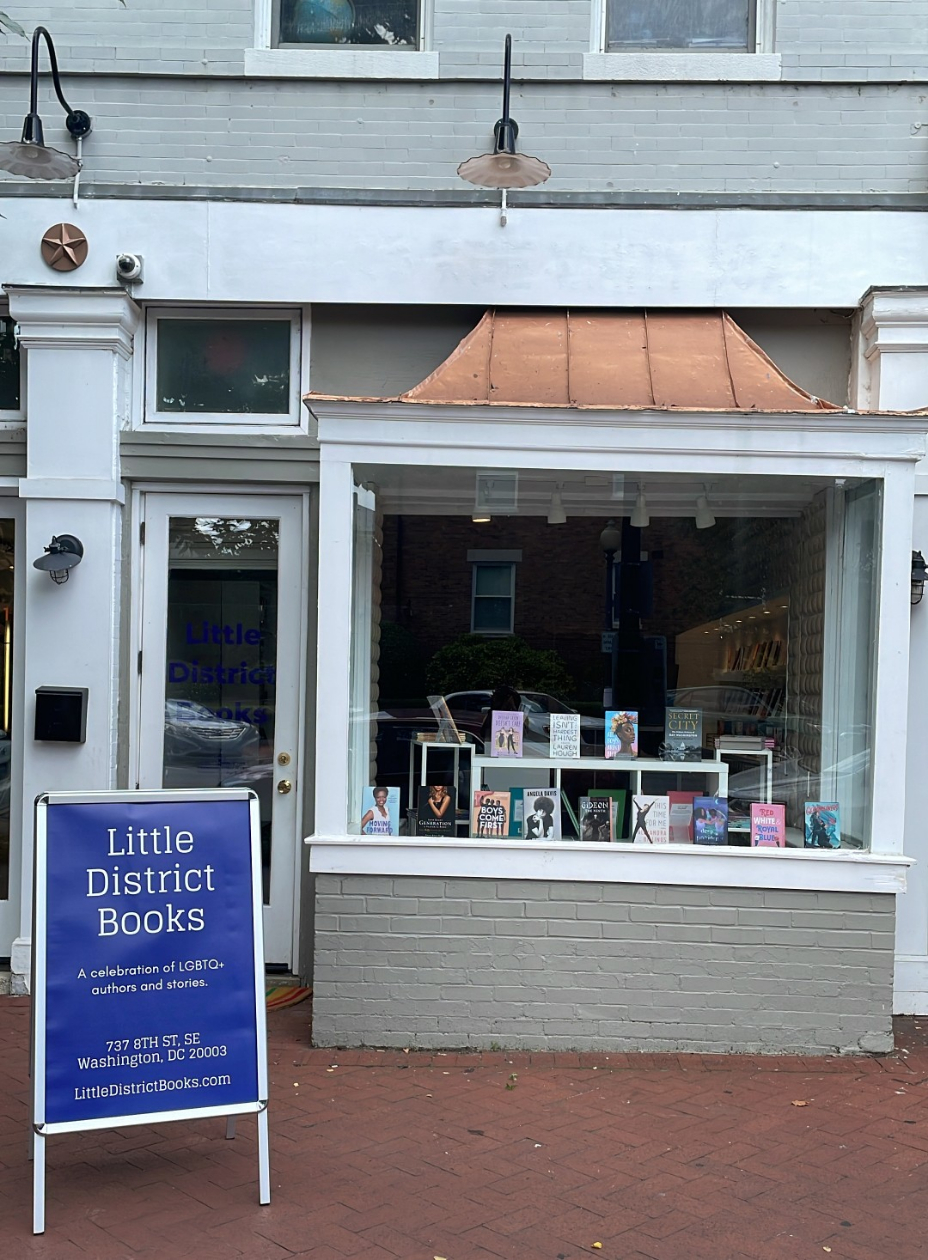
People strolling down Barracks Row this summer might have stumbled upon Little District Books. The new LGBTQ+ bookstore, which opened in June, aims to celebrate queer voices and stories by selling books for all ages.
The store’s opening, and its mission, are timely. Across the country a wave of challenges to LGBTQ+ literature in schools and libraries is underway. There were over 700 book challenges last year in schools, libraries, and universities, nearly double the number of challenges in 2020, according to the American Library Association. In 2021, the three most challenged books in the country were all books focused on LGBTQ+ content.
These challenges could be coming to Virginia where lawmakers are finalizing a policy that would allow parents to prevent their children from using sexually explicit instructional materials. Because of the vague definition of what is considered sexually explicit, some are worried the policy will lead to schools censoring books that address topics related to queerness.
Little District Books owner Patrick Kern spoke with DCist/WAMU about opening a LGBTQ+ bookstore amidst this wave of book challenges, and the importance of creating access to queer literature for people of all ages. The following interview has been lightly edited and condensed for clarity.
DCist/WAMU: Do you remember the first time you visited an LGBTQ-focused bookstore?
Patrick Kern: Actually the first one I ever went to was in the U.K. It’s a very famous LGBT bookstore called Gay’s The Word, and it’s kind of a medium sized bookstore. But it was completely different than any other bookstore I’ve ever been in. None of the books that were in that bookstore were in any of the bookstores that I was used to going to.
How did you decide on where to put your bookstore?
I have lived in D.C. for ten years and I’m very familiar with a lot of the neighborhoods. And I was looking to be in the neighborhoods that [the bookstore] was adding something to that neighborhood. There has been a bit of a focus on the Capitol Hill neighborhood with other LGBT businesses coming in. And, I thought it would be a good opportunity to be there and be in that community as well.
You’ve been very vocal about how this is a bookstore for all ages. Why is that so important to you?
It’s so much about what I didn’t have. In the ’90s, there weren’t a lot of LGBT books available for middle grade children, the younger end of YA. It was only just really starting where publishers were actually producing that kind of content. And, now there is quite a wealth of books out there. But you don’t get that kind of curation in any one bookstore because most bookstores are focused on serving the whole community and not the people who aren’t getting what they need.
You’ve called Little District Books the bookstore that you always wanted when you were younger. Is there a moment you remember as a kid when you thought, “Wow, I’ve been missing out?”
Yes. I would say the one that kind of comes [to mind] is when I was in high school. Some of my classmates [saw] themselves in the characters that are selected in the curriculum, but I didn’t really see myself in very many of those characters because they didn’t reflect who I was.
What’s it like to open your store in this kind of environment, where books dealing with queer sexuality or by queer authors are under attack?
Everything going on nationally and in Virginia, it really drives home how important places like this are. LGBT people are not born into their own affinity group. They don’t have their parents to teach them the things about who they are, who they desire to have relations with, what their gender is. They have to seek that out outside of their family groups. So if you aren’t creating a path to finding that, it just creates confusion that carries on throughout their lives.
Do you see your space as bridging a gap?
I do. LGBT spaces in general have kind of been in this evolution where there was a lot of focus on very white, male oriented spaces. So the LGBT spaces that are coming along now are much more oriented at bringing everyone in: trans community, non-binary community, people of color. So the kind of evolution of the spaces in general — the bookstore is very much part of that process.
LGBTQ spaces, especially those that are not explicitly adult bars, have had a lot of trouble staying open lately. Does that worry you about the future for your store?
I mean, it’s always a consideration. I think the thing is the challenges that these spaces face are similar to the challenges that any small business faces. And a lot of it is you have to kind of adapt to who the customer is and how the community itself is changing over time. I know DC is a good space for this because it has a very large LGBT community. You know, that population will always be there to be served. It’s always in my mind.
Are you planning any future events or highlighting any local authors?
We have just launched our book clubs. Our first couple meetings will be in September with more book clubs planned on a monthly basis. We’re partnering with other local businesses to host events. We have author events detailed on our website in September and October with more in the planning stages.
What are some titles you recommend to someone who may not be familiar with the LGBTQ+ space?
I think a lot of the information learning that non-LGBT people have to kind of go through, it’s very much important to look at things in the context of growing up. So actually a lot of the best books for illustrating these ideas are books that are written for children because they’re centered around how people learn. We have a book called The Pronoun Book that’s an easy guide to understanding the importance of pronouns. We have a variety of adult theory books. How to Be Ace, which is all about understanding the asexual identity. And it’s a popular title both for people who are figuring out their own identity and for people looking to understand ace people.