Ally Schweitzer
As housing costs climb, some tenants in a D.C. suburb are calling for a policy feared and loathed by the development industry: rent control.
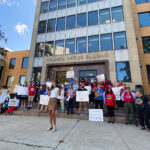
“When I say ‘renter,’ you say ‘power,'” barked organizer Frankie Santos Fritz into a microphone Friday morning, as roughly three dozen demonstrators waved signs in front of the Montgomery County Council building in Rockville, Maryland. “Stop gouging us,” one sign read. “My rent increase: $195,” proclaimed another.
Activists with immigrant advocacy organization CASA, Jews United for Justice, and a local chapter of the Democratic Socialists of America were gathered to support pending rent control legislation while members of the Small Multifamily Owners Association, a local landlord group, held Zoom meetings with county lawmakers. On the steps of the council building, demonstrators urged elected officials to support the temporary bill, which would ban rent increases over 4.4% for six months.
The measure, introduced by County Executive Marc Elrich, is gaining political momentum as rents rise, pushed upward by a perfect storm of factors that include inflation, booming demand for rental housing, the end of pandemic rent protections, and a preexisting housing shortage.
Median rents for new leases in Montgomery County have increased 11% since 2019, according to Apartment List. Attendees of Friday’s rally told their own stories of rent increases.
“We have been fighting things like COVID,” said Silver Spring resident Luis Alonso Cruz Fuentes, who spoke in Spanish with an interpreter. “Paying rent has become really hard. I’m the father of a family, and it’s hard for me to pay rent, especially with a 10% increase.”
At-Large Councilmember Will Jawando, the only sitting council member who attended the demonstration, told the crowd he received an email from a constituent whose rent shot up more than $1,000. “What was the number one thing we said during the pandemic?” the Democrat said. “We want to keep people in their homes and keep them safe. How do you keep people in their homes if their rent goes up 40, 50 percent? The answer is, you don’t.”
D.C. and the city of Takoma Park have rent stabilization on the books but Montgomery County hasn’t had such a law since the 1970s.
“The council actually took the lead on rent control in the seventies, but they backed down under pressure from the apartment industry,” says Elrich, who introduced the stabilization bill after pandemic restrictions on rent increases expired in May. Council President Gabe Albornoz declined to bring Elrich’s proposal to a vote this summer, saying a majority of the council didn’t support it. According to Albornoz, the council’s Planning, Housing and Economic Development committee intends to hold a meeting this fall to discuss rent stabilization more broadly.
“We want to see if there are other solutions we can enact,” the council president says.
Landlords and development interests are seeking to quash the idea entirely. The Small Multifamily Owners Association has made rent control a top issue for the group, its CEO tells WAMU/DCist, and the Apartment and Office Building Association of Metropolitan Washington is vocally opposed. Landlords say rent increases were inevitable after governments restricted them during the health crisis, and any attempt to enact price controls will have deleterious effects on housing construction.
Law firm Ballard Spahr has waded into the debate on behalf of the real estate industry. Attorney Roger Winston, who represents owners of multifamily developments, says placing a cap on rent increases would further challenge building owners already facing rising costs of insurance, utilities, and labor.
“Even though all those things are going up, the government in Montgomery County has said, ‘We don’t care,'” Winston says.
The lawyer says rent stabilization could have a dramatic effect on the housing industry while providing dubious benefits for tenants. The current proposal isn’t means-tested, he says, meaning all renters benefit regardless of their income level. In an affluent locality like Montgomery County, he says, affordable housing policies should be tailored toward people who need them most.
“What’s the public policy of saying somebody who makes a six-figure income should have their rent controlled by the government?” Winston says.
The number of renters who are cost-burdened in Montgomery County grew between 2010 and 2018, though the percentage of cost-burdened households decreased as the county added more affluent renters, according to a 2020 study by the planning department. An earlier study showed that 74% of renters in the jurisdiction earned less than 100% of the area median income, which was $110,300 in the 2017 fiscal year.
Despite the opposition, the county council may take up permanent rent control legislation next year, when as many as six new council members are expected to join the body. One likely newcomer is Kristin Mink, a progressive Democrat nominated to represent District 5. Mink, who will face Republican Kate Woody in November’s general election, supports rent control.
“Rent stabilization does not mean that rents can never go up. The model still ensures profitability. It just keeps that profitability within reason, and it prioritizes keeping tenants housed,” Mink says in an interview with WAMU/DCist.
During Friday’s rally, Mink said the council should consider rent control as part of a broader package of policies that protect renters and encourage more affordable housing construction.
“Is rent stabilization the entire solution for all of our housing issues? No, that would be ridiculous. There is no one silver bullet,” Mink said. “But when we look at displacement, rent stabilization is the answer.”
Matt Losak, executive director of the Montgomery County Renters Alliance, says the pandemic helped bring attention to tenant issues that have traditionally fallen by the wayside in Montgomery County politics.
“We’re in a crisis. We are seeing what we believe is the forced migration of working families, low-income families, and people on fixed incomes” from Montgomery County, Losak says.
But a changing of the guard on the county council gives him faint hope, he says.
“I’ve given up on predicting what elected officials are absolutely going to do, but we are hopeful,” Losak says. “If we end up with two, three, or four voices [in support of rent stabilization], we will have a different chorus.”