 Jordan Pascale
Metro is in better financial shape next year than previously hoped, but the transit agency will still face a tough fiscal road in the years ahead. Leaders say addressing the shortfall will require a wholesale look at the operation — from who it serves, to how much service it will provide and when.
The transit agency faces a $185 million deficit for the fiscal year that runs from July 2023 to June 2024, a drastic reduction from previous estimates of $500 million and $350 million. Metro arrived at this improved position in part via cost savings and increased ridership, according to a presentation made public Monday.
Metro officials plan to present a number of possible mitigation measures for the shortfall later this week, including train turnbacks to account for changing ridership, large fare structure overhauls (including potential fare increases), and more. The list of proposals does not include drastic service cuts like those proposed in previous years. The presentation is the first step to passing a budget by March.
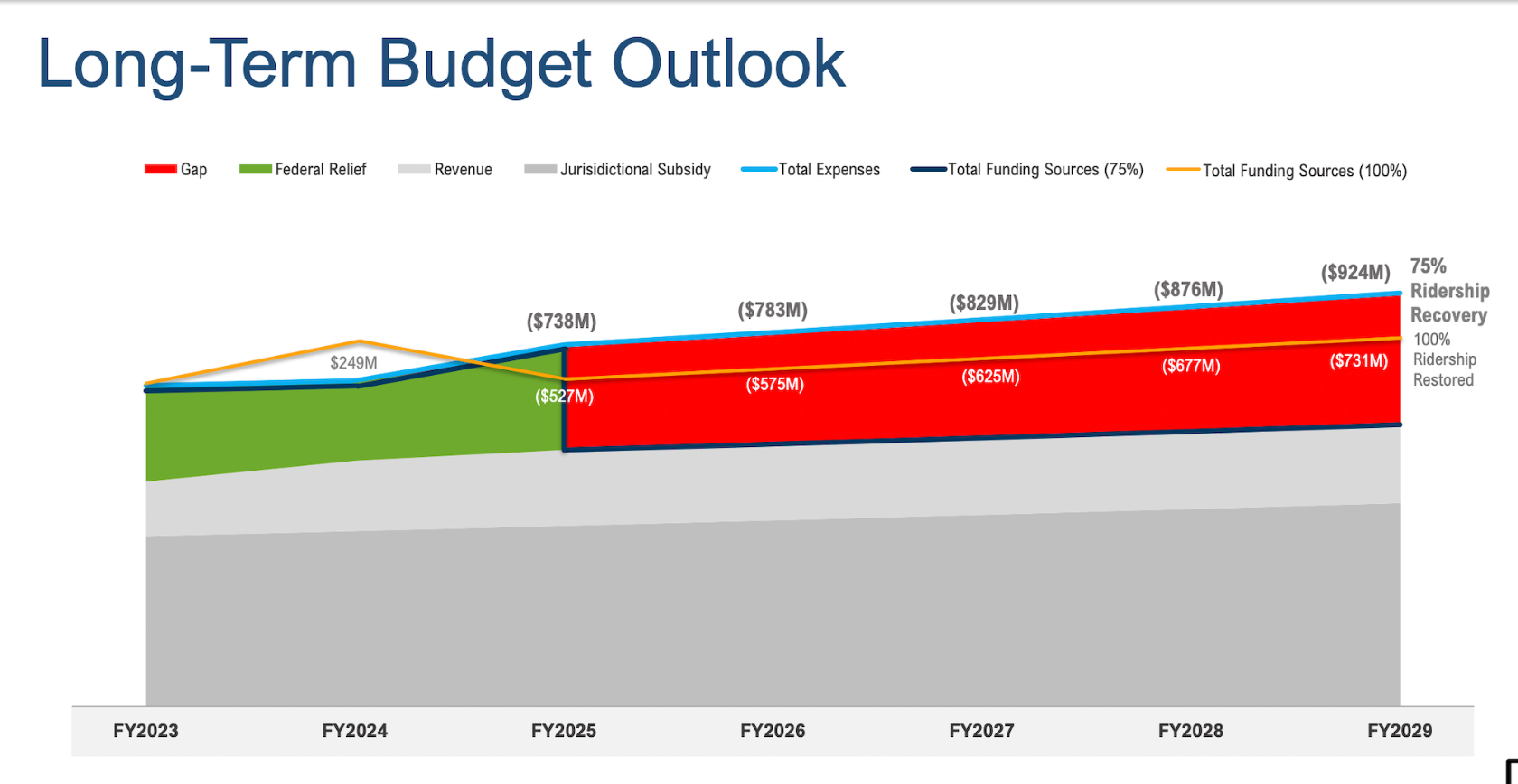
The announcement comes at a critical moment for Metro. After this year, federal pandemic stimulus funds will be depleted, leaving Metro without the money that has kept it afloat for the last two years. Long-term, Metro projects deficits of $527 million in 2025, $575 million in 2026, $625 million in 2027, $677 million in 2028, and $731 million in 2029.
It’s the first budget for new Metro General Manager Randy Clarke as the agency grapples with funding issues. Clarke discussed some of these issues last week when he met the board of the regional Metropolitan Washington Council of Governments.
“After this year is over, we are going to have to come to a realization as a region that there will not be a lot of tools in our toolbox (to fix the budget),” Clarke said. “As a region, we’ll have to solve the longer-term question. But I think the first piece is us gaining trust and credibility.”
WMATA board chair Paul Smedberg told the MWCOG board that Metro leaders will have to pay close attention to “how people are going to use the system in the future.”
Ridership trends have dramatically changed during the pandemic, which is affecting Metro’s current business model. The agency once thrived on ridership revenue from rush hour, long-distance rail riders that paid pricey fares of up to $6 a trip — often federal and white-collar workers from the suburbs. Now those people are staying home and working remotely most of the week.
Metro officials say they are seeing less use of end-of-line stations and other suburban stations, but more ridership in the core and fast-growing parts of the region, like the southern ends of the Green and Yellow lines which include new developments, major sports venues, and National Airport. Metro wants to capture all the entertainment, travel, and non-discretionary customers it can. It will also look at operating hours, leaders said.
Metro says it’s also facing headwinds of increased fare evasion, rising labor costs, inflation, lack of dedicated operating revenue, and a law that caps Metro’s budget increase requests at just 3%.
How Metro Plans To Bridge The Gap Next Year

The $2 billion budget could include many changes for riders. Here’s what’s on the table, per the presentation:
- Train “turnbacks”: Metro eliminated this confusing concept back in 2018-2019, but the transit agency could bring it back because of changing ridership. Turnbacks aim to create more service frequency in the core by “turning back” some trains at stations farther out in the suburbs.
In the past, the Red Line had turnbacks at both Groversnor-Strathmore and Silver Spring, which meant longer waits for suburbanites or having to transfer on the same line to get to a suburban destination. The Yellow and Green line turnbacks at Mt. Vernon Square may also return, which would give more service to the southern end of those lines. - Fare restructuring: It’s not clear what mix of options will be chosen, but Metro is considering charging more for rail trips, changing or eliminating its peak and non-peak pricing model, and changing to a zoned-fare structure on rail instead of different prices for each destination. Metro has had distance-based fare pricing since its inception in the 70s, but it’s created a complicated fare table with a specific price for each station-to-station journey. Zone-based pricing may sound familiar to longtime D.C. residents who used taxis — it means you would pay different set prices for crossing into different zones. RTD in Denver uses zone-based pricing for its rail system.
“We have arguably the most complicated fare table for transit in the world,” Clarke said last week. “It is pretty outdated, it’s not easy to use, and it’s maybe not as equitable [as it should be].” Metro will also consider reducing bus fares from $2 to $1 to increase ridership and help those in need. - Rail operating hours: Options include earlier opening times on Saturdays and Sundays (currently 7 a.m.) and later closing times on Friday and Saturday (currently 1 a.m.). In its presentation, the agency also brought up the idea of earlier and later times for trains on the Blue, Orange, and Silver lines in light of the new Silver Line extension opening rail access to Dulles Airport.
- Addressing fare evasion: Metro says more and more people aren’t paying their fares. Metro lost an estimated $36 million from fare evasion in 2019. Now they’re looking at making it hard to jump turnstiles and capture more revenue. At the same time, they’re also looking into discounted or free fare programs for low-income individuals.
- Bus changes: Metro saw ridership increases of 37% on bus lines that saw more frequency. Last year, Metro launched a series of lines that had 12-minute and 20-minute frequencies. They’ll look to replicate that success with an upcoming bus network redesign. Clarke told the MWCOG board that getting the bus network as efficient and usable as possible is “incredibly important.” He hopes there can be incremental changes before a larger overhaul in 2024.
Metro will also do some accounting changes:
- Increased subsidy: Metro’s largest funding source is tax dollars from local jurisdictions, but a 2019 law put a 3% increase cap on funding from localities. Metro is considering seeking to increase that cap to 5%, which would yield an extra $24 million, according to the presentation.
- Federal money from the infrastructure bill: Metro will get $125 million annually from the federal infrastructure bill, which will allow them to move around other money. Metro would focus that money on preventative maintenance, working to avoid more expensive maintenance after problems surface. In the past Metro has spent less than 10% of its maintenance budget on preventative maintenance.
The presentation is described as laying out the table for what’s to come. Clarke will present a more formal budget proposal to the board in November. The board wanted to kick off the process earlier because of so many changing circumstances.