Martin Austermuhle
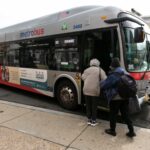
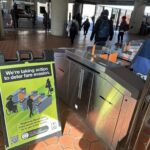
A D.C. Council committee on Monday advanced a bill that would give most D.C. residents up to $100 a month to be used for Metrorail and Metrobus, effectively making public transit free — or at least significantly cheaper — for many city-based users.
The council’s five-person transportation committee unanimously voted to approve the bill, sending it to the full legislature for debate and a first vote as early as October.
During a brief discussion on Monday afternoon, lawmakers touted the measure as a means to boost ridership and offer the transit agency a steady source of additional revenue from D.C., especially as it navigates financial difficulties caused by the pandemic.
“I think that this is a major step forward. First, we need to help our transit system. It’s in a lot of trouble, and this will do that. The second thing is, it will increase ridership and increase transit use with all the benefits that accrue,” said Councilmember Mary Cheh (D-Ward 3), the committee chairperson. “It’s not cheap, but the repayment to us as a community will be worth it.”
The bill, first introduced by Councilmember Charles Allen (D-Ward 6) in 2020, would provide a monthly $100 subsidy to D.C. residents to be used on Metro, building on the existing Kids Ride Free program, which serves more than 50,000 D.C. school children on an annual basis. (The D.C. Streetcar is also free, and Mayor Muriel Bowser tried unsuccessfully in the past to make the D.C. Circulator free.)
While free public transit has been adopted more broadly in parts of Europe, U.S. cities from Olympia, Washington to Kansas City, Missouri have in recent years tested the idea. In Montgomery County, Ride On buses were free until July 2022 as part of a two-year program, and earlier this year Boston eliminated fares on three bus lines for two years.
Under the bill, qualifying residents would get the initial $100 subsidy, and get monthly installments thereafter to keep them at that level. (So if a rider only spent $25 on Metro in a given month, they would get $25 as a subsidy the following month to bring them back to $100.) Any expenses above the monthly subsidy would have to be covered by the user. According to the committee, the $100 a month would cover the transit needs of 92% of adult users in the city.
The legislation would also create a Transit Equity Fund that would dedicate $10 million a year for the D.C. Department of Transportation to “improve transit infrastructure and service in areas of high transit need or historically underserved communities,” according to a committee report, thus ensuring reliable service.
In comments during the hearing, Allen said the subsidy would help Metro and its users.
“As we are faced with the economic recovery, it’s absolutely imperative [to get people back on Metro]. Metro’s success is so closely linked to the District’s success and frankly, the region’s success. It’s how our residents get to and from work. It’s how neighbors move around their community. It’s how students get to and from school. It’s what small businesses rely on to get customers to and from their storefronts, as well as their employees,” he said.
Initial plans to offer the subsidy only to lower-income residents were scrapped because of what the committee said would be a costly and “significant administrative burden” to verify incomes. Additionally, it said, “making the subsidy immediately accessible to all income levels would still disproportionately benefit lower income residents, who are less likely to have access to workplace subsidies and spend a higher portion of their incomes on transportation.”
According to a study on the legislation by the council’s budget office, 78% of D.C. residents do not currently receive any transit subsidies from their employer. Additionally, white residents are more than twice as likely to get a workplace subsidy, and higher-income riders were five times more likely to receive a subsidy than lower-income users.
The legislation would exclude federal employees who receive transit subsidies, mostly because those subsidies are currently worth more than $100 a month and the committee said beneficiaries would be unlikely to opt out of them.
The biggest question mark around the bill is the price tag, which the city’s chief financial officer pegged at $373 million for the first four years. While the legislation says the costs will be covered by the additional (and unexpected) revenue that D.C. has been taking on a yearly basis, the committee report also concedes it is “by no means a predictable funding source” and could decrease significantly or disappear altogether if the economy sours.
Still, the committee says the proposed funding is “a creative solution that would potentially allow scaling up this large program rapidly without having to raise taxes or fees.”
“As our budget grows, we’re going to be giving it back to our residents,” said Allen. “We’re going to help them pay to get to and from work, to get to the doctor’s office, to get those groceries or to visit family in the region. I’m really excited about what this program is going to mean for district residents who struggle to pay for all their needs and who rely on public transportation.”
Councilmember Christina Henderson (I-At Large) stressed that while the subsidy could help boost ridership, the region would have to keep pushing to ensure that Metro service is reliable. She also said Maryland and Virginia would have to start considering their own options to help bring people back to transit.
“We need to figure out how do we get people to get back on public transportation in the numbers that at least we saw pre-pandemic. For some folks, it’s cost as a barrier, but for a lot of people is around the reliability piece,” she said. “As we modernize the system and look forward, I think this is one tool in our toolbox to help sort of boost ridership and to add some additional funding. But if any other jurisdictions are listening, it is going to require that all of us, especially Maryland, Virginia, are doing their part as well.”