Colleen Grablick
D.C. has written the final chapter in the epic that is The Development Of The McMillan Sand Filtration Site.
Mayor Muriel Bowser announced the final sale of the 25-acre plot on Thursday evening, ending one of the city’s longest (and most litigious) development sagas. Vision McMillan Partners, a group comprised of three local construction companies — EYA, Trammell Crow, and Jair Lynch — bought the land at North Capitol Street and Michigan Avenue NW for $17.3 million, finally setting in motion a project that will create more than 600 new homes, restaurants, and full-service grocery store. In addition to the privately developed project, the city is building an eight-acre park, community center, and pool on the property.
While all of that may seem straightforward…trust us, it’s not.
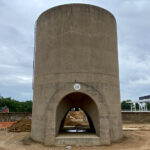
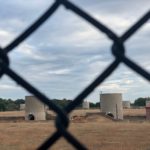
The McMillan Site’s history traces back more than a century. Originally it was part of the larger, 92-acre McMillan Reservoir and Filtration Plant, the city’s first large-scale water filtration system. This is back when typhoid, not COVID, was the infectious disease making headlines. The system used sand, which was stored in large silos on the perimeter of the property, and filtered water through the sand in large underground catacombs, making it drinkable for residents. It was decommissioned in 1986, and sold to the city the following year. (Residents could tour the space until 2012, when city barred visitors over safety concerns.)
For more than three decades, the space has sat unused — and at the center of a complicated legal drama with pro-development folks on one side, pushing to make use of the vacant space (especially given the city’s lack of affordable housing), and vocal opponents on the other, who argue the city’s plans for the space have gone on without community input and ignore McMillan’s historic value.
Since the city acquired the land in the 1980s, groups have batted around different ideas for how the space should be used (options included a memorial for dogs killed at war, a Kmart, and a prison), but in 2007, the city launched a competitive bidding process to select a developer that would create a master plan for the site. The city landed on Vision McMillan Partners (VMP) to figure out what to do, and then de-facto decided that VMP should be the project’s developer — a move that later ruffled feathers and was found by the D.C. auditor in 2015 to be in violation of D.C.’s bidding protocol. But instead of restarting the bidding process, the D.C. Council passed emergency legislation that allowed the city to circumvent the bidding requirement entirely for the project.
VMP’s original development plans in 2014 look similar to those outlined in Bowser’s Thursday announcement — a mixed-use space with housing, retail, and dining — but the project was stymied by a series of court battles over the years. Two groups — Save McMillan and Friends of McMillan — filed numerous appeals in the D.C. Court of Appeals that stalled the project. At one point in 2016, literally the day after the city held a groundbreaking ceremony at the site, the D.C. Court of Appeals ruled that the city’s Zoning Commission hadn’t properly addressed the development’s impact on the neighborhood, causing an immediate setback.
In the summer of 2021, D.C. Council Chairman Phil Mendelson, hoping to expedite the project, introduced an amendment. The legislation called for the project to “proceed expeditiously and without further delay through all phases of demolition and construction of the foundation of the community center.” Though some councilmembers expressed concern that the council’s interference in court disputes gave them a bad look, it passed anyway and helped demolition move forward in October of 2021, even as a lawsuit challenging the city’s permit made its way through the court. (To give you a sense of the anti-McMillan-development fervor, after demolition began, a group of protesters broke into the site last fall and literally chained themselves to construction equipment.)
One of opponent’s later legal challenges argued the demolition created a health hazard to the community, potentially releasing asbestos into the air, but now, one year later, legal issues have been resolved, allowing the sale to finalize. (Friends of McMillan did not immediately return DCist/WAMU’s request for comment on whether future legal challenges are in the works to further halt development.)
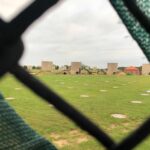
According to Deputy Mayor for Planning and Economic Development John Falcicchio, whose office has overseen McMillan for years, VMP can now begin some initial work toward building out the infrastructure for construction, like adding utilities and roadways. As for the public portion of project — which will deliver the park, community center, and public pool — work has already begun, and the $100 million effort is expected to be complete in 2024. (The city will also be maintaining four regulator houses, 20 sand silos, sand bins, and two underground filter beds of the original filtration system.)
Once the privately developed portion of the McMillan site is complete, there will be 146 for-sale townhomes and 467 rental apartments. Twenty-two townhomes will be affordable at 50% to 80% median family income, and 112 of the apartment rentals will be affordable, in addition to an all-senior affordable housing building at 60% median family income. The project also includes a grocery store, retail space, and a one-million square foot office space that will be used for healthcare facilities.
“A lot of the argument previously was that we had to save McMillan Park, but really what we’ve done by this financial close is make sure that we can move forward with a $100 million investment in a public park and community space,” says Falcicchio. “It’s a long time coming, but it’ll definitely — when it delivers — be worth the wait.”