 Jordan Pascale
Metro is rolling out a multi-faceted plan to address a $40 million fare evasion problem.
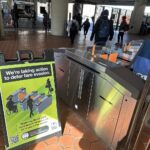
Beginning this month, Metro will start posting reminders on digital screens in stations, and Metro Transit Police officers will hand out fliers reminding riders to pay their fares. Metro will have more police out on the system and install cameras and monitors to deter gate-jumping.
https://twitter.com/wmata/status/1577314000328704005
Then, starting in November, MTPD will begin writing tickets for fare evasion in the District. Police had already been writing tickets for the offense in Maryland and Virginia. In those two states, criminal tickets come with a fine of up to $100. In D.C., where fare evasion was made a civil offense in 2019, MTPD will start handing out $50 tickets.
While tickets are written by MTPD, they are actually tickets from each jurisdiction. The District, not Metro, will handle the adjudication and appeals process. Metro previously didn’t have the ability to issue citations in the District because that process was not established.
Meanwhile, Metro will also test out prototypes to make station fare gates more difficult to jump over. It could include “tactile deterrents” on the top of the gates and higher emergency exit and ADA gates, the agency says. Employees will get a look at the new tech this year and customers could see the rollout early next year.
“There needs to be some sense of fairness in the system,” new WMATA General Manager Randy Clarke told DCist/WAMU. “So we have a lot of people paying a fare that are upset that others are not.”
“My ideal scenario is we have no enforcement and we have no violators… but I am worried that will not be the actual case.”
The fare evasion issue is contentious, with some advocates saying that enforcement unnecessarily ratchets up the tension between police and people of color. A Washington Lawyers’ Committee for Civil Rights and Urban Affairs analysis of fare evasion tickets in 2018 found more than 90% of tickets were given to Black riders. Fare evasion interactions have also escalated to high-profile use-of-force incidents, including one in 2018 when police took a woman to the ground after she refused to pay.
Others say fare enforcement criminalizes poverty. The District is working on a low-income fare pilot program to help those in need. Another bill making its way through D.C. Council could give residents up to $100 a month in fares, which could help address that issue.
Critics on Twitter are quick to point out that drivers owe tens of millions in unpaid speeding and red light camera tickets, but that issue doesn’t get the attention that fare evasion does.
Others say enforcing fares shouldn’t be a priority for the agency, while Metrorail is still seeing long wait times and fallout from the sidelined 7000-series trains.
“Some people ask me, ‘why can’t you focus on running safe, frequent, reliable transit?’ I spend all day thinking about that,” Clarke said. “We’re chewing gum and walking at the same time here at Metro. There are a lot of things to focus on.”
But fare evasion is also something that Clarke said has come up often during his conversations with riders and during public comment periods. Some people have told him they feel like suckers for paying for fares while others waltz through. Regional leaders say they don’t want to give Metro more subsidies until it cleans up the fare evasion issue.
Clarke has said that every person who has the ability to pay and doesn’t do so hurts the rest of the system.
“The only true lever I have to save money is to cut service,” Clarke said. “If you have the means to pay your fare, then you should pay your fare because it’s our community’s transit system that does a community good. And in the longer term, if the region wants to have a conversation about funding Metro in a different way then we should have that. But that’s not today.”
Metro estimates that 34% of all Metrobus trips are not paid for. Bus operators press a button every time a fare is not paid. It’s harder to estimate how often train fares are not paid because fare gates aren’t constantly monitored.
Clarke said he can’t pinpoint one reason that fare evasion has gotten worse in recent years (it was a $36 million problem back in 2019 when ridership was nearly doubled; Metro estimates that fare evasion costs the agency $40 million this year), but he said he believes that many societal norms broke down during the pandemic.
“We also have some orderliness issues around the system and society,” Clarke said. “Compared to pre-pandemic, people seem to have high tempers that they didn’t have before. They have a lower tolerance and lower patience.”
He says he doesn’t want fare enforcement to create confrontations with transit police, saying that he expects police to treat people with respect and customers to do the same. Station managers and bus operators are not authorized to write tickets and are encouraged not to escalate a fare evasion situation for safety reasons.
This year, Metro expects about $301 million in fare revenue from passengers, making up about 13% of its total operating budget of $2 billion. The estimated shortfall from fare evasion this year, meanwhile, represents about 2% of that budget.
Meanwhile, Metro’s budget problem — a $185 million budget gap this year – is set to worsen in coming years if ridership doesn’t return and federal funding runs out. The deficit could grow to $900 million or more by 2028, meaning Metro will need to have a much larger conversation about how to pay for the system.
“Many people have mentioned going to a fare-free model, but fare-free does not mean free,” Clarke said in Tuesday’s release. “There are costs associated with running the community’s transit system and therefore the necessary revenues must exist to deliver the services the community needs.”
Metro did not have concrete figures on how much it may cost to retrofit faregates but said the cost for the campaign and more enforcement is “very minor.
Metro wrote more than 15,409 fare evasion tickets in 2017. That number was halved in 2019 as criticism of fare evasion and the D.C. law changed. Last year, just 297 tickets were issued for far evasion – none in D.C.