 Aja Drain
The set is small and intimate, so no matter where you sit for Mosaic Theater Company’s production of The Till Trilogy — a series of three plays being performed concurrently as a singular work for the first time — you’ll be front row for the story of Emmett “Bo” Till.
Many in the audiences will be familiar with the basics of Emmett Till’s killing. He was 14 years old in 1955 when he traveled to Mississippi to visit family. After Carolyn Bryant accused him of grabbing her wrist and waist and making lewd comments at her in a country store — testimony she later admitted was partially fabricated — he was murdered by Roy Bryant and J.W. Milam. Emmett’s death sparked a national outcry after his mother shared his casket with the world, illuminating the inhumane lynchings and persecution of Black people.
For most, that’s where the story ends. But playwright Ifa Bayeza and Mosaic hope to expand that narrative and move beyond the trauma by producing all three of Bayeza’s plays about Till’s story in D.C. this month.
The first, The Ballad of Emmett Till, debuted at Chicago’s Goodman Theatre in 2008. The play, which opens Oct. 4, uses songs and dance to capture the last two weeks of Till’s life, contrasting joyous celebration with the haunting story of his murder. Benevolence, which focuses on two families — the Bryants and the Meltons, a Black family that lived next door to Milam — came next, premiering in 2019 at the Penumbra Theater in Minneapolis. (It opens Oct. 6 in D.C.)
Now Bayeza will debut the third installment at Atlas Performing Arts Center on Oct. 5. That Summer in Sumner follows the journey of three Black journalists who covered the aftermath of Till’s murder.
The D.C. production of Bayeza’s trilogy, directed by Talvin Wilks, coincides with a renewed national conversation on Till’s story. Till, a film coming out Oct. 14 that follows the journey of Mamie Till-Mobley, Emmett’s mother, met much pushback from Black Twitter when the trailer was released, with critics saying the story alienates Black audiences by rehashing Black trauma. That trauma also continues in real life: in August, a Mississippi jury declined to indict Bryant, Till’s accuser, on charges of kidnapping and manslaughter after the discovery of an unserved warrant for her arrest.
Navigating this traumatizing story and communicating the value in retelling it is one part of a trilogy of its own challenges Mosaic Theater faces as it puts on these plays. The other two? Honoring Till’s legacy, and juggling the production of three shows at once.

Three times the roles, three times the work
The Till Trilogy, originally planned to run in 2020, has been in the works for more than two years. The same mostly Black cast appears in all three plays; when all is said and done, 10 actors play between 60 and 70 characters. The three plays run at different times, so audiences can see all three in or out of order, should they choose to.
Mosaic artistic director Reginald “Reg” Douglas describes the trilogy as leaning into the Greek tradition, or how Shakespeare put on big productions in multiple installments to be viewed at a festival.
“I wanted to honor Black history and American history in the same way. And so it is a huge undertaking, but it’s one that we’re doing with lots of focus, lots of craft leading the way and lots of care,” Douglas says.
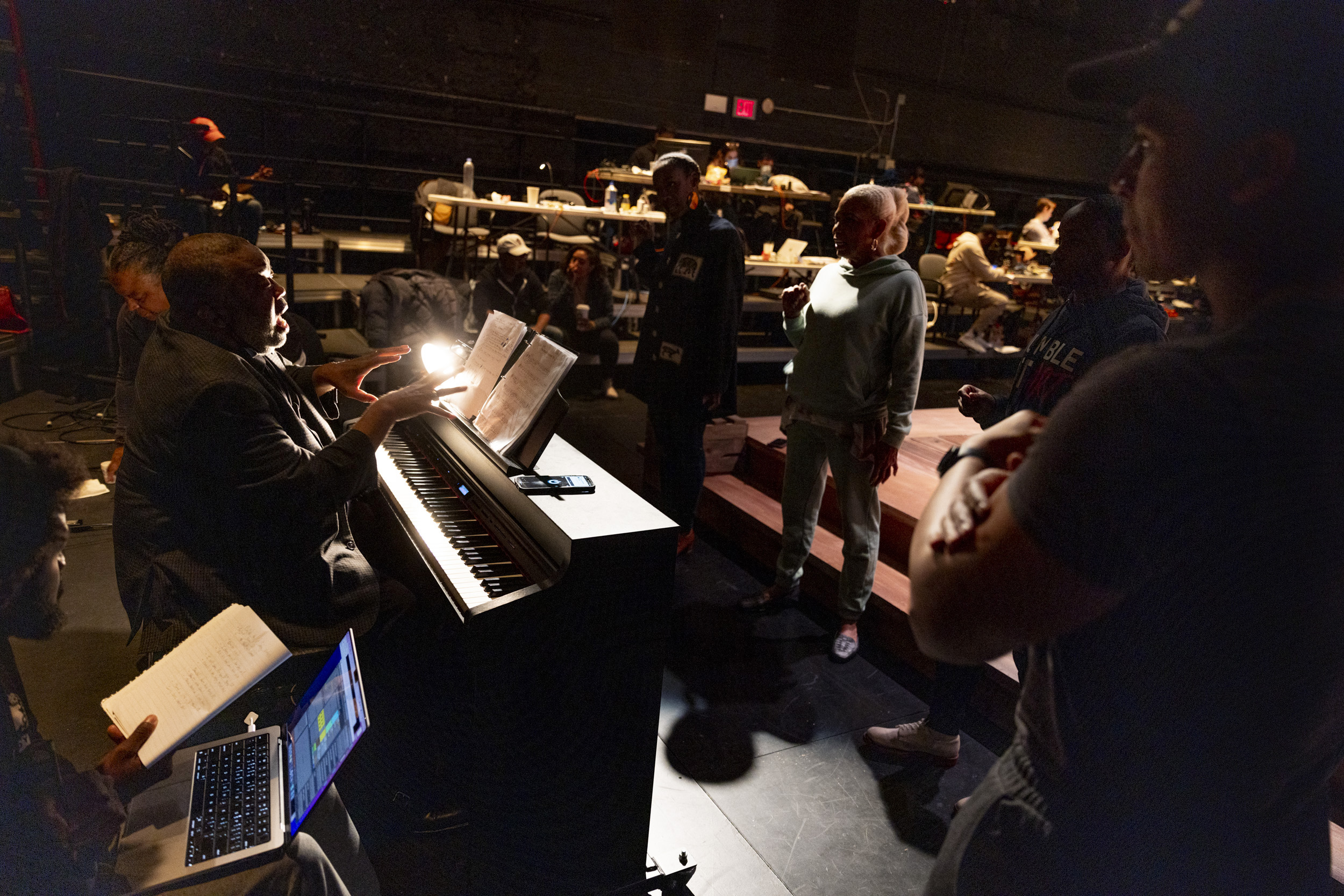
And suffice to say, lots of work. The three shows have come together in just four months, requiring rehearsals six days a week, oftentimes two different plays in a day.
“That’s been one of the challenges, I think, for the actors,” Douglas says. “It’s been maintaining their stamina.”

It has been intense, acknowledges Billie Krishawn, who plays Mamie Till-Mobley, Till’s mother. Krishawn is a D.C. native who most recently starred in The Joy That Carries You at Olney Theatre Center; among other roles, she was nominated for a Helen Hayes Award for Outstanding Lead Actress for her portrayal of Tilly in Constellation’s 2018 production of Melancholy Play.
“The biggest challenge there is that you hop around so quickly, and we’re discovering [our roles] on our feet,” says Krishawn. Each actor must make sure those characters are distinct, but still believable for audiences, she adds. To achieve that believability, Krishawn says the cast often drew on personal experience.
“Well, this character is experiencing anger. When’s the last time I felt anger? How can I use that recollection?” Krishawn says. For her own role, she was able to draw on the fact that since she was cast in 2020, she’s become a mother — emotions which are potent. Though her own experience is separate and unique from Mamie and Emmett’s relationship, Krishawn says, the parallels can be helpful to inform the role.
“Emmett loves mirrors. My daughter loves mirrors. Emmett is a music lover, at least in this iteration, and [my daughter] is also a music lover,” Krishawn says. “[There are] constantly just things flooding in from my personal experience.”
That process, alongside the heavy content of the shows, can be taxing. Mosaic has partnered with the Black Mental Health Alliance to provide space and time for actors to ask questions and process the subject matter, which is also ever-changing, according to Douglas.
“The scripts have all changed from the first day of rehearsal,” Douglas says. “We knew Ifa was going to work on That Summer in Sumner and keep writing and tweaking it towards its first production ever.” Bayeza has also made changes to Benevolence and The Ballad of Emmett Till as well to make the plays fresh for D.C. audiences.

An epic evolves
The continued evolution of these plays reflects the fact that Bayeza didn’t necessarily set out to write a trilogy. When she embarked on writing The Ballad of Emmett Till 14 years ago, Bayeza entrenched herself in research for the project. She utilized primary and secondary sources, but also interviews with Till’s cousins, Sunday schoolmates, classmates, and people who were his age at the time in Chicago to truly get a sense of what he would have been like.
“He loved humor. And so by capturing his joy, I capture one of the major kind of building blocks of Black resilience, the joy of his life, the faith, and love within the family, their stalwartness, their commitment to one another,” Bayeza says.
Krishawn didn’t want Ballad to be simply focused on the events of Till’s death.
“The death is only a small part of the Ballad. It’s about his life. He was funny. He was a jokester … We are not just our struggles and strife. There’s a life that was lived and it’s important to acknowledge it because otherwise, what was it for?” she says. “He didn’t just live to die so the civil rights movement could happen.”
Even with the care the playwright took with the story, input from Emmett’s own family led her to change Ballad after its debut. Simeon Wright, one of Emmett’s cousins, contacted Bayeza because he disapproved of a dramatized scene depicting Emmett alone with Carolyn in the store. The choice was meant to “heighten” the exchange, Bayeza says, but Simeon, who was with Emmett that day, said the representation conflicted with his recollection that Emmett wasn’t alone in the store with Bryant.
“I took that note and revised that scene so that it was clear that there were eyes on what was happening in the store. But it was too late to reclaim my relationship with Simeon,” Bayeza says. “He never forgave me for that. And that was a lesson in how careful you must be with people’s sacred stories.”
Simeon passed away before he could see newer versions of the story, but his feedback, along with interest in Ballad from a producing manager in L.A. at the time, prompted Bayeza to change the script and expand the narrative into more plays.

That’s why the second show focuses on a story most people don’t know, and one Bayeza felt needed its own space. Benevolence includes the Bryants’ perspective, but also that of another family not so readily associated with Till’s story. Beulah and Clinton Melton, a Black couple, were neighbors of J.W. Milam. They were greatly affected by Till’s murder and suffered their own tragedy not long after it: Clinton Melton was murdered by a white man three months after Emmett Till was killed.
“Simeon’s criticism in that way was a gift because it alerted me to the attention to detail that I must give each element,” Bayeza says. “And one of those elements was then the trial that I had left on the cutting floor, and so I started thinking about Sumner.”
That Summer in Sumner focuses on the trial from the perspective of the journalists who covered it. (Till’s murderers were ultimately acquitted for their crimes.)
“Summer in Sumner is groundbreaking. It reveals stories, actions that we don’t really think about, trial testimony that we don’t really hear about,” Director Talvin Wilks says.
“This project was an exercise in how do I restructure my work so that I can keep my big themes and I can keep that sense of the epic and still do a minimal cast,” Bayeza says.
One of those themes is illuminating the flawed justice of the time — something that still reverberates today.
Production looks to navigate, not exacerbate Black trauma
With the trilogy, Wilks says he and his team have taken care to address apprehension within the Black community about the retelling of Till’s story.
“I think the important thing, especially when we’re looking at the significant events of Black trauma, is that we also never really tell the surrounding story fully,” Wilks says. “So for me, this is not reliving Black trauma. This is really liberating the truth.”
Many of the critiques around the Till film could apply to the theatrical production. Specifically, what purpose do the plays serve for Black audiences? Across the board, Wilks, Bayeza, Douglas, and Krishawn say the trilogy attempts to expand the narrative beyond Till’s death.
“How could I reconcile these two things Black life and Black trauma?” Bayeza says. “And so one of the ways I try to do that is to seduce audiences into reengaging with our history with Emmett.”
Krishawn has done a lot of thinking — and talking with fellow actors — in the past two years about whether they want to continue to do “just Black trauma on stage,” she says. One reason she continues to be interested in taking nuanced roles like Mamie’s is to honor her ancestors, she adds.
“They didn’t get to experience anything other than the injustice that they were living through. And because they did, I am here. So it’s not to say I don’t have the right to feel overwhelmed by the sadness of it all, but I do feel like I have a job to continue their stories,” she says. “I can’t speak my ancestors’ names. I don’t know them. I don’t know exactly where they came from. And that makes me sad. And I acknowledge that the only thing that keeps us here beyond our actual existence is the stories we leave behind.”
In addition, although Ballad is technically a tragedy, it captures more joy than people experience from the facts of the case.
“So may [the audience] allow themselves, for example in Ballad, to sit through the joy of his life those two weeks and enjoy those two weeks, as opposed to letting the two weeks be a reminder that soon he’s going to pass,” Krishawn says.
Both joy and pain are a part of Black history, which can be difficult for audiences to digest. Bayeza points out the same apprehensive feeling can come from retelling slave stories, but she feels if people today don’t confront the past, despite the pain, they lose the ability to come to terms with it.
“The history of the abuse very often didn’t carry on — like your grandmother or great aunt would say, ‘I’m not going to talk about that.’ That becomes a kind of erasure that is linked with people shutting down, and for me, part of the process of getting past it is to recognize it, to honor it,” Bayeza says.
Wilks, the director, sees the work as extremely relevant, given that these themes are alive and well in the U.S. today.
“Trayvon Martin, Tamir Rice, Michael Brown. I mean, there are many reasons why we tell this story. I mean the crime around the killing of Trayvon Martin — immediately we started talking about Emmett Till,” Wilks says.

Wilks sees value in revisiting “one of the most egregious indictments of white supremacy inside our culture,” especially as Black Americans continue to face its repercussions.
“If we are quiet about this story and this history, we really are not addressing the core history, an issue that we still need to battle and challenge,” Wilks says.
Preserving the legacy of Emmett Till
By putting on all three plays together, Mosaic is aiming to make Till’s story relevant to audiences of all ages. For those who were alive during the civil rights movement, the shows piece together details that may have been lost over the years.
“So many of us were on the bus, in the classroom, walking into an all-white environment, trying to integrate the swimming pool and not really getting that much information,” Bayeza says.
Younger theater-goers, meanwhile, are bound to connect to scenes like one in which Mamie rattles off the list of places where the fight for racial justice is ongoing: Montgomery, Birmingham, Selma, says Krishawn.
“The first time that I read that chunk in the rehearsal room, I remember crying because we’re in 1955. So that list is shorter,” she says. “But the list now … There’s also Rodney King and George Floyd and Eric Garner and Trayvon Martin. And and and and and…”
Douglas sees the shows, which are expected to be attended by members of Congress and Till’s family, among others, as “urgent” for that very reason.
“I hope that audiences walk out of these plays, whether you see one or you see all three, that you walk out feeling a deeper understanding of your neighbor and of yourself, a deeper commitment to the role you can play in civic change and community building and activism that we all have a responsibility to where we’ve been as a country and where we want to go next,” he says.
Despite where we may want to go next, the stories — and the trauma that goes along with them — will continue. The fight continues. When the curtain rises on The Till Trilogy, a story you think you know, it may answer questions, prompt more of them, inspire you, anger you, or provide healing. It’s all a part of sparking conversation, the essence of what Bayeza set out to do.
“With the youth generation, it was an opportunity to connect to the history in an organic way because they said, ‘Aha! I can relate to it. I can see what he went through, and I can see that that’s what I’m going through right now,’” Bayeza says. “And they begin to understand this cyclical nature of our struggle, that every generation will have its challenge.”
The Till Trilogy from Mosaic Theater Company runs at Atlas Performing Arts Center from Oct. 4-Nov. 20. Tickets can be purchased here.